


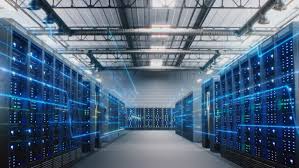
Along the Chennai-Bengaluru industrial corridor and across the National Capital Region (NCR), India’s newest infrastructure is not visible from highways. It sits behind secured compounds: hyperscale data centres that power digital payments, governance platforms and increasingly, artificial intelligence systems.
India’s data centre capacity is projected to expand sharply by 2030, with industry estimates suggesting a doubling of installed capacity within the decade. Each hyperscale facility can demand upwards of 50-100 megawatts (MW) of continuous electricity—equivalent to the consumption of a mid-sized town. The expansion is central to India’s ambition for sovereign compute capacity. It is also an emerging climate governance test.
AI is not immaterial innovation. It is energy- and water-intensive industrial activity. The ecological implications are no longer peripheral.
The material burden of the “Thirsty Algorithm”
High-performance AI systems require uninterrupted base-load power. Unlike seasonal industries, server clusters operate continuously. Even short power fluctuations can disrupt operations.
India’s electricity mix remains significantly coal-dependent, and nuclear energy currently contributes only around 3-4 per cent of total generation. As data centre loads rise, peak demand could intensify pressure on thermal generation unless new low-carbon capacity is added.
Water demand compounds the challenge. Conventional evaporative cooling systems draw substantial freshwater. In already stressed aquifers around Chennai and parts of NCR, clustering of data centres risks intensifying groundwater depletion. Policymakers are therefore exploring Water-Neutral Mandates requiring facilities to recharge at least as much groundwater as they extract.
However, recharge obligations do not eliminate aggregate extraction. If compute capacity doubles, total withdrawals may still rise despite efficiency gains. The “thirsty algorithm” is not a metaphor; it is a systems-level stressor.
Digital sovereignty meets energy reality
India’s push for domestic AI infrastructure is strategically rational. Platforms such as MausamGPT, designed for climate modelling and weather forecasting, rely on high-performance compute that cannot depend indefinitely on overseas servers. Sovereign digital capacity strengthens economic and geopolitical resilience.
Yet sovereign compute without energy stability is incomplete. If AI infrastructure depends heavily on coal-based electricity during peak loads, emissions intensity will rise. If grids in high-growth states remain financially and technically stressed, digital resilience is compromised.
Energy architecture is therefore central to digital sovereignty.
Federal coordination and grid stress
Data centre investments are concentrated in a handful of states competing through fiscal and electricity incentives. This competition has implications for already stressed distribution companies (DISCOMs), many of which struggle with financial deficits and transmission losses.
Large, continuous industrial loads require grid reinforcement. Without coordinated planning between central power authorities, state regulators and digital infrastructure planners, AI growth could exacerbate transmission bottlenecks and raise cross-subsidy tensions. India’s federal energy system has historically faced coordination challenges. AI expansion now makes that coordination urgent.
The SMR Debate
Within policy circles, Small Modular Reactors (SMRs) are increasingly discussed as a potential low-carbon base-load option. Unlike conventional large nuclear plants, SMRs are factory-built, smaller-capacity reactors designed for incremental deployment. Internationally, they are being evaluated for industrial clusters with high and continuous electricity demand.
For AI infrastructure, the appeal lies in:
Continuous zero-carbon generation
● Reduced reliance on variable renewables without storage
● Potential co-location with industrial parks
Budget 2026 customs duty relief on advanced technology components lowers the cost of importing specialised equipment relevant to next-generation energy systems, including nuclear technologies. While not an AI-specific intervention, it signals openness to high-technology infrastructure investment.
However, SMRs operate within India’s tightly regulated nuclear framework. Licensing procedures, liability structures and environmental clearance processes are complex. Public acceptance of new nuclear facilities—particularly near urban clusters—cannot be assumed.
Cost transparency is equally critical. Early-stage SMR deployment globally remains capital-intensive. Comparative evaluation against renewable-plus-storage systems is necessary to avoid technological lock-in.
SMRs may form part of a diversified portfolio, but they are not a standalone solution.
Water governance and ecological design
Advanced reactor designs can reduce freshwater dependence relative to coal-based thermal plants, particularly if dry-cooling systems are deployed. Yet nuclear energy still requires long-term waste management and safety oversight.
Simultaneously, data centres must shift toward closed-loop cooling,