


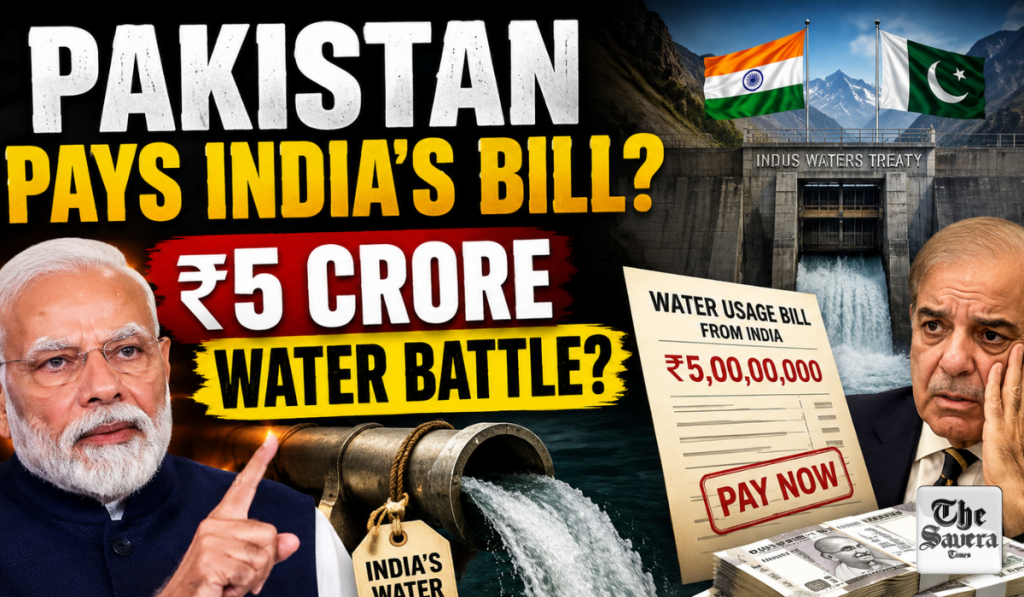
Imagine filing a legal case against someone—and then ending up paying not just your own legal bill, but theirs too. Sounds strange, right? But that’s exactly what is happening in the Indus Waters Treaty dispute between India and Pakistan. As India has refused to take part in the arbitration process, Pakistan is reportedly paying both its own share and India’s share of the arbitration costs to keep the case going.
So, why has this happened? What is the Indus Waters Treaty? Why are the two countries fighting over it? And why is Pakistan paying the entire bill? Let’s understand.
What Is the Indus Waters Treaty?
The Indus Waters Treaty is a water-sharing agreement signed between India and Pakistan on September 19, 1960, with the World Bank helping both countries reach the agreement.
Even after wars and decades of political tensions, this treaty continued to survive and was often seen as one of the strongest examples of cooperation between the two neighbours.
How Is the Water Shared?
The treaty divides the six rivers of the Indus river system between the two countries.
India received the rights over the Ravi, Beas and Sutlej rivers.
Pakistan received most of the water from the Indus, Jhelum and Chenab rivers.
At the same time, India was allowed to use the western rivers for purposes like drinking water, irrigation and hydroelectric power generation, but only within the rules mentioned in the treaty.
What Is the Dispute?
The current dispute is about two Indian hydroelectric projects—Kishanganga and Ratle—in Jammu and Kashmir.
Pakistan says the design of these projects violates the Indus Waters Treaty and could affect the flow of water into Pakistan.
India strongly disagrees. It says both projects fully follow the treaty and that such technical issues should be examined by a Neutral Expert, not an international arbitration court.
Why Did Pakistan Go to Arbitration?
Pakistan approached the Permanent Court of Arbitration, asking it to hear the dispute.
India objected from the very beginning.
According to New Delhi, the treaty clearly provides that technical disagreements should first go to a Neutral Expert. India believes both processes cannot run together and has repeatedly questioned the tribunal’s jurisdiction.
Why Is India Boycotting the Proceedings?
After the April 2025 Pahalgam terror attack, India announced that it was placing the Indus Waters Treaty in abeyance until Pakistan takes what India calls credible and irreversible action against cross-border terrorism.
Following that decision, India stopped participating in the arbitration process.
The Indian government has also described the arbitration tribunal as illegally constituted and says any decision taken by it will have no legal value for India.
So Why Is Pakistan Paying India’s Share?
Normally, both countries are supposed to share the expenses of the arbitration.
But international arbitration rules allow the proceedings to continue even if one side refuses to participate.
Since India is not attending the hearings, Pakistan has decided to continue the case. To prevent the process from stopping, it is reportedly paying not only its own legal costs but also India’s share of the arbitration expenses.
Reports say Pakistan has already spent more than 600,000 US dollars, and the amount is expected to increase as the case continues.
Can the Arbitration Continue Without India?
Yes.
The tribunal has already said it has the authority to hear Pakistan’s case.
India, however, does not recognise the tribunal’s authority and has made it clear that it will not accept any decision delivered through this process.
So, even if the arbitration continues, its practical impact remains uncertain.
Why Does This Matter?
This comes at a time when Pakistan is still facing economic challenges and is working under an IMF financial assistance programme.
While the arbitration costs may not be huge compared to the country’s overall economy, paying the full bill—including India’s share—adds another financial burden.
More importantly, this dispute shows how India-Pakistan relations have changed.
For decades, the Indus Waters Treaty survived even during wars. Today, however, water cooperation has become closely linked to security concerns and cross-border terrorism.
The Bottom Line
The Indus Waters Treaty dispute is no longer just about dams or river water. It has become another symbol of the deep trust deficit between India and Pakistan.
For now, Pakistan is continuing with the arbitration and paying the entire cost to keep the case alive. India, meanwhile, remains firm that it will neither participate in nor recognise the proceedings.
So, in one of the most unusual legal battles between the two neighbours, the country that filed the case is also paying the bill for the country it has taken to court.