


For over three decades, the idea of reserving seats for women in India’s legislatures has hovered between promiset and postponemen. It has been invoked in manifestos, debated in Parliament and celebrated in speeches. Yet, when the moment of truth arrived, when intent needed to transform into action, the Opposition, led by the Congress, has repeatedly faltered. Today, as India stands at the cusp of translating women’s reservation into a lived political reality, this pattern of obstruction stands exposed more starkly than ever before. Prime Minister Narendra Modi’s commitment to women’s empowerment has been consistent, visible and outcome-driven. Over the past decade, the Government led by Narendra Modi has implemented a wide spectrum of schemes to drive women’s empowerment through a lifecycle-based approach. Flagship programmes like Beti Bachao Beti Padhao have shown measurable impact, with the national Sex Ratio at Birth improving from 918 (2014–15) to 930 (2023–24), alongside a steady rise in girls’ school enrolment. Financial inclusion has been strengthened through Sukanya Samriddhi Yojana, under which over 4.2 crore accounts have been opened, securing the future of millions of girls. In health and nutrition, Mission POSHAN 2.0, backed by an outlay of over Rs 1.81 lakh crore, targets women and children through integrated services. Maternal care schemes like Janani Suraksha Yojana (benefiting over 11 crore women) and Pradhan Mantri Matru Vandana Yojana (Rs 5,000 assistance) have significantly improved institutional deliveries and nutrition. Pradhan Mantri Ujjwala Yojana has distributed over 10.33 crore LPG connections, while Swachh Bharat Mission has enabled construction of over 12 crore toilets, improving safety and hygiene. Under Jal Jeevan Mission, tap water connections have expanded to over 15.6 crore households, reducing drudgery for women. On the economic front, Pradhan Mantri MUDRA Yojana has sanctioned over 52.5 crore loans, with nearly 68% going to women, while Stand-Up India Scheme has extended around 83% of its loans to women entrepreneurs. Additionally, Deendayal Antyodaya Yojana – National “Prime Minister Narendra Modi’s decisive push for women’s political empowerment exposes decades of duplicity and delay by the Opposition.” Rural Livelihoods Mission has mobilized over 10 crore women into self-help groups, fostering grassroots entrepreneurship. For safety, security, and rights, Mission Shakti has supported over 10.98 lakh women through One Stop Centres and handled over 214 lakh helpline calls. Meanwhile, the Nari Shakti Vandan Adhiniyam marks a historic step by reserving 33% seats in legislatures for women. The passage of the Women’s Reservation Bill in 2023 was a natural extension of this vision, a historic step aimed at correcting decades of underrepresentation in legislative bodies. However, what has unfolded since then reveals an uncomfortable truth about the Opposition’s politics. However, the Congress did not merely oppose the Women’s Reservation Bill in 2026. It sought to stall its implementation the moment it became real and immediate. This is not an isolated instance. It is a pattern, deeply embedded in its political conduct. The historical record speaks for itself.In 1996, the Women’s Reservation Bill was first introduced under the government of Prime Minister HD Deve Gowda. That government relied heavily on Congress support. Yet, despite the opportunity, the bill never saw the light of day. Congress ensured that it remained in limbo.The pattern repeated itself during the late 1990s and early 2000s. Between 1998 and 2003, the NDA government under Prime Minister Atal Bihari Vajpayee made four separate attempts to pass the bill. Each attempt required broad consensus and the crucial support of the Congress to secure the constitutionally mandated two-thirds majority. Each time, that support was either withheld or diluted, effectively blocking the bill’s passage. In 2010, there appeared to be a moment of convergence. The BJP extended its full support to the UPA government to ensure the bill’s passage in the Rajya Sabha. It was a rare instance of bipartisan cooperation on an issue of national importance. Yet, when it came to the Lok Sabha, the Congress retreated. Political calculations took precedence over principle, and the bill was never brought forward. Once again, the promise of women’s representation was sacrificed at the altar of expediency. Fast forward to 2023! With a decisive mandate and political clarity, the Modi government succeeded where others had failed. The Women’s Reservation Bill was passed, marking a watershed moment in India’s democratic journey. The Congress, confronted with the inevitability of its passage, offered support but this support came when obstruction was no longer possible. It was, at best, a pro forma endorsement. But the real test was yet to come. The 2023 legislation linked the implementation of women’s reservation to the completion of the Census and the subsequent delimitation exercise. This effectively meant that the actual enforcement could be delayed until 2034 or beyond. For the Opposition, this delay was convenient. Supporting a reform whose impact lay in the distant future came at little political cost. What changed in 2026 altered the entire equation. The proposal to advance implementation to the 2029 General Elections transformed women’s reservation from a distant promise into an immediate reality. It meant that political parties would have to recalibrate their strategies, rework candidate selection and crucially, cede space to women in a meaningful way. It is at this juncture that the Opposition’s true stance became evident. Suddenly, the same voices that had claimed to champion women’s empowerment began raising objections. Concerns were manufactured, procedural hurdles highlighted, and attempts made to delay or dilute the process. The argument was no longer about principle but was about preserving political turf. Similarly, they also spread canard about the southern states that they would lose Lok Sabha seats post de-limitation. However, Union Home Minister Amit Shah has clarified that the proposed framework ensures that no region will lose seats in absolute terms, and that southern states will see a rise in representation. He said in the Lok Sabha that at present out of the 543 seats, the strength of Southern States in the House is 129, which is approximately 23.76 per cent and as per the new strength of the Lok Sabha, the number of seats will go up to 195. Thus, the exercise is designed to maintain balance and fairness while accommodating changes in population. So, the Opposition’s resistance betrays a deeper anxiety. They need to know that women’s reservation is not merely about increasing numbers. It is about reshaping the political landscape. It challenges entrenched power structures, disrupts established hierarchies, and introduces new voices into the decision-making process. For parties accustomed to operating within traditional frameworks, this shift can be unsettling. There have also been attempts to mislead the public on technical aspects such as seat expansion and delimitation. The truth is that these processes are part of a transparent, constitutional framework. Any increase in seats or adjustments in representation is proportionate and designed to reflect demographic realities. To suggest otherwise is to distort facts for political gain. Prime Minister Modi’s approach, in contrast, has been anchored in clarity and conviction. His government has not treated women’s empowerment as a slogan but as a structural priority. The push to implement the Nari Shakti Vandan Adhiniyam by 2029 underscores a willingness to move beyond symbolism and deliver substantive change. It is also important to recognize that women’s reservation enjoys broad public support. Across urban and rural India, there is a growing recognition that greater representation of women in legislatures will lead to more inclusive policymaking and stronger democratic outcomes. By attempting to stall implementation, the Opposition risks alienating a significant and increasingly assertive segment of the electorate. This moment, therefore, is not just about a piece of legislation. It is about credibility. For decades, the Congress and its allies have spoken about empowering women. Yet, when confronted with the opportunity to make it happen, their actions have consistently fallen short. The gap between rhetoric and reality has never been more apparent. In contrast, the Modi government has demonstrated that political will can overcome historical inertia. By passing the bill in 2023 and pushing for its timely implementation, it has set the stage for a transformative shift in India’s political landscape. The choice before the nation is clear. It is a choice between those who view women’s empowerment as a convenient talking point, and those who are prepared to translate it into tangible outcomes. As India moves towards the 2029 elections, the implementation of women’s reservation will serve as a litmus test, not just of policy but of intent. It will reveal which political forces are genuinely committed to empowering women, and which are merely paying lip service to the idea. The time for delay has passed. The time for decisive action has arrived. And in this defining moment, the contrast could not be sharper. (The views expressed are strictly his personal.)
Women’s Reservation: From Rhetoric to Reality, and the Opposition’s Relentless Roadblocks
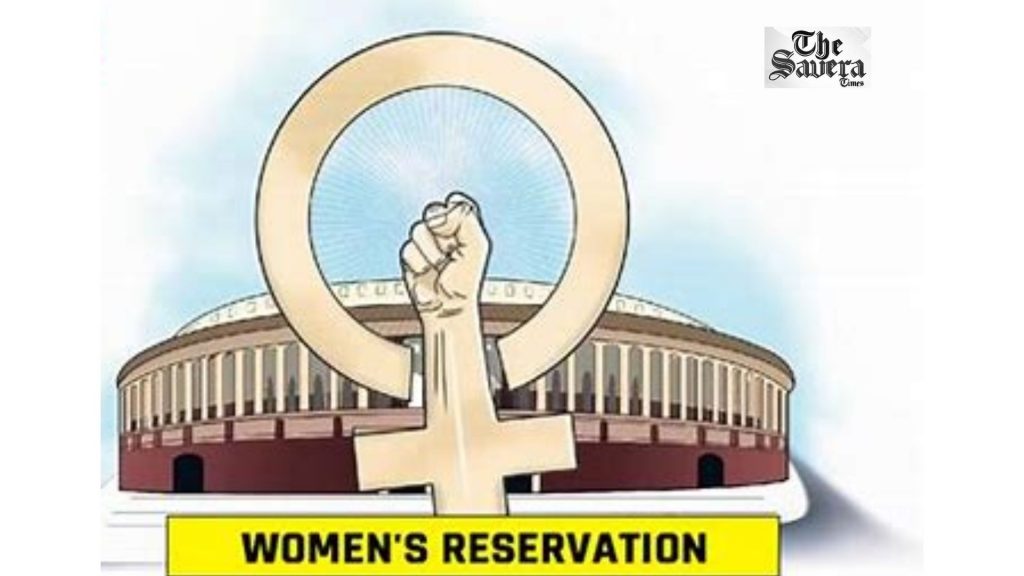
Women’s Reservation: From Rhetoric to Reality