


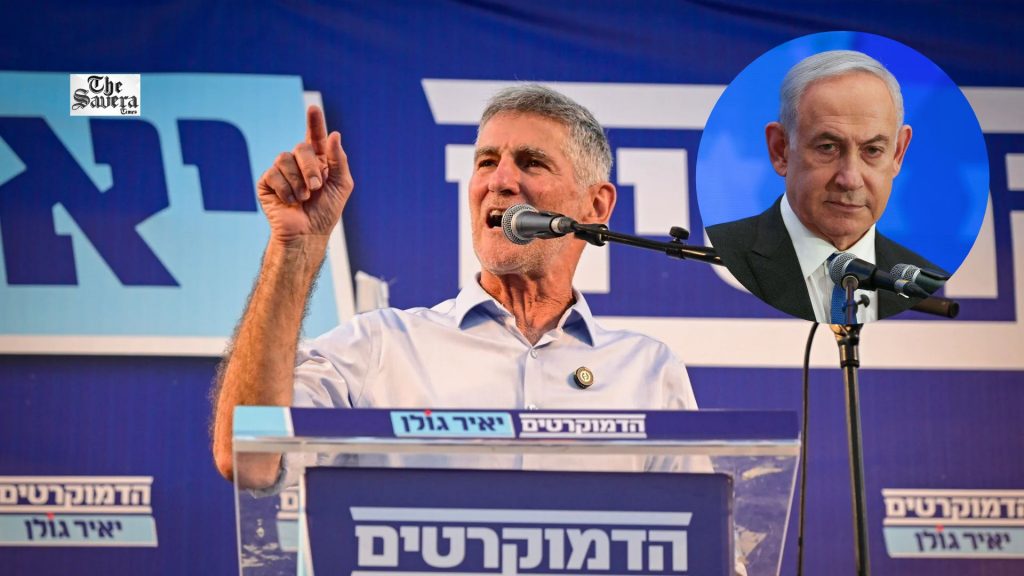
Tel Aviv: Israeli opposition leader Yair Golan on Tuesday urged rival political parties to accelerate efforts to form a new government, claiming that Prime Minister Benjamin Netanyahu could be replaced as early as the next day if the anti-Netanyahu bloc acted quickly.
In a series of posts on X, the leader of the Democratic Party argued that Netanyahu had no legitimacy to remain in office and called on opposition leaders to set aside their preconditions and reach an agreement on an alternative government.
“Netanyahu can be replaced as early as tomorrow,” Golan wrote. He claimed that Netanyahu had failed in every area and called for increased pressure to remove him from the prime minister’s office, adding that courage and flexibility were needed to make it happen.
Urging opposition figures to avoid rigid demands, Golan warned that delays in coalition negotiations could undermine efforts to form a new government.
“Get off the rooftops. This is not the time for ultimatums. This is the time for leadership. Bold, swift action will save Israel,” he said.
Golan also asked Israelis to consider an alternative cabinet featuring figures such as Gadi Eisenkot, Naftali Bennett, Avigdor Lieberman and himself, instead of Netanyahu and his current ministers.
“What are we waiting for? Saving Israel is within reach,” he added.
Golan Pushes Legislation Targeting Netanyahu’s Tenure
Alongside his call for a new coalition, Golan said Knesset committees chaired by members of his party were moving forward with legislative initiatives targeting the prime minister’s powers and tenure.
“The legislation to reverse the judicial coup continues. This week, we will also bring forward the incapacitation bill and the bill limiting the prime minister’s term in office,” he said.
Golan also praised members of his party who chair the committees responsible for advancing the proposed legislation.
Opposition Leader Raises Concerns Over Reconstruction Funds
In a separate post, Golan referred to a front-page report in the Israeli daily newspaper Yedioth Ahronoth, which said coalition negotiations remained stalled while the outgoing government was preparing to cut 300 million shekels allocated for rebuilding communities in northern Israel and along the Gaza border.
“We have no time to waste. We need to form a new government immediately that will put the North and the South at the top of its priorities,” Golan wrote.
He accused the current government of prioritising funding for what he described as “Jewish terrorism and its cronies” instead of investing in areas that had suffered heavily during the war.
Ruling out any political partnership with Netanyahu, Golan said opposition parties must honour their commitments to voters and focus on post-war reconstruction.
“We cannot sit with someone who abandons Israel’s citizens again and again. Not across the table, not under it, and not beside it,” he stated.
He described rebuilding northern and southern Israel as a national, security and social mission, adding that the government must restore security, homes and confidence in the future for affected residents.
Gadi Eisenkot Reportedly Plans Surprise Coalition Announcement
Golan’s remarks came a day after reports that Yashar Party chief Gadi Eisenkot was planning to announce a coalition at an unexpected moment in the coming weeks and seek a Knesset vote within a day or two to prevent political manoeuvres and defections.
According to reports, Eisenkot has pledged to try to form a new government despite the lack of substantial progress in negotiations with ultra-Orthodox factions, Arab-led parties and Netanyahu’s Likud.
His reported strategy is based on the possibility that some potential partners may abstain rather than vote against the proposed government. This could allow him to form a minority government and replace Netanyahu as prime minister, even if the administration later collapses and leads to another round of elections.
However, Eisenkot is also facing political challenges, as members of his own bloc have publicly rejected several of the possible coalition arrangements under consideration.
Reports further indicated that Eisenkot intended to announce his coalition unexpectedly and hold a vote in the Knesset plenum within one to two days. The move was aimed at increasing pressure on potential allies and leaving little time for counter-moves or defections.
Likud and Eisenkot Face Differences Over Coalition Formation
Earlier, Eisenkot had directed his party’s negotiating team to invite Likud representatives for intensive coalition discussions, with an initial meeting scheduled for the following day.
The two parties had already held an initial round of discussions but failed to make progress. They subsequently exchanged accusations over their willingness to form a unity government.
Likud called on Eisenkot’s bloc to suspend its legislative agenda and end cooperation with Arab parties. Eisenkot, meanwhile, ruled out a rotational arrangement with Netanyahu, insisting that he would serve as the sole prime minister in any unity government involving Likud.
Likud also insisted that Naftali Bennett’s B’Yachad party should be excluded from negotiations over a possible unity government.
President Isaac Herzog formally tasked Eisenkot with forming Israel’s next government on November 8. He was given an initial 28-day period, with a possible 14-day extension, to assemble a coalition backed by at least 61 lawmakers in the 120-member Knesset.
Although the two Arab-majority parties, the Joint List with 11 seats and Ra’am with eight seats, supported Kahana’s 66-52 speakership vote, key figures in Eisenkot’s bloc have ruled out formal coalition arrangements with them. This has forced opposition leaders to explore alternative ways of securing a parliamentary majority.