


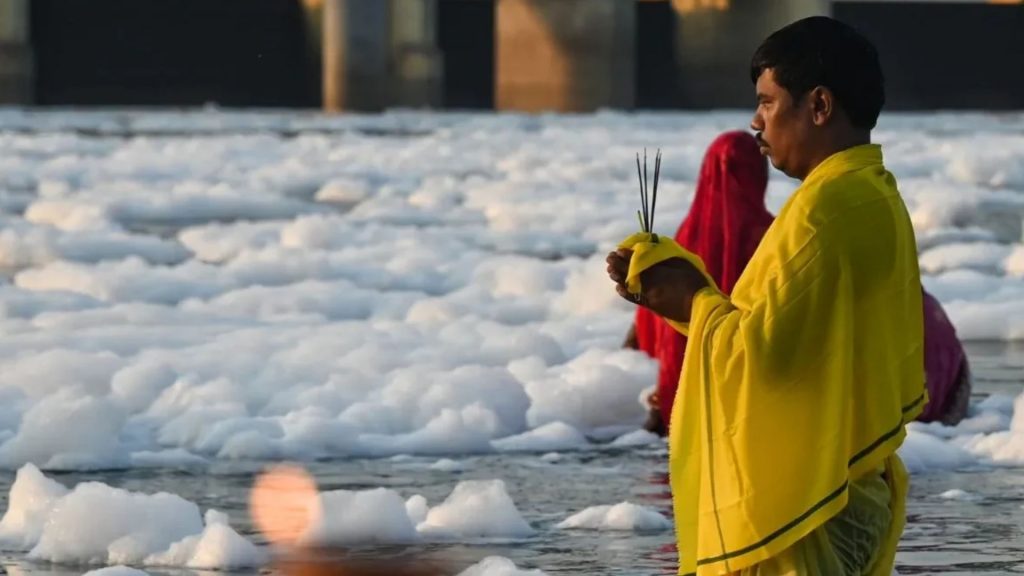
The Supreme Court has strongly reprimanded the concerned states, union territories, and administrative authorities, including Delhi, for the continuously increasing pollution in the Yamuna River. The court stated that despite huge expenditures on cleaning the river, the pollution in the Yamuna has worsened instead of improving. The court warned that if states, union territories, and concerned authorities do not take effective steps to curb pollution, they could face fines.
A two-judge bench of the Supreme Court, comprising Justices Manoj Mishra and Manmohan Singh, made these important observations in its order issued on November 4.
Dirty water flowing into the Yamuna from 520 drains
The Supreme Court stated in its order that the poor civic management of cities, towns, and villages along the Yamuna has a direct impact on the river’s health. According to the court, dirty water is reaching the Yamuna through approximately 520 drains.
The bench stated that despite significant expenditures on river cleaning, the continued rise in pollution levels reflects the failure of the administrative system. The court emphasized the need to stop or completely eliminate industrial pollution and untreated sewage at the source.
The court stated that where it is impossible to stop pollution at the source, sewage should first be separated from the drains and then properly treated. However, this task remains challenging due to the lack of a robust sewage system and the interconnection of sewage drains with stormwater drains.
Pollution problem due to illegal colonies
The Supreme Court also cited illegal and unauthorized colonies as a major cause of Yamuna pollution. The court stated that these colonies, built on encroached land, lack proper roads and adequate space, making it difficult to lay a sewage system.
According to the bench, sewage from such colonies will continue to flow into the Yamuna, perpetuating the river’s pollution problem. Therefore, cleaning the river alone is not enough; it is also necessary to control the sources of pollution.
Emphasis on creating a green zone along the Yamuna River
The Supreme Court called for Zone ‘O’, designated in the Delhi Master Plan 2047, to be protected as a green zone and, if possible, expanded to the upper and lower reaches of the river. The court suggested that the possibility of preserving this area from the source of the Yamuna to its confluence with the Ganga River, should be considered.
The court stated that no permanent construction should be permitted in this area in the future. However, green parks and essential public infrastructure projects may be allowed.
No permanent construction allowed even in the name of tourism
The court stated that only semi-permanent structures, such as cycling and walking tracks, should be permitted for recreational and tourist activities. Permanent construction should only be located outside Zone ‘O’ and at an appropriate height.
The Supreme Court also stated that efforts should be made to remove existing structures in Zone ‘O’ and the proposed expanded area in accordance with existing laws. However, where residents are entitled to alternative housing, action should be taken only after providing them with housing elsewhere.
The bench remarked that the Yamuna River should have sufficient space to flow along its natural path and change its course if necessary. The court emphasized that making the river pollution-free requires not only a clean-up campaign but also effective control of sewage management, illegal construction, and industrial pollution.