


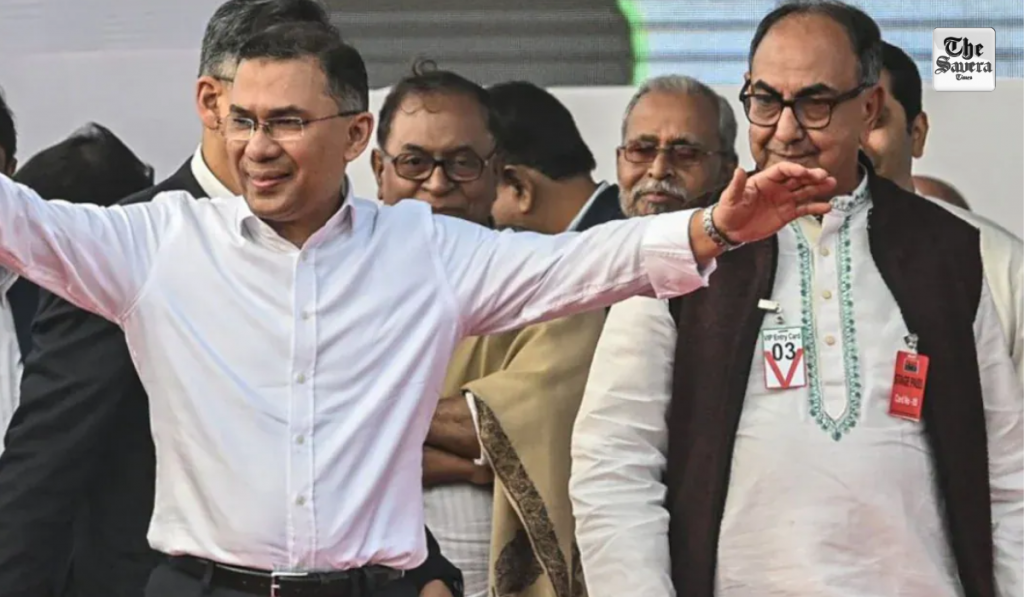
Dhaka: Tarique Rahman, son of former Bangladesh Prime Minister Khaleda Zia, has returned to the country after 17 years and is now emerging as a major contender in the general elections to be held in February next year. His return is being considered a turning point in Bangladesh’s electoral politics amid the long-standing changes in the political landscape.
Rahman chose to go into self-exile in London in 2008. Since then, he has led the party’s strategy as the acting president of the Bangladesh Nationalist Party (BNP).
New opportunity emerges in the political vacuum
Bangladesh politics is currently undergoing major changes.
Sheikh Hasina’s party, the Awami League, has been barred from contesting elections. Meanwhile, BNP’s main leader, Khaleda Zia, is battling serious illnesses, limiting her active political involvement.
In this environment, a political vacuum has emerged, and Rahman is considered a natural choice to fill it.
Although Jamaat-e-Islami and new groups emerging from recent student movements are also contesting the elections, Rahman’s political training and his mother’s legacy distinguish him.
Since his return, Rahman has been regularly attending public meetings, strengthening his support base and re-positioning the BNP as a strong alternative in national politics.
Controversial past, but attempts to build a new political image
Along with Rahman’s return, the opposition has also raised questions about his past legal disputes.
In 2007, he was arrested on corruption charges, later acquitted under a plea agreement, and briefly withdrew from active politics.
However, supporters dismiss these allegations as a “political conspiracy.”
Experts believe his return is part of a deliberate political strategy by the interim administration to ensure a smooth political transition before the elections.
Tariq Rahman’s grand welcome is being interpreted as a sign that this return may be state-backed.
The Story of a ‘Fugitive’ to a ‘Front-Runner’
A report by International Science for Peace Studies* suggests that Rahman’s image transformation is not just the result of street protests, but also of high-level political agreements.
In particular, his meeting with Chief Advisor Muhammad Yunus in London in June 2025 is considered significant.
The interim government is embroiled in numerous policy disputes, and the search for a moderate leadership intensified amid pressure from extremist groups—a move that provided the BNP with an opportunity to re-emerge.
Rahman is now emphasizing a “Bangladesh First” policy, presenting himself as the country’s “safe, democratic, and liberal alternative.”
In a recent speech, he quoted Martin Luther King Jr., stating, “I have a plan for my country, for my people.”
February elections will play a decisive role
Rahman’s return and electoral activism indicate that the BNP has entered the political race fully prepared.
Supporters believe that Rahman can inject new energy into the party and has the potential to lead a transition of power.
However, critics remain concerned about his past controversies and growing political polarization.
Rahman’s strategy, coalition-building, and public relations campaign in the coming months will determine whether he truly emerges as a leading contender for the prime ministership.