Last Updated: October 24, 2026
Last Updated: October 24, 2026





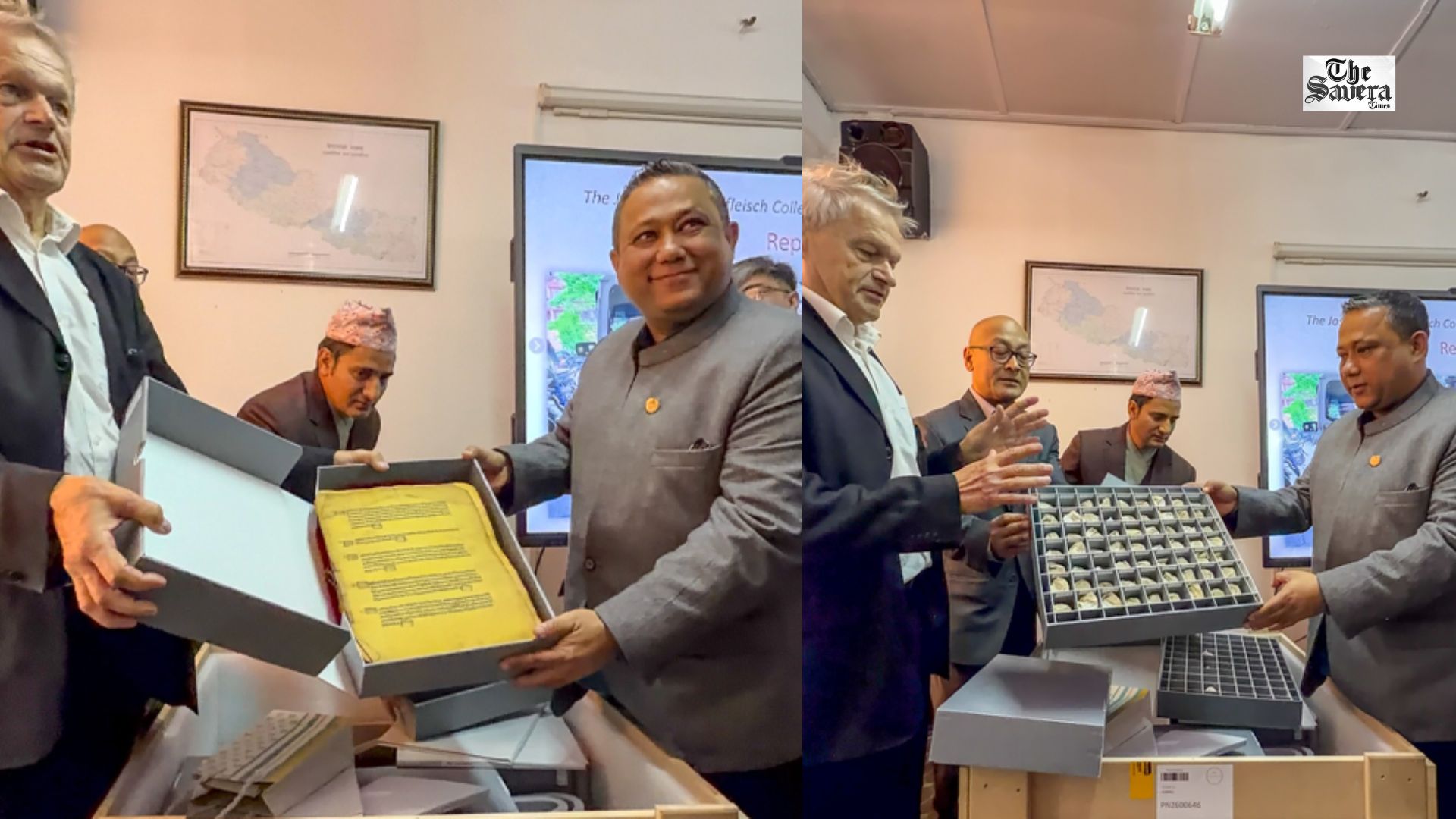
Kathmandu: More than 800 historical documents relating to Nepal’s political, legal, intellectual and cultural heritage have been returned to Nepal from Germany, with some of the materials dating back to the 13th century.
The documents, which had been housed in a private collection in Germany, were formally handed over to the National Archives of Nepal at a ceremony in Kathmandu on Friday, according to a statement issued by Nepal’s Ministry of Foreign Affairs.
The collection includes ancient palm-leaf manuscripts, royal decrees, court orders, legal documents, Sanskrit texts and historical travel accounts.
Collection Includes Documents From Malla, Shah and Rana Periods
The documents were originally part of the private collection of the late Joseph Peter Rindfleisch. His son, Walter Rindfleisch, handed the collection to Professor Axel Michaels of the Heidelberg Academy of Sciences and Humanities under Heidelberg University.
Michaels, along with his team members Dr Manik Bajracharya and Rajan Khatiwada, subsequently facilitated the handover of the documents to Nepal’s Foreign Minister Shishir Khanal.
According to Nepal’s Foreign Ministry, the documents had been collected from Nepal between the 1780s and the 1990s.
The collection comprises more than 800 royal and official documents, including rukkas, or official orders, and lal mohars, or royal decrees bearing a red seal.
According to the catalogue, the collection contains 465 palm-leaf manuscripts from the Malla period, including lal mohars; 312 legal decrees and royal documents from the Shah and Rana periods, including documents bearing clay seals; 18 manuscripts and travel diaries from the offices of Rana prime ministers; and 11 manuscripts covering various subjects.
Some of the palm-leaf manuscripts are among the oldest surviving documents from Nepal.
Documents Preserved and Catalogued in Germany
The collection was preserved and catalogued by the Heidelberg University Library and the Heidelberg Academy of Sciences and Humanities before being repatriated to Nepal in cooperation with the Nepalese government.
Michaels and Walter Rindfleisch were friends, which helped Michaels take the lead in facilitating the return of the documents to Nepal.
During the handover ceremony, Foreign Minister Khanal said the return represented the restoration of Nepal’s cultural rights and sovereign ownership over its civilisational heritage.
Khanal also recalled the late Rindfleisch’s wish to return the more than 800 Nepali documents held in his private collection and praised his respect for Nepal’s cultural heritage.
Nepal-Germany Cooperation Behind Repatriation
The repatriation was carried out through cooperation among the Embassy of Nepal in Germany, Heidelberg University, the Heidelberg Academy of Sciences and Humanities, the Saraf Foundation and the National Archives of Nepal.
Khanal praised Professor Michaels and his research team for their role in identifying, documenting and repatriating the historical materials.
He also noted that Nepal and Germany are both parties to the 1970 UNESCO Convention on the Means of Prohibiting and Preventing the Illicit Import, Export and Transfer of Ownership of Cultural Property.
According to Khanal, the handover demonstrates the two countries’ commitment to the principles of the international convention. He also appreciated the support extended by the German government, the German Embassy in Kathmandu and Heidelberg University in facilitating the return.
The Indian Army on Friday rejected claims on social media that the Army had taken action against the...
Abdul Majid Hakim Elahi, Iran's Supreme Leader's representative and senior diplomat, said on Friday that the US has...
New York, USA: The New York City Council has passed a law to ban horse-drawn carriages, naming the...

Washington: US President Donald Trump suggested that further military action against Iran remained possible, while acknowledging that the...
Lhasa: Sixteen people were killed and 32 others injured after a 7.0-magnitude earthquake struck Tibet on Thursday, according...
More than two weeks after the Yemeni government launched a major offensive against the Houthi group, front lines...
Aries: The day will be auspicious...