Last Updated: October 24, 2026
Last Updated: October 24, 2026





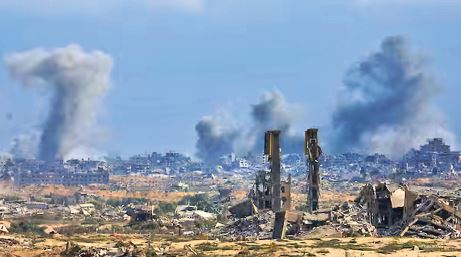
As negotiations between Israel and Hamas resume in Egypt, the focus has shifted to Khalil al-Hayya, the senior Hamas leader heading the Palestinian delegation. The talks, held in the resort city of Sharm el-Sheikh, are being viewed as the most serious diplomatic effort in more than two years to end the Gaza conflict. Mediated by the United States, Egypt, and Qatar, the discussions are expected to centre on a ceasefire, the release of hostages, and a roadmap for Gaza’s reconstruction and governance.
The timing of the talks comes amid cautious optimism. US President Donald Trump has taken personal charge of the process, calling it a “rapidly progressing peace effort.” The United States is represented by Trump’s son-in-law Jared Kushner and special envoy Steve Witkoff, who arrived in the region to finalise a deal involving hostage exchanges and a permanent ceasefire. Israel’s delegation is led by Strategic Affairs Minister Ron Dermer, a close ally of Prime Minister Benjamin Netanyahu.
For Hamas, Khalil al-Hayya’s presence marks a symbolic and strategic moment. Al-Hayya, a senior member of the group’s political bureau, survived an Israeli airstrike in Doha last month that killed six people, including his son. His arrival in Egypt on Sunday signalled Hamas’s readiness to engage in direct discussions, despite recent losses and mounting pressure from within Gaza. According to a Hamas statement, the delegation will focus on “mechanisms for a ceasefire, withdrawal of occupation forces, and a prisoner exchange.”
The negotiations are being closely shaped by the 20-point peace framework drafted under Trump’s directive. The proposal envisions Gaza as a “deradicalised, terror-free zone” governed by a technocratic Palestinian body. It outlines a phased process beginning with the release of hostages, followed by Israel’s withdrawal and large-scale humanitarian assistance. According to the plan, once both sides agree, Israeli combat operations will halt and the “battle lines” will remain frozen until the withdrawal is complete.
The first stage of the proposal requires Hamas to release all hostages—both living and deceased—within 72 hours of Israel’s acceptance of the deal. In return, Israel would free 250 prisoners serving life sentences and 1,700 Palestinians detained after the October 2023 attacks, including women and children. The agreement also stipulates an exchange of remains: for every Israeli hostage’s body returned, Israel would release the remains of 15 Gazans.
A key element of the framework is its focus on reconstruction and humanitarian relief. It prioritises restoring electricity, water, hospitals, bakeries, and transport routes across Gaza. The White House proposal ensures that “no one will be forced to leave Gaza,” while granting amnesty to Hamas members who disarm and renounce violence. Those wishing to leave will be offered safe passage to third countries willing to host them.
Israel would retain no occupation or annexation rights over the territory, while Gaza’s interim administration would be handled by an apolitical committee responsible for basic services. Humanitarian aid is expected to exceed the quantities established under the January 2025 agreement, in a bid to stabilise living conditions.
Yet despite public signals of willingness from both sides, major sticking points remain. Hamas has not agreed to full disarmament, which Israel insists is non-negotiable. Hamas’s statement referred to ongoing discussions about the “rights of the Palestinian people” and the “future of Gaza,” implying it seeks continued political influence. The second phase of talks is expected to address these contentious issues, along with guarantees for Israel’s security and measures to prevent renewed hostilities.
Trump’s unusually direct involvement has added political weight to the negotiations. Over the weekend, he posted on Truth Social that the talks were “proceeding rapidly” and urged both parties to “move fast.” He also said Israel had “temporarily stopped the bombing” to give the peace process a chance. However, Gaza’s civil defence agency reported ongoing Israeli airstrikes overnight, killing at least 57 people.
For Washington, the talks represent a rare opportunity to claim a diplomatic success in the Middle East. A breakthrough could enhance Trump’s foreign policy credentials while easing tensions in a region long mired in conflict. For Israel, the deal offers a route to secure the release of hostages while addressing growing international criticism of its military campaign.
Hamas, however, faces an uncertain future. Its political and military structures have been severely weakened after sustained Israeli operations. Many of its senior leaders, including Ismail Haniyeh and Saleh al-Arouri, have been killed. The group’s military arm, the Izz al-Din al-Qassam Brigades, has suffered heavy losses, with leadership now reportedly under Izz al-Din al-Haddad after the deaths of Yahya and Mohammed Sinwar.
The humanitarian situation in Gaza has deteriorated dramatically. Local authorities estimate that more than 67,000 people have been killed and 169,000 injured since the war began. Over 90 per cent of Gaza’s 2.2 million residents have been displaced, many living in tents and makeshift shelters. International aid agencies report acute food shortages, rampant disease, and a near-total collapse of medical facilities.
In several areas of northern and central Gaza, Hamas’s control has eroded. Local militias and community groups, some reportedly backed by Israeli intelligence, have assumed limited administrative roles. Internal dissent has grown, with public anger directed at both Hamas and Israel. Reports of arrests and executions of alleged collaborators by Hamas’s internal security forces have deepened disillusionment among civilians. A May 2025 poll indicated that nearly half of Gaza’s population supported anti-Hamas demonstrations.
Given these conditions, political analysts believe Hamas may be forced to evolve into a civilian political movement to survive. Countries such as Egypt, Qatar, and Turkey are expected to play crucial roles in facilitating this transition. However, Hamas’s ideological opposition to Israel remains a significant obstacle.
The outcome of the Sharm el-Sheikh talks will determine whether the war’s end is within reach or whether the region slips back into violence. For now, both sides appear cautiously committed to Trump’s peace framework, aware that the alternative may be another prolonged and devastating phase of conflict.
Washington: US President Donald Trump has acknowledged that the war with Iran has driven up oil prices and...
Washington: US President Donald Trump has announced a new labelling initiative to identify American-produced seafood, seeking to give...
Kinshasa: A major clinical trial to evaluate vaccines against the Bundibugyo Ebola virus began Friday in the eastern...
Washington: US President Donald Trump has warned that American forces could launch another round of military strikes against...
The Indian Army on Friday rejected claims on social media that the Army had taken action against the...
Abdul Majid Hakim Elahi, Iran's Supreme Leader's representative and senior diplomat, said on Friday that the US has...
Aries: The day will be auspicious...