Last Updated: October 15, 2026
Last Updated: October 15, 2026






K SIVA PRASAD
Retired senior IAS officer in the Punjab Government.
In the second chapter of the Bhagavad Gita (2.31–2.37), Krishna introduces a crucial concept to Arjuna—swa-dharma, one’s own inherent nature. At a moment when Arjuna is paralysed by despair and moral confusion on the battlefield of Kurukshetra, Krishna does not begin by prescribing action alone. Instead, he first anchors Arjuna in a deeper understanding of existence, identity, and duty.
This progression is deliberate and deeply philosophical. Krishna opens the Gita by speaking of that which is eternal, unmanifested, indestructible, and all-pervading. For ease of understanding, this eternal reality is referred to as atma. It is beyond birth and death, beyond sorrow and joy. Only after establishing this eternal foundation does Krishna speak of swa-dharma—a step closer to human experience, yet still rooted in truth. Swa-dharma acts as a bridge between our worldly existence and the realization of our eternal inner self.
The journey toward realizing the eternal nature of the self can be understood in three stages. The first stage is our present condition—where we exist as a mix of our inherent nature, personal experiences, accumulated knowledge, memories, social conditioning, and assumptions shaped by a restless and wavering mind. The second stage is the gradual realization of swa-dharma, our natural disposition. The final stage is the realization of the eternal self, free from identification with the mind and body.
Our present condition is clouded by mental baggage. We carry fears, desires, expectations, and borrowed identities that obscure our true nature. Swa-dharma does not need to be created or acquired; it is uncovered slowly as we free ourselves from this mental clutter. It emerges naturally when we stop trying to become something we are not.
Krishna reminds Arjuna that he is a kshatriya and that fighting injustice is his swa-dharma. The word kshatriya itself offers profound insight. It is derived from two roots: kshat, meaning “hurt” or “injury,” and trayate, meaning “to protect.” A kshatriya is one who protects others from harm. This protection need not always be physical warfare; it is an innate tendency to stand up against injustice and shield the vulnerable.The most powerful and universal example of this is a mother. A mother instinctively protects her child—first in the womb and later in the world—often without any formal training or prior experience. This protective impulse arises naturally from within her. In this sense, she is the first kshatriya most of us encounter in life. Her actions are not forced; they flow effortlessly from her swa-dharma. This natural inclination offers a glimpse into how swa-dharma operates—effortless, spontaneous, and deeply rooted in one’s being.
To explain this further, consider the metaphor of a rose and a lotus. Once, a rose became enchanted by the beauty and majesty of a lotus and began nurturing the desire to become one. But no matter how much it wished, a rose could never become a lotus. The rose might change its colour, size, or shape, but it would still remain a rose. Its essence—its swa-dharma—cannot be altered.
Human beings often behave like this rose. We aspire to become something entirely different from what our nature supports, driven by comparison, social expectations, or misplaced ideals. This inner conflict leads to dissatisfaction, confusion, and despondency—the very state Arjuna experiences on the battlefield. Arjuna’s despair is not just about violence; it is about resisting his own nature while being overwhelmed by emotional and mental turmoil.
Krishna’s teaching is clear: fulfillment does not come from imitating another’s path, but from fully inhabiting one’s own. The rose blooms beautifully when it embraces being a rose, just as the lotus thrives in water. When we align our actions with our swa-dharma, life flows with less resistance and greater clarity.
Ultimately, realizing swa-dharma is not the end of the journey but an essential milestone. It prepares the ground for the deeper realization of the eternal self. When action arises from one’s true nature, it becomes selfless, effortless, and free from inner conflict. As Krishna teaches, honoring one’s swa-dharma is not limitation—it is the doorway to liberation.
Good Afternoon Viewers! Stay updated with The Savera Times Afternoon Bulletin, bringing you the latest news from Punjab,...

New Delhi: Heavy rain and thunderstorms swept parts of Delhi-NCR on Thursday as dark clouds covered the national...

A street vendor has approached the Delhi High Court seeking to stop the Cockroach Janata Party (CJP)'s protest...

Suva: India and Fiji on Thursday held discussions focused on deepening bilateral ties and reaffirmed their shared commitment...

Bokaro (Jharkhand): The protest by trained youth from displaced families affected by the Bokaro Steel Plant (BSL) intensified...
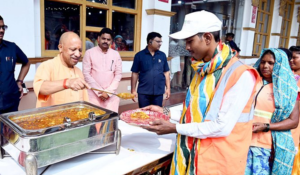
Varanasi: Uttar Pradesh Chief Minister Yogi Adityanath, on a two-day visit to Varanasi, honoured sanitation workers from the...
Aries: The day will be auspicious...