Last Updated: October 25, 2026
Last Updated: October 25, 2026





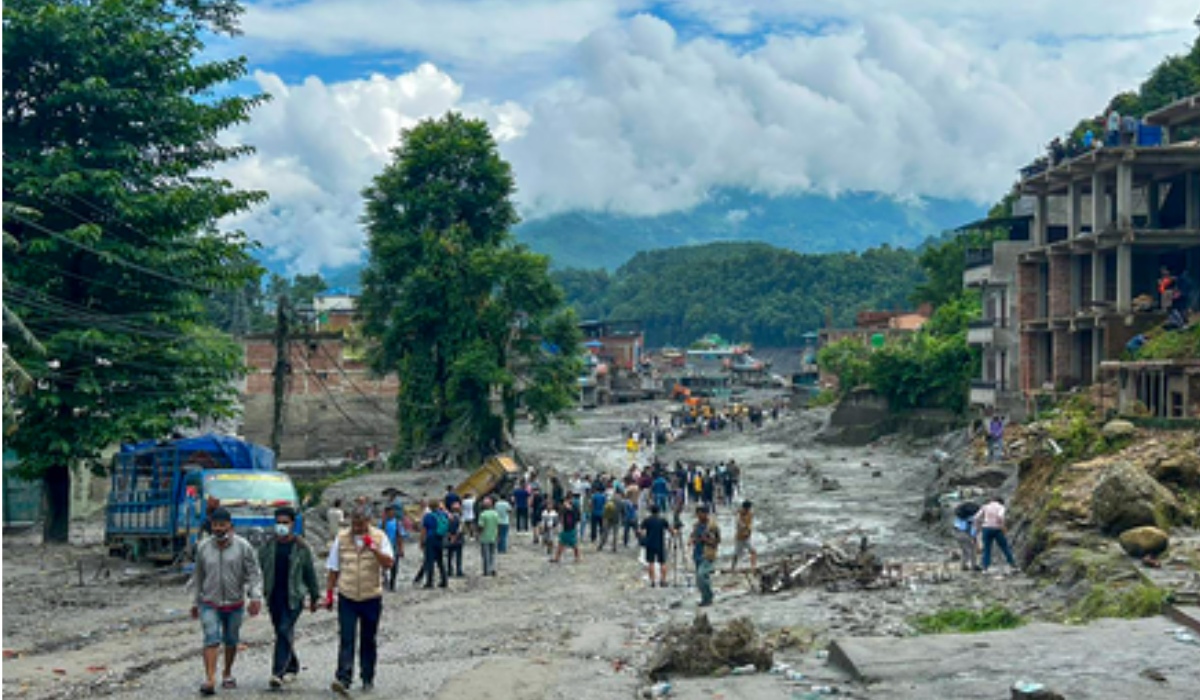
The 2025 and 2026 floods in the Lhende river system provide a particularly important example because they involved different cryospheric processes within the same broader mountain environment. On July 8, 2025, about 35 kilometres upstream from the Nepal-China border, a supraglacial lake on Tibet’s Purepu Glacier rapidly drained, causing a flash flood. The National Disaster Risk Reduction and Management Authority (NDRRMA) of the Government of Nepal reports that the flood caused significant damage downstream as it moved along the Lhende river, also referred to as the Bhotekoshi river in Nepal. Roads, bridges, hydroelectric plants, and the Rasuwagadhi dry port were all impacted by the catastrophe. The NDRRMA report also used satellite observations to investigate the source of the flood. Sentinel-2 imagery showed that supraglacial ponds began forming on the Purepu Glacier in March 2025 and expanded during the following months. By July 7, the combined lake area had reached approximately 0.75 square kilometres. On July 8, the lake area had decreased sharply and drainage features were visible on the glacier surface. These observations supported the conclusion that rapid drainage of the supraglacial lake contributed to the downstream flood. The contrast between the different cryospheric processes affecting the same Lhende river system in 2025 and 2026 is particularly important for understanding Himalayan risk. In July 2025, the flood was associated with the rapid drainage of a supraglacial lake on Tibet’s Purepu Glacier, around 35 kilometres upstream from the Nepal-China border. Satellite observations documented the development and expansion of supraglacial ponds on the glacier before the event, followed by a sharp reduction in lake area and visible drainage features on July 8. The resulting flood travelled downstream through the Lhende river system and affected roads, bridges, hydropower facilities and the Rasuwagadhi dry port. In August 2026, the situation was different. Scientists investigated an ice-rock avalanche in the highaltitude Lhende Khola area as a possible trigger, with evidence suggesting that the river was temporarily blocked before the flood wave moved downstream. The immediate sequence is still being investigated, but the two events clearly point to different physical processes producing destructive flooding within the same broader river environment. This difference matters because it shows that a river corridor can remain exposed even when the specific hazard identified in an earlier event is different. After the 2025 flood, attention to glacial lakes and their potential drainage is important, but monitoring only glacial lakes would not necessarily identify an unstable ice-rock slope or a sudden river blockage. Similarly, a flood-warning system that depends mainly on rainfall and river-level changes may have limited lead time when the process begins suddenly at high altitude. The 2025 and 2026 events therefore show the need to look at the entire upstreamto-downstream hazard pathway, rather than treating each hazard as a separate event. A change in a glacier, an unstable slope, a river blockage or a sudden release of water can all alter the behaviour of the same river and create consequences farther downstream. This has direct implications for infrastructure planning in the Himalayan region. The same corridor contains communities, roads, bridges, hydropower facilities and important border and trade infrastructure, meaning that the consequences of a mountain hazard extend beyond the location where it begins. Infrastructure assessments should therefore consider not only whether a project is exposed to a conventional flood, but also whether an upstream glacier, ice-rock slope, landslide or temporary river blockage could generate a flood or debris flow capable of reaching the project. Historical flood records remain useful, but they cannot capture every possible mechanism through which water and debris can move through a mountain catchment. The two Lhende events provide a clear example: the hazard mechanism changed, but the downstream exposure remained.
New Delhi/Imphal: The Enforcement Directorate (ED) has conducted coordinated searches across Mizoram and Manipur under the Prevention of...
Five people were injured after a mini-bus overturned near Jyotipuram in Reasi district while travelling from Bakal to...

Bhubaneswar: In a major crackdown against corruption, Odisha Vigilance on Sunday arrested another senior clerk of the State...
Bhubaneswar: In a major crackdown against corruption, Odisha Vigilance on Sunday arrested another senior clerk of the State...

Expelled JD(U) MLA Anant Singh has announced plans to form his own party after a six-year expulsion over...

New Delhi: The Cyber Police Station of Delhi’s North-East District has arrested two men for their alleged involvement...