Last Updated: October 12, 2026
Last Updated: October 12, 2026





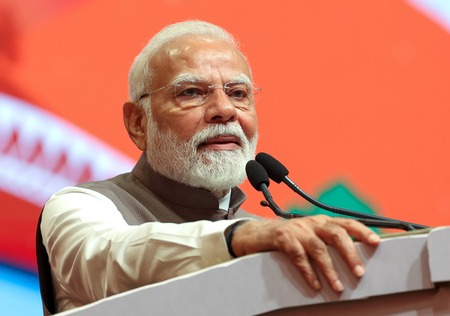
Abhishek Vij
A grand celebration was held at Bharat Mandapam in New Delhi on Wednesday to mark the completion of 12 years of Modi’s governance. In addition to members of the Union Cabinet, Chief Ministers of BJP-ruled states also attended the event. Everyone welcomed PM Narendra Modi with thunderous applause. Modi set the record for the longest tenure at the helm of the nation as an elected Prime Minister. Previously, the record for the longest tenure as an elected Prime Minister was held by Pandit Jawaharlal Nehru; he served as Prime Minister for 4,398 days, from May 13, 1952, to May 27, 1964.
Modi surpassed Nehru’s record by completing 4,399 days. Although some statisticians point out that Pandit Jawaharlal Nehru had actually become the Prime Minister of the interim government and led the country in that capacity until the first elections in 1952, the record is based specifically on the tenure of an “elected” Prime Minister; thus, Modi has broken Pandit Nehru’s record. The country has a population of 1.46 billion, immense linguistic and cultural diversity, and a vast geographical area, yet Modi has governed it for such an extended period.
The nation has benefited from this through continuity in leadership and policies over these 12 years. Modi formed governments after winning consecutive elections in 2014, 2019, and 2024, becoming the first nonCongress Prime Minister to complete two full terms with a majority and now serving a third. At the Bharat Mandapam event, the roadmap for ‘Viksit Bharat 2047’ (Developed India 2047), better coordination between the Centre and states, development projects, and the concepts of ‘Ease of Living’ and ‘Ease of Doing Business’ were highlighted as the guiding principles of his administration. Notably, Modi previously served as the Chief Minister of Gujarat; if that tenure is also included, he has been at the helm of power for 9,013 days. If one were to list the achievements of the Modi administration, free rations are being provided to over 80 crore people.
More than 4 crore poor people have been provided with permanent houses. Free health insurance coverage of up to Rs 5 lakh has been extended to 50 crore people. Over 11 crore families have received LPG connections. Furthermore, under the aegis of the Government of India, 145,000 kilometers of roads and 3,000 kilometers of expressways have been constructed over the past 12 years. NITI Aayog reports that 24.8 crore people have escaped poverty during the decade spanning 2013 to 2023. The number of airports has risen from 74 to 164, and over 140 Vande Bharat trains have been launched. Mobile phones have reached the hands of the common man, and the country has begun manufacturing mobile phones worth Rs 5.50 lakh crore, with exports accounting for Rs 2.6 lakh crore of that total.
The account of the Modi regime’s achievements does not end there. Statisticians note that milestones have been achieved year after year. An early achievement was the opening of 58 crore Jan Dhan accounts in 2014, while a recent feat involved military action against Pakistan— specifically ‘Operation Sindoor’—following the Pahalgam massacre, resulting in the destruction of terrorist hideouts. Significant milestones in the intervening years include the provision of LPG connections to 11 crore poor people under the Ujjwala Yojana in 2016; the launch of the GST regime (One Nation, One Tax) in 2017; the implementation of the Ayushman Bharat scheme for 600 million (60 crore) people in 2018; and the abrogation of Article 370 and Article 35-A regarding Jammu and Kashmir in 2019
Chief Justice Surya Kant said every citizen can approach the Supreme Court through a petition after declining a...
A major fire broke out at a scrap warehouse opposite the Maruti Temple in Sangameshwar, Maharashtra, around midnight....
A 48-year-old man, Pawan Sharma, died after an alleged altercation over a senior citizen seat at Delhi’s Supreme...
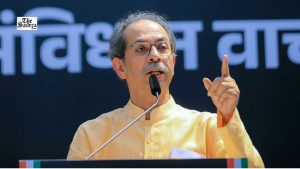
Shiv Sena (UBT), in its mouthpiece Saamana, has criticised the Centre over security measures and detentions during anti-government...
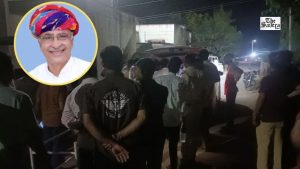
Former BJP MLA Attar Singh Bhedana died at Jaipur’s SMS Hospital after a violent clash at a crusher...
An eyewitness has recounted the fatal Mini Cooper crash in Nedumbassery, Kochi, claiming the driver said his father...

Aries: The day will be auspicious...