Last Updated: October 1, 2026
Last Updated: October 1, 2026





Abhishek Vij
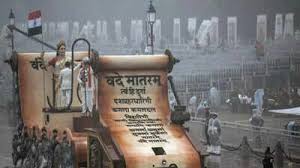
Jana Gana Mana,” composed by Nobel laureate Gurudev Rabindranath Tagore, is our national anthem, while “Vande Mataram,” composed by Bankim Chandra Chatterjee, is our national song. On January 24, 1950, the Constituent Assembly passed a resolution declaring that, in order to safeguard the national identity of Indians, Vande Mataram, along with Jana Gana Mana, would be our national song. Bankim Babu composed it in 1875 and included it in his novel Anand Math in 1882. When Lokmanya Tilak launched his national movement in 1905, Vande Mataram became a source of inspiration for patriots.
After independence, when the decision on the national anthem began, Rabindranath Tagore himself proposed that Vande Mataram be made the national anthem. However, because the six-stanza song praised the Hindu goddesses Maa, Durga, and Saraswati, Pandit Nehru, overriding Mohammad Ali Jinnah’s opposition, insisted that only two verses be included, while the remaining four were removed.
Last year, the Modi government celebrated Vande Mataram’s 150th anniversary with a fitting tribute and urged everyone to draw inspiration from it. The history of India’s independence, Vande Mataram, reveals that this inspiring national song was composed as early as 1875. Later, patriots who sacrificed their lives fighting for independence sang this song as they went to the altar. After independence, Gurudev Rabindranath Tagore’s composition, Jana Gana Mana, was adopted as the national anthem. The Government of India has now launched a campaign to recite Vande Mataram to instill a sense of patriotism and nationalism among the people.
Instead of the approved two verses, the government has now mandated the recitation of the entire six verses. The duration of the recitation has also been limited to 3:10 minutes. The new directive mandates that Vande Mataram be sung before the national anthem at any official ceremony, and only the full version will be sung during chorus singing.
Now, attendees will be required to stand at attention during the presentation of the national song along with the national anthem. While the graceful singing of Vande Mataram is being performed, it has also been mandated that all schools begin the day with the chorus singing of the national song, Vande Mataram. Now, recitation of Vande Mataram has also been made mandatory before Jana Gana Mana. All six verses of the national anthem will be sung during any government or public function, including the arrival of the President, the hoisting of the tricolor, speeches by governors, cultural programs, or parades, as well as all other official ceremonies.
It has been stated that if any part of Vande Mataram is played in a film or documentary, the audience is not required to stand in cinemas or during stage performances. Previously, a campaign was launched nationwide to honor the tricolor. It is the duty of every citizen to remember and respect the proud symbols of our country. In today’s materialistic age, where the younger generation is forgetting to respect even sacred relationships, reviving moral ideals and respecting the national song and national anthem, which reflect the pride of the nation, should be a universally accepted and universally accepted policy. This campaign should not become a mere formality; only then will the message of discipline and order be reestablished in this country.
The Savera Times Evening Wrap brings you the top India and world news, covering major developments across politics,...

Pakistan-based LeT terrorist Mohammad Asif alias Hashim Moosa, wanted in the Pahalgam terror attack case, was killed in...

The Supreme Court has ruled out both a complete firecracker ban and unrestricted 24-hour use, indicating that permissible...
The Centre has approved higher MSP for all mandated Rabi crops for the 2027-28 marketing season, with safflower...
Traders’ organisations have withdrawn the October 2 “No UPI Day” protest after meeting Finance Minister Nirmala Sitharaman over...

Ahmedabad: A Nigerian national allegedly acted as a link between a Gujarat-based wanted accused and a wider drug...
Aries: The day will be auspicious...