Last Updated: October 21, 2026
Last Updated: October 21, 2026





Abhishek Vij
It was understood that after the close ties and trade agreements between Russia and India, the US would also want to ensure that a large market like India did not slip from its grasp. The US, or rather Mr Trump, places great faith in tariff wars. He believes that when they raise tariffs on exports from countries like India, their exports will collapse. These countries’ import needs are inelastic, so the rupee will continue to depreciate against the dollar. As a result, everything purchased from the US will become more expensive in India. That’s why Trump first imposed a 50 per cent tariff on India.
But the main problem for the US lies in its agricultural production, which is produced at a higher cost and sells at higher prices globally. The US is desperately seeking markets like India for its farmers’ agricultural products. Since Trump came to power, there have been five rounds of trade talks between India and the US. We thought that since we had started free trade negotiations early on, we would be spared the brunt of America’s high tariff rates. But that didn’t happen, and even then, we didn’t stop buying petrol from Russia. Yes, we did reduce it slightly. But now, the US has a major problem with India’s rice, or basmati rice, being exported to the US. American farmers complain that Indian basmati rice is of very high quality and sells at low prices in the US.
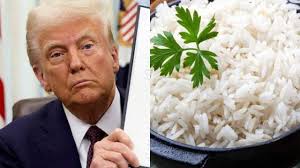
This has crippled American rice farmers because American customers prefer to buy Indian basmati. Now, to wipe away the tears of his farmers, Trump has announced a $123 billion package and said that he will also increase tariffs on rice.
This way, expensive Indian basmati will not be able to compete with American rice. It was understood that an agreement would be reached between the US and India in the new trade talks. The penalties on crude oil imports would be removed. Tariffs would also be reduced to 19 per cent. That didn’t happen, and now there’s a threat of increasing tariffs on Indian rice as well. Trump considers tariffs a powerful weapon in his arsenal. But in reality, tariffs are a double-edged sword. If higher tariff rates make Indian exports more expensive in the US, they will sell at higher prices, thus further burdening American consumers who are already struggling with inflation. Thousands of young people recently took to the streets in the US to protest against rising inflation and unemployment. Indian officials say that increasing tariffs on basmati rice will not significantly harm India.
Currently, there is a 10 per cent tariff on rice. We export only about 5 per cent of our total basmati rice production to the US. In 2024-25, we exported 48.87 lakh tons of basmati rice globally, but only 2.74 lakh tons were exported to the US. Even if the US increases tariffs and impacts this trade, Indian farmers will be able to withstand the shock. But will American citizens be willing to buy expensive basmati rice? In our opinion, this continuous tariff war will only increase their anger towards Trump. The hope is that a trade agreement will be reached between India and the US in the coming days, and the threat of a tariff war will cease. This agreement is a necessity for India, but even more so for the US.
A suspicious explosion occurred on Tuesday at a building under construction on Jermiah Road in the Pulikesi Nagar...

The Ayushman Bharat Pradhan Mantri Jan Arogya Yojana (PMJAY) is proving to be a significant relief for poor...

Rescue teams recovered the bodies of four youths from the Kotri canal in Kota on Wednesday morning, after...

A balloon containing a suspected flammable chemical burst during a stage play in Siwan, injuring around 10 spectators....

State Bank of India has confirmed that 3,897 customer records containing personal information were found on the dark...

A fire in a hut in Nonapar village of Deoria district claimed three lives, including those of a...

Aries: The day will be auspicious...