Last Updated: October 26, 2026
Last Updated: October 26, 2026





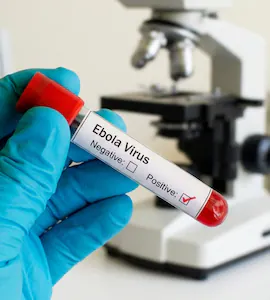
A bat-borne viral disease that often turns fatal, Ebola spreads by contact with body fluids of an infected person or animal or contaminated objects. On rare instances, the virus was observed to be airborne.
According to the World Health Organization (WHO), the average Ebola disease case fatality rate is around 50 per cent, while case fatality rates have varied from 25–90 per cent in past outbreaks.
The Indian Journal of Medical Research (IJMR) in 2019 published an article — Emerging / re-emerging viral diseases & new viruses on the Indian horizon. It categorised under the Biosafetyrisk group 4, indicating it requires the highest level of containment for laboratory work. The text noted Ebola alongside other highpriority pathogens like MERS-CoV and avian influenza as threats that require surveillance and preparedness in the Indian context.
In October 2025, the Indian Council of Medical Research (ICMR) listed it among the ‘Priority Pathogens To Be Tested For In Indian Clinical Settings’. In its document, it noted, “Pathogen testing in clinical microbiology laboratories differs as per institutional requirements and available laboratory resources, often missing out on common/ critical pathogens, thereby hampering patient care and aggravating public health problems such as antimicrobial resistance.”
ICMR also listed important pathogens causing critical infectious syndromes in India, in an effort to guide patient management, public health policies, and biomedical R&D. Ebola and Hantavirus were listed among Priority 3, which indicates ‘Rare pathogens, which may not be detected in routine clinical settings and may be detected during specialised laboratory testing as a part of surveillance’.
In May 2026, a rare multi-country outbreak of the Andes hantavirus occurred aboard the expedition cruise ship MV Hondius, according to WHO. This cluster resulted in 11 confirmed and probable cases (including three deaths) across 23 nationalities, with passengers transported to various international facilities for specialised care. Ebola disease is characterised by symptoms such as fever, weakness, muscle pain, headache and sore throat, followed by vomiting, diarrhoea, rash and in some cases bleeding.
Persons who come in direct contact of body fluids of infected person or infected animal are at risk, the advisory noted. “Ebola disease first occurred in 1976 in two simultaneous outbreaks: one outbreak was of Sudan virus disease in Nzara in what is now South Sudan, and the other outbreak was of Ebola virus disease in Yambuku, in what is now the Democratic Republic of the Congo. The latter occurred in a village near the Ebola River, from which the disease takes its name,” according to WHO.
Hindu Sena has sought an FIR against Mallikarjun Kharge over his remark about PM Modi’s late father at...

A bus travelling from Raipur to Ambikapur crashed into a stationary truck near Darchura village early Monday. Three...

Four people were declared dead at Dhar district hospital after a car caught fire near Sadalpur in Madhya...

A Sultanpur court acquitted Rahul Gandhi in a criminal defamation case filed over his 2018 remarks about Amit...

Several people were injured when five vehicles at the rear of Rahul Gandhi’s convoy collided with an ambulance...

The 17-year-old son of an Additional District Judge has been granted bail in a fatal road accident case...

Aries: The day will be auspicious...