Last Updated: October 21, 2026
Last Updated: October 21, 2026





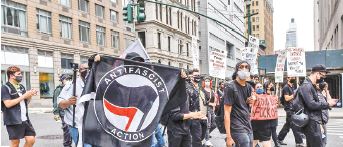
Days after the killing of conservative activist Charlie Kirk in Utah, US President Donald Trump declared Antifa a “major terrorist organisation,” calling the movement a “sick, dangerous, radical left disaster.” He also announced that financiers of the group would face investigations under the “highest legal standards.” The announcement has renewed debate over a movement that lacks leaders, formal membership, or even clear numbers. Critics say designating Antifa as a terror group is fraught with legal and constitutional challenges. Supporters of the move argue that the violence linked to Antifa in recent years demands tougher action.
Origins and history
Antifa is short for “anti-fascists.” The term traces back to Europe in the 1920s and 1930s, when groups confronted fascist movements in Germany, Italy, and elsewhere. The word itself was first recorded in English in 1946, borrowed from German usage against Nazism.
The movement entered the United States in the 1980s through Anti-Racist Action, a loose network that clashed with neo-Nazi groups at punk concerts in the Midwest. By the early 2000s, Antifa had faded from prominence, but it resurged with the rise of the alt-right during Trump’s first term. One of the first groups to publicly adopt the name in the US was Rose City Antifa, founded in Portland, Oregon, in 2007. Its activities included monitoring far-right groups online and exposing their identities.
Antifa drew national attention in 2017 during the violent clashes in Charlottesville, Virginia, where activists confronted white supremacists. The same year, members attacked alt-right demonstrators at the University of California, Berkeley, using sticks, pipes, and makeshift incendiary devices. In 2019, a self-identified Antifa activist, William Van Spronsen, attempted to bomb an immigration detention facility in Washington state but was killed by police. Antifa was also cited in connection with protests following the 2020 death of George Floyd, when some demonstrations turned violent. Right-wing media figures and politicians later claimed, without evidence, that Antifa members infiltrated the January 6 Capitol riot.
How Antifa operates
Antifa is not a formal organisation but rather a loose collective of activists who share anti-fascist ideology. Members, often dressed in black, attend right-wing rallies to confront speakers and demonstrators. They use chants, human chains, and sometimes violent tactics to disrupt events.The group is also known for “doxxing,” or publishing personal details of right-wing activists online. Supporters argue such tactics are defensive, citing historic violence by fascist movements against minorities. Critics, including scholars of fascism, caution that Antifa’s methods risk creating false equivalence with extremist violence from the right. According to data from 1994 to 2020, right-wing extremists were responsible for about 57 percent of terrorist incidents in the US, while left-wing extremists, including Antifa-linked actors, were connected to roughly 25 percent. Fatalities tell a starker story: 335 deaths from right-wing terrorism versus 22 from left-wing violence over the same period.
Trump’s stance
Trump has long attacked Antifa. In 2020, he pushed to designate it a terror group, but advisors warned of legal obstacles, as the FBI classified it as an ideology rather than an organisation. Christopher Wray, then FBI director, testified that Antifa lacked the structure necessary for such a designation. Now, after Kirk’s killing, Trump has revived his demand. On social media, he pledged to investigate not just activists but those “funding” the movement.
The Utah connection
Charlie Kirk was assassinated at a college event in Utah. Investigators arrested Tyler Robinson, who allegedly used a weapon with shell casings marked with anti-fascist slogans such as “Hey fascist! Catch!” and “Bella Ciao,” the latter a wartime Italian resistance anthem. Authorities have not confirmed Robinson’s membership in Antifa, but Utah Governor Spencer Cox pointed to the markings as evidence of a possible connection. Trump suggested Robinson had been “radicalised over the internet” and linked his politics to the far left. Still, investigators have yet to establish direct organisational ties. Antifa’s decentralised nature makes it difficult to determine whether individuals act as part of the movement or independently.
A political flashpoint
Antifa’s prominence in American politics reflects broader polarisation. To its critics, it embodies left-wing extremism and lawlessness. To its defenders, it represents resistance to racism and authoritarianism. For Trump, the movement serves as both a political target and a rallying cry, especially in the wake of violence directed at right-wing figures. But experts warn that branding an ideology as terrorism could trigger constitutional battles and expand the reach of government power in ways that blur distinctions between protest, dissent, and violence. As the investigation into Kirk’s killing continues, Antifa remains both an elusive subject of law enforcement and a powerful symbol in America’s fractured political landscape.
US President Donald Trump says Washington and New Delhi are close to a trade agreement that will differ...
Iran has ruled out transferring its enriched uranium stockpile outside the country, with security official Mohsen Rezaei reiterating...
Donald Trump has urged Volodymyr Zelensky to pursue a peace deal with Russia, warning that Ukraine could face...
Pakistan, battling insurgencies at home and tensions along multiple borders, is too overstretched to offer meaningful military support...
The World Bank Group has launched its first comprehensive digital strategy, placing artificial intelligence, affordable internet access and...
Fifty-four organisations and movements associated with France's October protests, along with their wider networks of supporters and international...
Aries: The day will be auspicious...