Last Updated: October 21, 2026
Last Updated: October 21, 2026





Parneet Sachdev
Feeling anxious? Feeling low or even depressed? What will you do? Resist for a while, try ignoring. Ultimately, you might take a pill that will give some relief. In 2021, approximately 359 million people worldwide, or about 4.4% of the global population, had an anxiety disorder, according to the World Health Organization (WHO). These stats do not include the vast majority of people who do not report anxiety and stress. Anxiety disorders are the most common mental issues globally, characterized by excessive fear and worry that significantly impairs functioning.
The prevalence of anxiety disorders has been increasing, with a 50% rise in absolute numbers from 1990 to 2019. Even in a ‘spiritual’ society like India, Anxiety disorders are highly prevalent, with the National Mental Health Survey (NMHS) 2016 and other research indicating that 44.9 million people suffered from anxiety disorders in 2017. The global market for anxiety and depression treatments was valued at approximately $15.4 billion in 2024 and is projected to reach $19.3 billion by 2030, showing steady growth in the anti-anxiety drug sector(fortune business).
Imagine if you could significantly reduce anxiety, stress in just 5 minutes. Imagine if that could happen without drugs, with just a simple and special technique of breathing!
WHAT STANFORD DISCOVERED
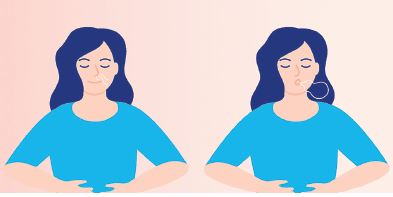
Modern medicine and ancient wisdom rarely converge with such simplicity as they do in the act of breathing. A recent study from Stanford Medicine has rekindled interest in the “cyclical sigh,” a breathing technique that may offer as much solace as any pill or therapy session. At its core, the practice is straightforward: inhale deeply through the nose, take a second small sip of air to fill the lungs completely, and exhale slowly through the mouth until no air remains. Repeat the cycle for five minutes.
The science is clear: long exhalations stimulate the parasympathetic nervous system, lowering heart rate and calming the body’s alarm system.
BREAKING THE ANXIETY SPIRAL
Modern neuroscience shows that anxiety is not merely a mental state but a full-body physiological cascade. Imagine the everyday triggers: a terse email from a superior or an unexpected call from your child’s school. The mind reacts with alarm, and the body follows suit. Heart rate accelerates, breathing grows shallow, muscles contract, palms sweat, and restlessness creeps in. These are classic symptoms of sympathetic nervous system activation—the so-called “fight-or-flight” response (McEwen, 2007, Annals of the New York Academy of Sciences).
For individuals predisposed to anxiety disorders, this bodily shift can become a trap. As Stanford researcher Dr. David Spiegel, Director of the Center on Stress and Health, notes, the awareness of bodily distress often triggers a feedback loop: “As soon as you notice what’s going on in your body, your brain thinks, ‘Oh no, this must be really bad,’ and you get more anxious.” The cycle resembles a snowball rolling downhill—small at first, but gathering size and momentum until it feels unmanageable(Univ of California Berkeley). An anxiety attack, as they call it.
What makes this spiral particularly potent is the role of interoception—the brain’s monitoring of internal bodily states. A landmark study by Paulus and Stein (2010, Nature Reviews Neuroscience) found that heightened sensitivity to bodily signals, such as a racing heart, strongly predicts vulnerability to anxiety disorders. The brain misinterprets these normal stress responses as catastrophic, thereby reinforcing the cycle.Yet the same body that generates this loop also provides the key to escaping it.
By consciously altering breathing patterns, individuals can send calming signals back to the brain and slow the runaway stress response.
Research in psychophysiology has consistently shown that slow, deliberate exhalation stimulates the vagus nerve, activating the parasympathetic nervous system—the branch responsible for “rest and digest” functions (Porges, 2011, Neurophysiological Foundations of Emotions).The Stanford protocol, popularised in recent clinical studies (Spiegel et al., 2023, Cell Reports Medicine), demonstrates how “cyclical sighing” offers a particularly efficient intervention.
The technique is elegantly simple yet physiologically profound:
In Inhale slowly through the nose until the lungs feel comfortably full.
In Take a second, smaller sip of air—a top-up breath that maximises lung expansion.
in Exhale very slowly through the mouth, extending the out-breath until no air remains.
Even after one or two such breaths, participants report noticeable calm. But the science suggests that sustained practice—around five minutes of repeated cycles—produces the most reliable effects.
In the Stanford trial, daily five-minute sessions of cyclical sighing significantly reduced anxiety and improved mood compared with mindfulness meditation or simple deep breathing (Spiegel et al., 2023). The mechanism is twofold. First, prolonged exhalation increases heart rate variability (HRV), a key biomarker of resilience against stress. Higher HRV is correlated with better emotional regulation and lower all-cause mortality (Thayer et al., 2012, Psychological Science). Second, focusing on the rhythm of breath quiets the default mode network—the brain circuitry associated with rumination and worry (Brewer et al., 2011, PNAS).
WHAT OLDER TRADITIONS SAY
These findings align with older traditions of controlled breathwork. Yogic practices such as Pranayama and Taoist qi gong have long emphasised lengthened exhalations as a way to harmonise body and mind. Modern science, now provides the biological rationale: breath is a lever through which humans can regain mastery over the stress response.
By repeatedly breaking the feedback loop of bodily alarm and catastrophic thought, it retrains the nervous system. Anxiety ceases to be an unstoppable downhill spiral and becomes a series of signals that can be noticed, modulated, and calmed. As Dr. Spiegel observes: “When we teach people to control the physical effects of a stressor on their body, it puts them in a better position to deal with the stressor itself.” In other words, calmness begins not with conquering the mind’s thoughts but with reshaping the breath that underlies them.This matters because stress is not merely psychological. For many with anxiety, physical sensations such as racing heartbeats or shallow breaths trigger a cascade of fears, as though each tremor in the body confirms catastrophe. By focusing on the mechanics of breathing, the mind is coaxed away from its spirals of self-perpetuating worry.
Participants reported a 15–20% drop in anxiety scores (measured by the State-Trait Anxiety Inventory) and exhibited lower resting heart rates and improved heart-rate variability—a clinical marker of resilience. Even more striking was the speed of the effect: subjects reported measurable calm after only a few cycles, though the full benefits accrued over weeks of practice.
What Stanford is documenting with brain scans and biomarkers, the yogis of India and the masters of Tai Chi in China have practiced for centuries. Yogic pranayama—literally, the expansion of vital energy—contains techniques strikingly similar to cyclical sighing. The ujjayi breath, where the practitioner takes slow, deep inhalations followed by lengthened exhalations, is known to produce a state of calm alertness. More striking still is nadishodhana, or alternate nostril breathing, which balances the two hemispheres of the brain, producing measurable effects on heart-rate variability—a modern biomarker of resilience.
Tai Chi, often described as “meditation in motion,” integrates breath with slow, deliberate movement. The emphasis on breathing from the diaphragm, rather than the chest, activates the same parasympathetic pathways as Spiegel’s sighs. Neuroscientific studies from Yale and Harvard have shown that controlled breathing reduces activity in the amygdala, the brain’s threat-detection hub, while strengthening prefrontal regions involved in rational decision-making.
As societies wrestle with epidemics of stress and burnout, the evidence suggests that solutions may be as close as the next breath.
(Views expressed are the author’s own).
Parneet Sachdev, IRS is the Chairman of Real Estate Regulatory Authority and a leading author.
Start your day with The Savera Morning Brief, bringing you the latest news from India and around the...

The Delhi Police Crime Branch will investigate a second case against Cockroach Janta Party leaders Saurav Das and...

Punjabi University is proud to have four of its scientists recognized among the nation’s 15 best scientists. The...

The Food Safety and Standards Authority of India (FSSAI) has issued notices to four companies, including the fast-track...

CJP leaders Saurav Das and Ashutosh Ranka are due to appear before a Special Executive Magistrate at 2...

Stay updated with The Savera Morning Brief, bringing you the top headlines from India and around the world,...
Aries: The day will be auspicious...