Last Updated: October 21, 2026
Last Updated: October 21, 2026






There are mathematical models to better understand the effects of interruptions to the body’s circadian rhythms such as daylight savings time, working night shifts, jet lag, or even late-night phone scrolling.
The University of Waterloo and the University of Oxford researchers have created a novel model to aid scientists in better understanding the robustness of the brain’s master clock: the cluster of neurons in the brain that coordinates the body’s other internal rhythms. They also want to offer approaches to help individuals with weak or damaged circadian rhythms increase their resilience. Sustained disruptions to circadian rhythm have been linked to diabetes, memory loss, and many other disorders. “Current society is experiencing a rapid increase in demand for work outside of traditional daylight hours,” said Stéphanie Abo, a PhD student in applied mathematics and the study’s lead author, adding, “This greatly disrupts how we are exposed to light, as well as other habits such as eating and sleeping patterns.”
Humans’ circadian rhythms, or internal clocks, are the roughly 24-hour cycles many body systems follow, usually alternating between wakefulness and rest. Scientists are still working to understand the cluster of neurons known as the Suprachiasmatic Nucleus (SCN) or master clock.
Using mathematical modelling techniques and differential equations, the team of applied mathematics researchers modelled the SCN as a macroscopic, or big-picture, system comprised of a seemingly infinite number of neurons. They were especially interested in understanding the system’s couplings – the connections between neurons in the SCN that allow it to achieve a shared rhythm.
Good Evening Viewers! Catch up on the day's biggest stories with The Savera Times Evening Bulletin. Get the...

Congress leaders continued their protest outside the Jaipur Police Commissionerate on Tuesday, demanding the registration of a zero...

On the auspicious occasion of Vijayadashami, Prime Minister Narendra Modi on Tuesday called on the countrymen to unite...

A historic milestone was achieved on Tuesday in the expansion of Chhattisgarh's rail networkA historic milestone was achieved...

Model Shraddha Dubey, one of the main accused in the death of Lucknow businessman Shiv Sharma, has been...

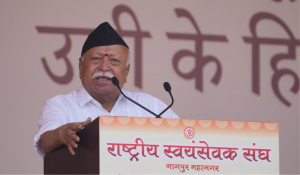
Rashtriya Swayamsevak Sangh (RSS) chief Mohan Bhagwat on Tuesday called for strengthening national unity, social harmony, indigenous practices...
Aries: The day will be auspicious...