Last Updated: October 21, 2026
Last Updated: October 21, 2026





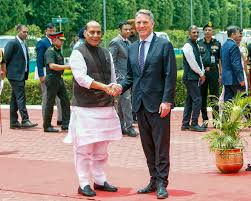
Australia and India agreed to hold an annual Defence Ministers’ Dialogue, joint exercises across numerous domains and closer co-operation on information sharing during the inaugural Defence Minister’s Dialogue. Defence partnerships do not move this fast by accident but because the strategic logic demands it. Released in April, Australia’s 2026 National Defence Strategy has stated the Northeast Indian Ocean as part of Australia’s primary area of military interest. The strategy has named India as a ‘top-tier security partner’ and the most ‘important defence partner’ in that region. The reasoning is clear. China’s military build-up, described in the strategy as the largest in the world today, is increasingly visible in the Indian Ocean. The People’s Liberation Army Navy’s submarines ¬patrol the region; Chinese research vessels survey its seabed; Beijing’s strategic reach extends well ¬beyond the Malacca Strait. Australia’s trade routes run through these waters, and both countries are ¬resident maritime powers. This shared geography, and shared threat, creates a set of practical opportunities for deeper co-operation. Maritime security is the obvious one, and the most developed. Australian and Indian maritime patrol aircraft now conduct collaborative anti-submarine warfare activities. The two countries are progressing an agreement on air-to-air refuelling. The Joint Maritime Security Collaboration Roadmap, discussed at the October meeting, points towards more sustained co-operation in the maritime domain across the region. The report highlighted that, for India and Australia, defence industry is the most consequential opportunity, and the most complex as well. India’s defence-industrial sector is a growing ecosystem of public shipyards, large manufacturers, defence start-ups, and Make in India policy, that focuses on technology transfer, local production, and indigenisation as conditions of ¬access. Australian defence industry is small, export-oriented, and generally sells finished capability instead of co-developing it in someone else’s industrial policy. The top-down approach would be needed from governments of India and Australia for meeting the unrealised potential. Australia’s Deputy Prime Minister and Minister for Defence, Richard Marles is travelling to India later this week for the second Australia-India Defence Ministers’ Dialogue. Marles stated that he is looking forward to meet Defence Minister Rajnath Singh during his visit to India. Australia and India are top-tier security partners. I look forward meeting with Defence Minister Rajnath Singh to further strengthen our defence partnership following the strong progress we made during his visit to Australia last year. Highlighting that the first AustraliaIndia Defence Ministers’ Dialogue was held in Australia last October, the Australian Defence Ministry stated on Thursday that the meeting showcases unprecedented progress in the bilateral defence partnership and a shared ambition to enhance cooperation.
New Delhi: US Secretary of State Marco Rubio has assured India that America’s relations with any country in...

The family of 5-year-old Fabiana Cabello in New York City, USA, is in deep shock after her death....

A Cessna 177A crashed onto Capitol Expressway in San Jose on October 17. Three people on board, including...

Protests in Jakarta, Yogyakarta and Bandung brought students onto the streets over rising costs, forest fires and civil...
Organisations linked to Neville Roy Singham are under US congressional scrutiny over funding. Their coverage of protests in...

US President Donald Trump says Washington and New Delhi are close to a trade agreement that will differ...

Aries: The day will be auspicious...