Last Updated: October 23, 2026
Last Updated: October 23, 2026





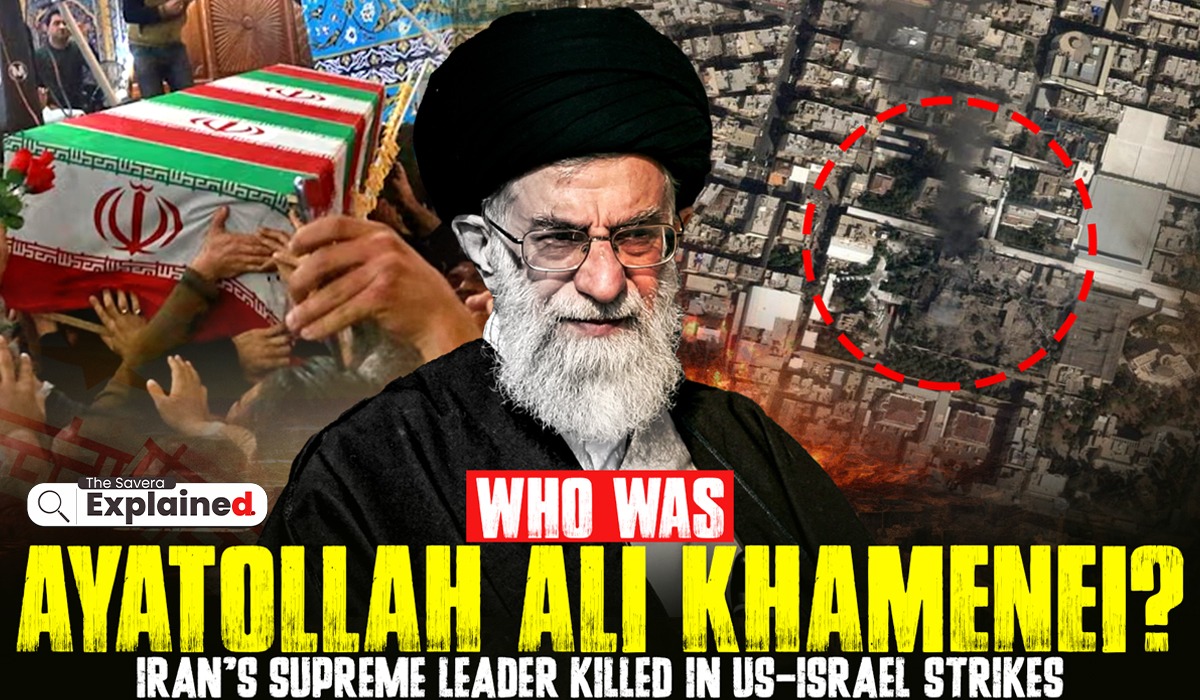
On February 28, 2026, Iran’s state media confirmed that Ayatollah Ali Khamenei, the country’s Supreme Leader for nearly four decades, was killed in joint military strikes by the United States and Israel.
The surprise operation targeted his compound in Tehran and other military sites, killing senior officials and members of his family.
Iran has declared 40 days of national mourning, while the U.S. and Israel describe the attack as a critical blow to what they called a dangerous regime. The strikes sparked protests around the world — some grieving his death, others celebrating it.
Who Was Ayatollah Ali Khamenei?
Early Life:
Ali Khamenei was born on April 19, 1939, in Mashhad, Iran, a deeply religious city. Raised in a cleric’s family, he entered Islamic religious schools as a child and studied theology, Arabic, and Quranic teachings.
He trained under senior clerics in the holy city of Qom, including Ayatollah Ruhollah Khomeini, the leader of Iran’s 1979 Islamic Revolution.
Revolutionary Begins:
In the 1960s and 1970s, Khamenei became active in politics opposing the Shah of Iran — the Western‑aligned monarch then in power.
He was arrested multiple times for anti‑Shah activity, gaining support among students and religious conservatives. When the 1979 Islamic Revolution overthrew the Shah, Khamenei emerged as a trusted supporter of Ayatollah Khomeini.
From Cleric to President and then Supreme Leader
Political Rise:
After the revolution, Khamenei became part of Iran’s new ruling elite. He served in key roles including deputy defence minister and was a driving force behind the formation of the Islamic Revolutionary Guard Corps (IRGC) — a powerful military and political institution in Iran.
In 1981, after the assassination of Iran’s president, Khamenei was elected President of Iran. He served two terms until 1989, navigating the country through the brutal Iran‑Iraq War and solidifying his status in the political system.
Becoming Supreme Leader:
When Ayatollah Khomeini died in 1989, the Assembly of Experts selected Khamenei as Iran’s new Supreme Leader — the highest authority in the country.
To allow his appointment, Iran’s constitution was amended so that a leader did not have to be the highest‑ranking cleric. As Supreme Leader, Khamenei had ultimate control over the military, judiciary, and foreign policy — a role far more powerful than president.
What Did He Stand For?
Domestic Rule:
Under Khamenei’s leadership, Iran’s system became tightly controlled. Political opposition was often suppressed, media were restricted, and protests over elections and economic hardship were frequently cracked down on.
Foreign Policy:
Khamenei’s foreign policy was defined by deep hostility toward the U.S. and Israel. He backed militant groups in the Middle East — including Hezbollah in Lebanon and Hamas in Gaza — as part of Iran’s strategy to challenge Western influence and support the Palestinian cause. Iran’s nuclear program also expanded under his watch, raising tensions with the West, which feared Tehran might develop nuclear weapons.
Why Was He Targeted by the U.S. and Israel?
The U.S. and Israel saw Khamenei as a major threat for several reasons:
What Happens Next?
With Khamenei’s death, Iran faces an uncertain transition. A new Supreme Leader must be chosen, but rival factions — clerics, military leaders, and political elites — could clash over who fills the power vacuum. The strikes have triggered retaliatory attacks and raised fears of broader regional war.
Ayatollah Ali Khamenei was Iran’s Supreme Leader since 1989, shaping decades of Iranian politics with a mix of religious authority, political control, and regional influence. His death in U.S.–Israel strikes marks a major turning point in Middle Eastern geopolitics and could reshape the future of Iran and its relations with the world.
The Indian Army on Friday rejected claims on social media that the Army had taken action against the...
Abdul Majid Hakim Elahi, Iran's Supreme Leader's representative and senior diplomat, said on Friday that the US has...
New York, USA: The New York City Council has passed a law to ban horse-drawn carriages, naming the...

Washington: US President Donald Trump suggested that further military action against Iran remained possible, while acknowledging that the...
Lhasa: Sixteen people were killed and 32 others injured after a 7.0-magnitude earthquake struck Tibet on Thursday, according...
More than two weeks after the Yemeni government launched a major offensive against the Houthi group, front lines...
Aries: The day will be auspicious...