Last Updated: October 18, 2026
Last Updated: October 18, 2026





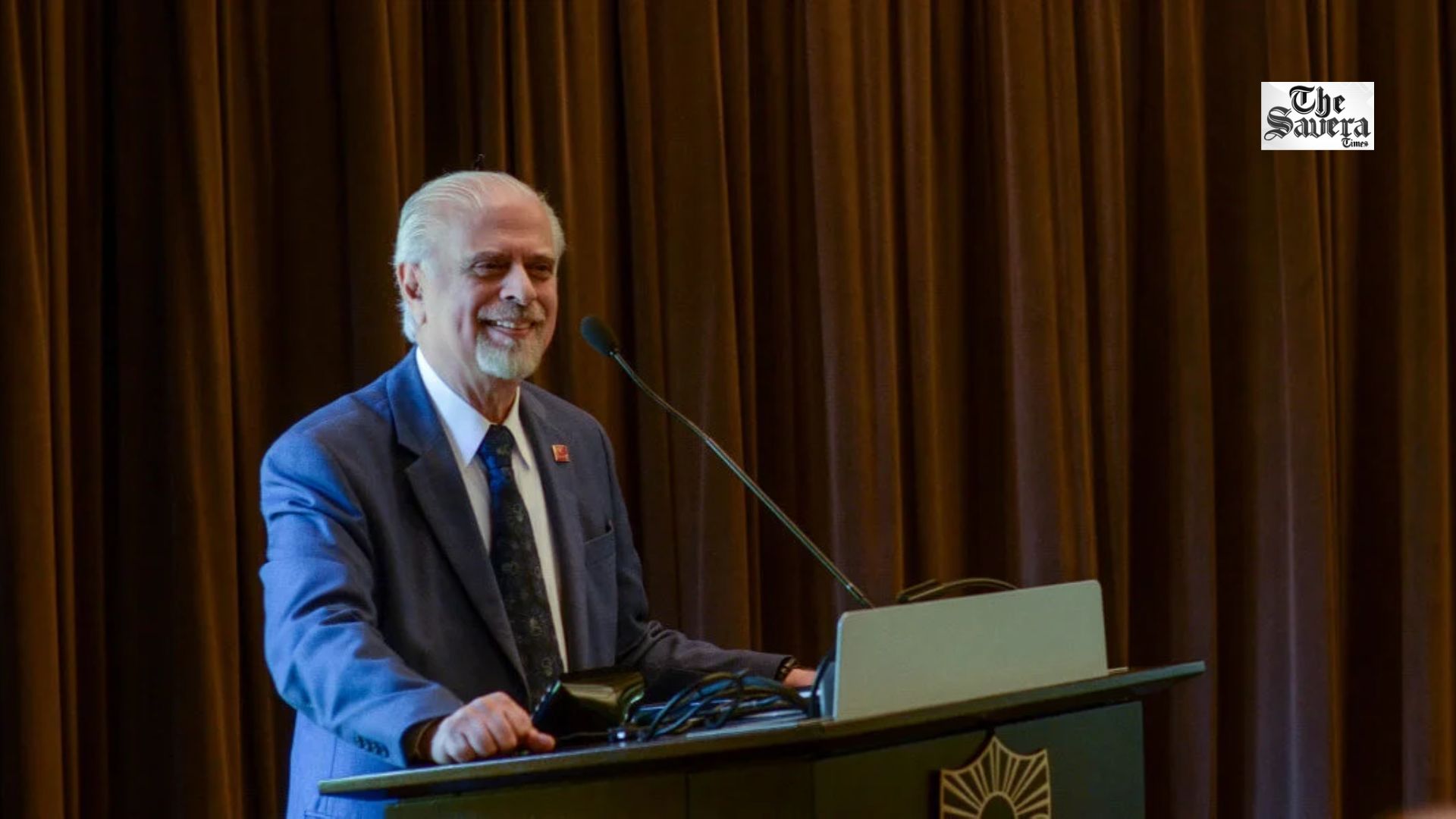
Washington: An engineer who grew up in Mumbai has received one of the most prestigious honours in the engineering profession. Azad M. Madni, an Indian-American engineer and University Professor at the University of Southern California (USC), has been awarded the 2026 John Fritz Medal for his contributions to systems engineering.
Often described as the “Nobel Prize of Engineering”, the John Fritz Medal was established in 1902 to recognise individuals whose work has made a significant contribution to human progress. Previous recipients include renowned inventors and technology leaders such as Thomas Edison, Alexander Graham Bell, Claude Shannon, Gordon Moore, Andrew Viterbi and Elon Musk, according to USC’s Viterbi School of Engineering.
Madni was recognised for his pioneering work in transdisciplinary systems engineering, an approach that brings together knowledge and techniques from different fields to develop solutions for complex problems.
According to the university, his award citation highlights his contributions through the convergence of different disciplines, augmented intelligence, green learning and interactive storytelling in virtual worlds.
USC President Beong-Soo Kim congratulated Madni, saying his work had helped transform the way complex systems are designed. He added that the honour recognised the innovation and impact that had shaped Madni’s career.
Gaurav Sukhatme, interim dean of USC’s Viterbi School of Engineering, also welcomed the recognition, noting that the school’s namesake, Andrew Viterbi, received the same medal in 2011. He said Madni’s achievement continued USC’s legacy of engineering innovation.
From Mumbai Classrooms to a Career in Aerospace
Madni’s journey began in Mumbai, where he attended St. Mary’s High School before studying science at St. Xavier’s College. His interest in aerospace engineering grew after he heard US President John F. Kennedy’s 1962 speech outlining the goal of sending a man to the Moon.
Inspired by the speech, Madni moved to the United States in 1965 to pursue engineering studies at the University of California, Los Angeles (UCLA). He completed his bachelor’s degree in 1968, his master’s degree in 1971 and his doctorate in 1978.
In an oral history interview with the Institute of Electrical and Electronics Engineers (IEEE), Madni recalled that pursuing a doctorate was also important for his immigration prospects at the time.
“At that time, the only option available to get a green card was to pursue a doctorate, with proof of two-year self-support,” he said.
His academic training later helped him build a career spanning aerospace, research, entrepreneurship and university teaching.
Contributed to NASA’s Space Shuttle Programme
Madni began working at Rockwell International, where he contributed to NASA’s Space Shuttle programme. His work included developing a model-based approach to testing the shuttle’s navigation system, helping address the challenges involved in evaluating complex aerospace technology.
He later led research at Perceptronics before founding Intelligent Systems Technology, Inc. in 1994. In 2009, he joined the University of Southern California, where he continued his work in systems engineering and interdisciplinary research.
At USC, Madni serves as executive director of the university’s Systems Architecting and Engineering Program. His work focuses on bringing together different areas of expertise to improve the design and development of complex systems.
A Career Recognised Across Engineering
The John Fritz Medal adds to a long list of honours received by Madni during his career. He is a member of the US National Academy of Engineering and has also received the NAE Gordon Prize, the IEEE Simon Ramo Medal and the ASME Spirit of St. Louis Medal.
At USC, he holds joint and courtesy appointments across engineering, medicine and education. He also serves as the Northrop Grumman Foundation Fred O’Green Chair in Engineering.
Madni’s recognition highlights a career that began with his education in Mumbai and developed through decades of work in aerospace technology, systems engineering and research. The 2026 John Fritz Medal acknowledges his contributions to a field that increasingly relies on collaboration across disciplines to tackle complex technological challenges.
Nairobi: Kenya’s Ministry of Health on Saturday confirmed four new cases of Ebola Bundibugyo virus disease, bringing the...
Increasing Houthi attacks on Saudi Arabia are testing Pakistan’s ability to defend Riyadh without affecting its ties with...
Nepal is seeking substantial financial assistance from India ahead of Prime Minister Balendra Shah’s proposed visit to New...

The race to succeed Antonio Guterres remains uncertain after three leading candidates faced opposition from two permanent members...

Democratic lawmakers have criticised Donald Trump for waiving key sanctions and tariff provisions under the Graham Act, citing...

Shipping Minister Sarbananda Sonowal confirmed that all 24 Indian seafarers aboard two vessels struck in separate incidents in...

Aries: The day will be auspicious...