Last Updated: October 22, 2026
Last Updated: October 22, 2026





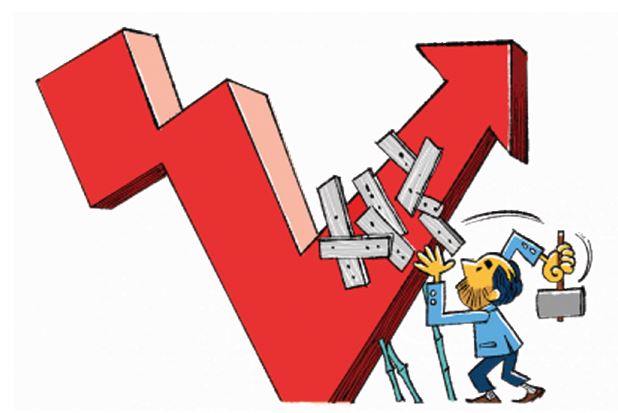
Over a year after the ousting of former Prime Minister Sheikh Hasina, Bangladesh continues to grapple with deepening economic distress. A new assessment by the Asian Development Bank (ADB) warns that the country is facing one of its gravest financial crises in recent memory, with all three pillars of its economy—the banking sector, non-bank financial institutions (NBFIs), and the stock market—trapped in instability despite efforts by the Muhammad Yunus-led government to restore order.
At the heart of this crisis lies a cycle of defaulted loans, corruption, weak regulation, and political influence, which has left the system vulnerable and shaken public confidence. With elections scheduled next year, the government’s ability to stabilise the economy remains under scrutiny.
Banking Sector in a Default Trap
Bangladesh’s banking industry is at the centre of the storm. According to Bangladesh Bank, defaulted loans reached Tk 6 lakh crore by June 2024, while another Tk 3.18 lakh crore remains hidden under various legal and accounting mechanisms. This includes Tk 1.78 lakh crore tied up in money loan courts, Tk 80,000 crore written off, and Tk 60,000 crore under court stays.
Financial experts trace the problem back to years of lax policies and political interference, with many influential business groups accused of taking loans without repayment. A Bangladesh Bank official told The Dhaka Tribune that under the previous government “widespread looting” had occurred in the name of loans. In response, the Yunus administration has proposed reforms, including dropping the definition of “wilful defaulter” in the new Banking Company Act 2023, a move that has sparked debate.
Bangladesh Bank Governor Dr Ahsan H Mansur has pledged to bring greater transparency. “From now on, no information will be kept secret. All defaulted loans will be made public, and strict recovery efforts will be carried out,” he said.
ADB Raises Alarm
The Asian Development Bank’s report paints a bleak picture. It states that 20.2 per cent of all disbursed loans defaulted in 2024, up 28 per cent from the previous year. With this, Bangladesh now ranks as having the highest volume of defaulted loans in Asia. The ADB described the country’s banking system as the “weakest in Asia,” urging structural reforms similar to those implemented in India.
Former World Bank economist Dr Zahid Hussain warned that without bold steps, the crisis will persist. “The stricter the rules, the more the number of defaulted loans increases. Without bold reforms, this will not end,” he said.
In an attempt to contain the damage, the central bank has merged five Islamic banks—First Security, Social Islami, Global Islami, Union, and Exim—into a new state-owned institution, United Islami Bank. These banks had default rates ranging from 48 to 98 per cent. Governor Mansur sought to reassure depositors, stating that the government would take full responsibility and that there was “nothing to panic about.”
NBFIs Caught in the Ripple Effect
The crisis has not spared the non-bank financial institutions sector, where problems appear even more severe. According to Bangladesh Bank, defaulted loans of 20 troubled NBFIs stand at Tk 21,462 crore, representing 83 per cent of their total loan portfolios.
The central bank has recommended liquidating nine of these institutions, as many are unable to repay depositors. Experts describe the sector as virtually bankrupt, with confidence collapsing further as institutions fail to honour commitments. By December 2024, the total debt of these 20 NBFIs was Tk 25,808 crore, but available collateral was only Tk 6,899 crore, just 26 per cent of the total debt.
Officials have warned that unless urgent steps are taken to protect depositors, the entire sector risks collapse.
Stock Market Under Prolonged Stress
The third pillar of the economy, the stock market, is also in disarray. Over the past 16 years, Bangladesh’s stock market has shrunk by 38 per cent, with investors losing capital at an average rate of 3 per cent annually. According to the Dhaka Stock Exchange (DSE), shares of 98 out of 397 listed companies now trade below the face value of Tk 10, with more than half valued under Tk 5.
Market observers say this reflects the dominance of weak firms and junk stocks. “The fact that so many shares are trading below face value shows these companies are not performing. Investors are leaning toward a few strong firms,” said Kazi Monirul Islam, CEO of Shanta Asset Management.
Saiful Islam, president of the DSE Brokers Association of Bangladesh, argued that the glut of junk stocks is discouraging both foreign and institutional investors. “Weak companies need to be closed or merged quickly, and strong new companies must be introduced,” he said.
An Uncertain Future
The Yunus government has pledged reforms, but the scale of the challenge is daunting. With the banking sector mired in defaults, the NBFIs nearly bankrupt, and the stock market eroded, public and investor confidence is at a low ebb.
While authorities attempt to reassure the population, experts remain concerned that without sweeping reforms and strong enforcement, Bangladesh’s economy will struggle to recover. As the country moves towards elections, the financial instability underscores the urgency of decisive action.
For now, the ADB’s warning highlights the scale of the crisis: Bangladesh’s economy, once a model of growth in South Asia, now risks being dragged down by systemic weaknesses it can no longer afford to ignore.
Pakistan's Defense Minister Khawaja Asif has questioned alleged plans by senior government officials to permanently settle abroad. He...
The Baloch Liberation Army (BLA) has claimed responsibility for carrying out 34 operations between October 9 and 20...
Russian President Vladimir Putin said on Wednesday that Russia's first tanker carrying 40,000 tons of diesel fuel will...

Ten people were killed and 44 others injured in a horrific road accident in Pakistan's Punjab province. The...

North Korean leader Kim Jong-un's influential sister, Kim Yo-jong, and a military marshal inspected fortification work along the...

New Delhi: US Secretary of State Marco Rubio has assured India that America’s relations with any country in...
Aries: The day will be auspicious...