Last Updated: October 22, 2026
Last Updated: October 22, 2026





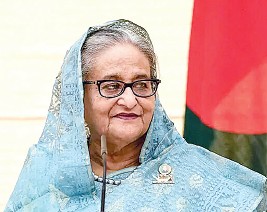
Ousted Bangladeshi Prime Minister Sheikh Hasina has strongly criticised the policies of Muhammad Yunus, calling his actions “foolish and self-defeating” for Bangladesh’s diplomatic ties with India. In an interview with PTI, Hasina said India has “always been Bangladesh’s most important international relationship,” adding that Yunus’ hostility towards India is a reflection of his weak and unelected position.
Hasina, who fled to India last year amid weeks of anti-government protests and escalating street violence, said the Islamist mobs that had opposed her joined forces with the military to bring Yunus to power as an unelected ruler. She highlighted that, under Yunus, extremist elements previously marginalised have been mainstreamed, several convicted terrorists have been released, and attacks on religious minorities, including Hindus, have continued unabated.
The former Prime Minister expressed concern over the political retribution directed at her party, the Bangladesh Awami League (BAL), which Yunus’ government has banned under an anti-terrorism law. She described the ban as a “huge missed opportunity” at a time when Bangladesh is preparing for elections, stressing that tens of millions of citizens support the Awami League and that it must remain part of the political conversation in the country.
“Whether in government or in opposition, the Awami League needs to be part of the political dialogue in Bangladesh. This foolish ban should be rescinded,” she said. Hasina noted that elections have been scheduled for February 2026, but she expressed doubts over their legitimacy as a principal political party has been outlawed and ongoing political retribution continues.
Describing Yunus as “unelected, chaotic, and dependent upon extremists,” Hasina said his approach undermines Bangladesh’s stability and international relationships. “His hostility towards India is extremely foolish and self-defeating, and it exposes him as a weak monarch clinging to power through extremist support,” she said. Despite Yunus’ actions, she expressed confidence that the “broad and deep” ties between India and Bangladesh will survive his tenure. “The India-Bangladesh relationship is robust and will endure the foolhardiness of this interlude,” she added.
Addressing concerns over her safety and the hostile environment in Bangladesh, Hasina said Yunus’ regime does not represent the views of ordinary citizens. “India remains, and will remain, our nation’s most important friend,” she said, expressing gratitude to the Indian government and people for providing refuge and support during this period.
On legal matters, Hasina dismissed the International Crimes Tribunal (ICT) proceedings initiated against her, calling them a “kangaroo tribunal” controlled by political opponents. She pointed out that prosecutors in the tribunal have sought the death penalty to neutralise her and the Awami League. Hasina further stated that she has challenged Yunus’ government to bring her case to the International Criminal Court (ICC), which she believes would acquit her due to its impartiality.
Regarding her return to Bangladesh, Hasina made it clear that the restoration of “participatory democracy” is essential. She said the ban on the Awami League must be lifted and free, fair, and inclusive elections conducted before she considers coming back. “The primary condition for my return is the same as that required by the Bangladeshi people: a return to participatory democracy, the lifting of restrictions on the Awami League, and the conduct of free and inclusive elections,” she stated.
Reflecting on the protests that led to her ouster, Hasina stressed the importance of learning lessons from the events while noting that “some responsibility lies with so-called student leaders, who in reality were seasoned political firebrands whipping up the crowds.” She condemned the violence but also underscored the broader political failures that allowed the unrest to escalate.
Hasina reiterated her commitment to Bangladesh’s democratic and pluralistic values, highlighting the need to protect religious minorities, maintain the rule of law, and ensure political inclusivity. She expressed hope that once political normalcy is restored, her party will be able to participate fully in Bangladesh’s political system and contribute to the nation’s governance.
In her assessment, while the current regime under Yunus represents an aberration, the fundamental India-Bangladesh relationship remains resilient. Hasina urged both domestic and international stakeholders to encourage a return to inclusive governance and democratic norms, emphasizing that Bangladesh’s long-term stability and prosperity depend on participatory political processes and protection of civil liberties.
She concluded by thanking the Indian government once again for its hospitality and support, reaffirming the enduring bond between the two nations and stressing that “where humanity is at stake, standing for it is the true essence of governance and leadership.”
Pakistan's Defense Minister Khawaja Asif has questioned alleged plans by senior government officials to permanently settle abroad. He...
The Baloch Liberation Army (BLA) has claimed responsibility for carrying out 34 operations between October 9 and 20...

Russian President Vladimir Putin said on Wednesday that Russia's first tanker carrying 40,000 tons of diesel fuel will...

Ten people were killed and 44 others injured in a horrific road accident in Pakistan's Punjab province. The...
North Korean leader Kim Jong-un's influential sister, Kim Yo-jong, and a military marshal inspected fortification work along the...

New Delhi: US Secretary of State Marco Rubio has assured India that America’s relations with any country in...

Aries: The day will be auspicious...