


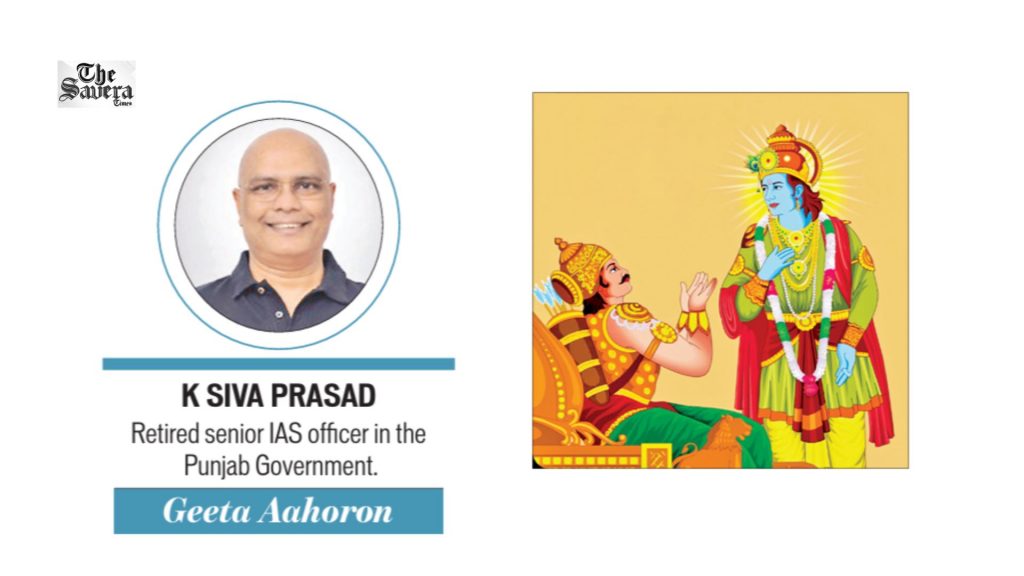
Lord Krishna explains that true spiritual wisdom lies not in abandoning action, but in performing one’s duties without attachment to their outcomes. In the Bhagavad Gita, he emphasises that a person who acts with a calm and balanced mind can attain inner purity, lasting peace and freedom from bondage. In Chapter 5, Verse 11, Krishna says that yogis perform actions through the body, mind, intellect and senses, giving up attachment, for the purification of the inner self. This teaching suggests that even when a person begins to abandon attachment in the present moment, the influence of past actions and their consequences may still remain. Therefore, continuing to perform one’s duties becomes necessary. Another way to understand this teaching is that once a person becomes truly detached, there is nothing left to acquire in the material or external world. Every action then becomes an opportunity for the purification of the inner self rather than a means of fulfilling personal desires. Krishna further explains in Verse 12 that a person who is disciplined and gives up attachment to the fruits of action attains lasting peace, while one who is undisciplined, driven by desires and attached to results becomes bound by those actions. One of the central spiritual messages of the Bhagavad Gita is that human beings have control over their actions, but not over their results. Krishna expresses this principle in Verse 47 of Chapter 2, where he teaches that a person has the right to perform actions but should not consider himself entitled to their fruits. Renouncing the fruits of action does not necessarily mean becoming indifferent to the outcome. Rather, it means accepting whatever result emerges without allowing personal preferences, expectations or fears to disturb one’s inner balance. A person may work sincerely towards a particular goal, but the final outcome may be different from what was expected. The spiritual challenge is to remain balanced in both success and failure, happiness and sorrow, or favourable and unfavourable circumstances. Krishna had earlier explained in Verse 66 of Chapter 2 that a person who lacks discipline and a steady understanding cannot attain peace. Without peace, lasting happiness also remains beyond reach. In Verse 13 of Chapter 5, Krishna describes a person who has disciplined the inner self through the practice of Sankhya Yoga. Such a person mentally renounces all actions while remaining within the body, which is described as a house with nine gates. Though actions continue to take place, the individual remains established in the Supreme Self, experiencing inner happiness. The key to understanding this teaching is the distinction between performing an action and becoming mentally attached to it. A person may continue to work, fulfil responsibilities and participate in worldly activities without allowing the mind to become entangled in the desire for particular results. Krishna’s teaching also draws attention to the countless processes that take place beyond our conscious involvement. After eating, for instance, hundreds of biological activities occur within the body to facilitate digestion. These processes continue without requiring our conscious attention or deliberate participation. Similarly, many actions in life unfold through circumstances and processes beyond individual control. Recognising this can help a person reduce the burden of excessive expectations and the anxiety associated with outcomes. The Bhagavad Gita, therefore, presents detachment not as an escape from responsibility, but as a way of performing duties with sincerity, awareness and inner freedom. By accepting the results of actions with equanimity, a person can remain engaged in the world while gradually moving towards lasting peace and spiritual fulfilment.
Equanimity in accepting the results of actions
Equanimity in accepting the results of actions