Last Updated: October 12, 2026
Last Updated: October 12, 2026





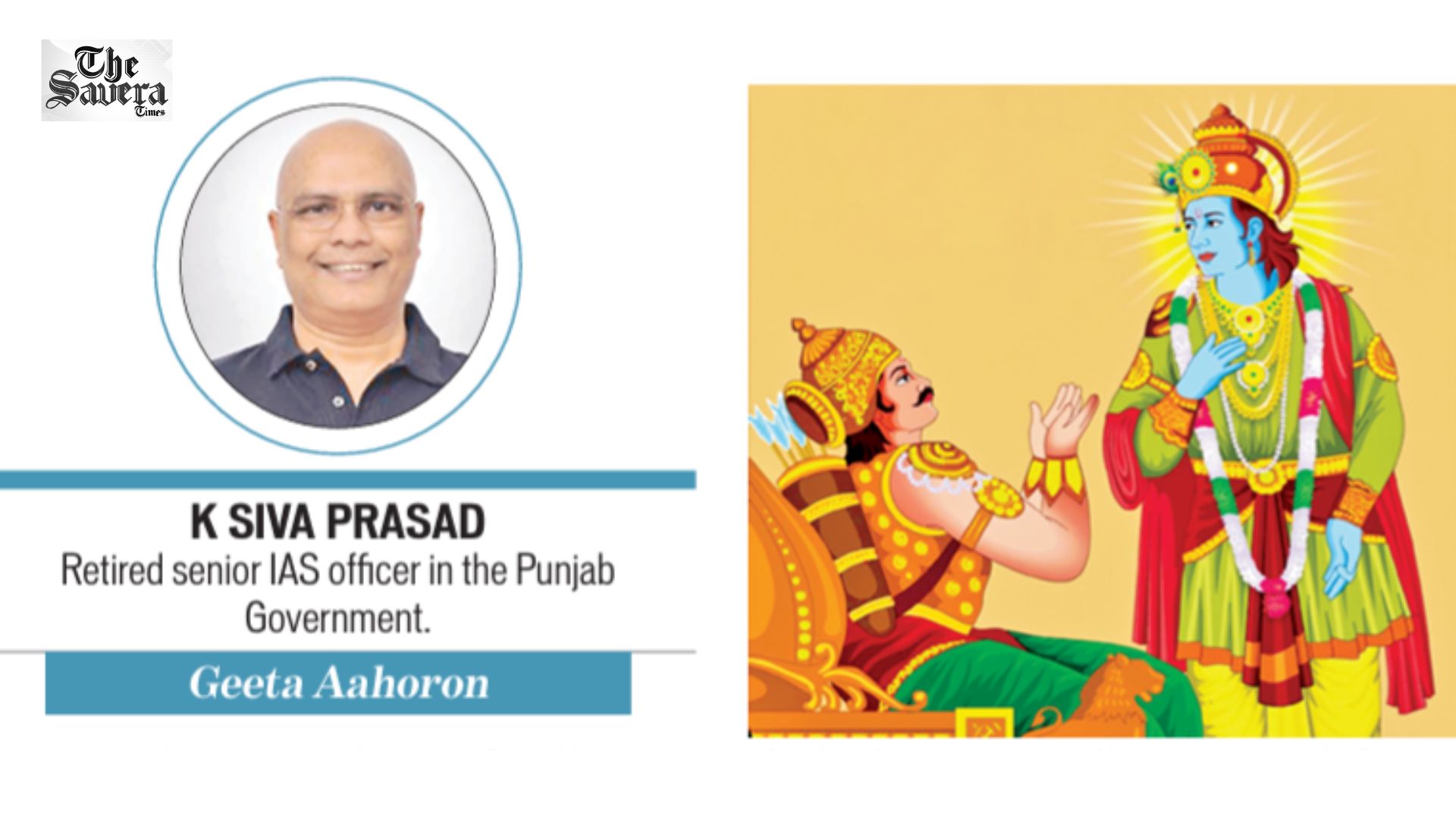
The question of vikarma (forbidden action) or sin is a complex one. Arjuna faces this dilemma and states that killing one’s relatives in battle would be a sin (1.36). In fact, cultures have defined various actions as sins, and this list has changed over time. In the modern era, countries have their own penal codes that define certain actions as crimes or sins.
Failure to comply with the penal code is punishable. When we commit such so-called sins, we punish ourselves with guilt, regret, and shame for a long time. In this context, Sri Krishna says, “One who is hopeless, with a determined mind and body, renouncing all possessions, and performing only physical work, commits no sin” (4.21).
Sri Krishna first spoke about sin and told Arjuna to treat pleasure and pain, gain and loss, victory and defeat equally and fight, thereby committing no sin (2.38). The subtle point to understand in evaluating sin is that we usually evaluate it based on our actions in the material world, whereas for Sri Krishna, it is an internal phenomenon. Our actions are a result of our state of mind, and Sri Krishna encourages us to control our mind. On a philosophical level, this raises many doubts, but on an experiential level, one gains clarity.
Sri Krishna further says, “One who is always content with what comes naturally without desire, who is completely devoid of jealousy, who is completely transcendental to the dualities of joy and sorrow—such a Karmayogi, who is equal in success and failure, is not bound by them even while performing his actions” (4.22). In fact, this verse can be called a microcosm of the Gita, containing all the teachings given in various places in the Gita. Sri Krishna asks us to transcend duality. This means nothing more than using the divisive mind only for physical activities.
One of the most common questions people ask these days is how to lose belly fat. Belly fat...

Turtle doves picking fallen grain from Paddy fields, Cicada chirping on willow trees and the cackle of migratory...

Andre Agassi became one of the greatest tennis players in the world. Agassi’s father, Mike, a former Olympic...
Have you ever wondered how the words you speak can influence your thoughts, emotions, behavior, relationships and even...

Ac There’s no doubt that smoking can cause serious health related problems and also up the risk of...

Are you one of those who exercise daily but are still unable to lose weight? We might have...

Aries: The day will be auspicious...