Last Updated: October 12, 2026
Last Updated: October 12, 2026





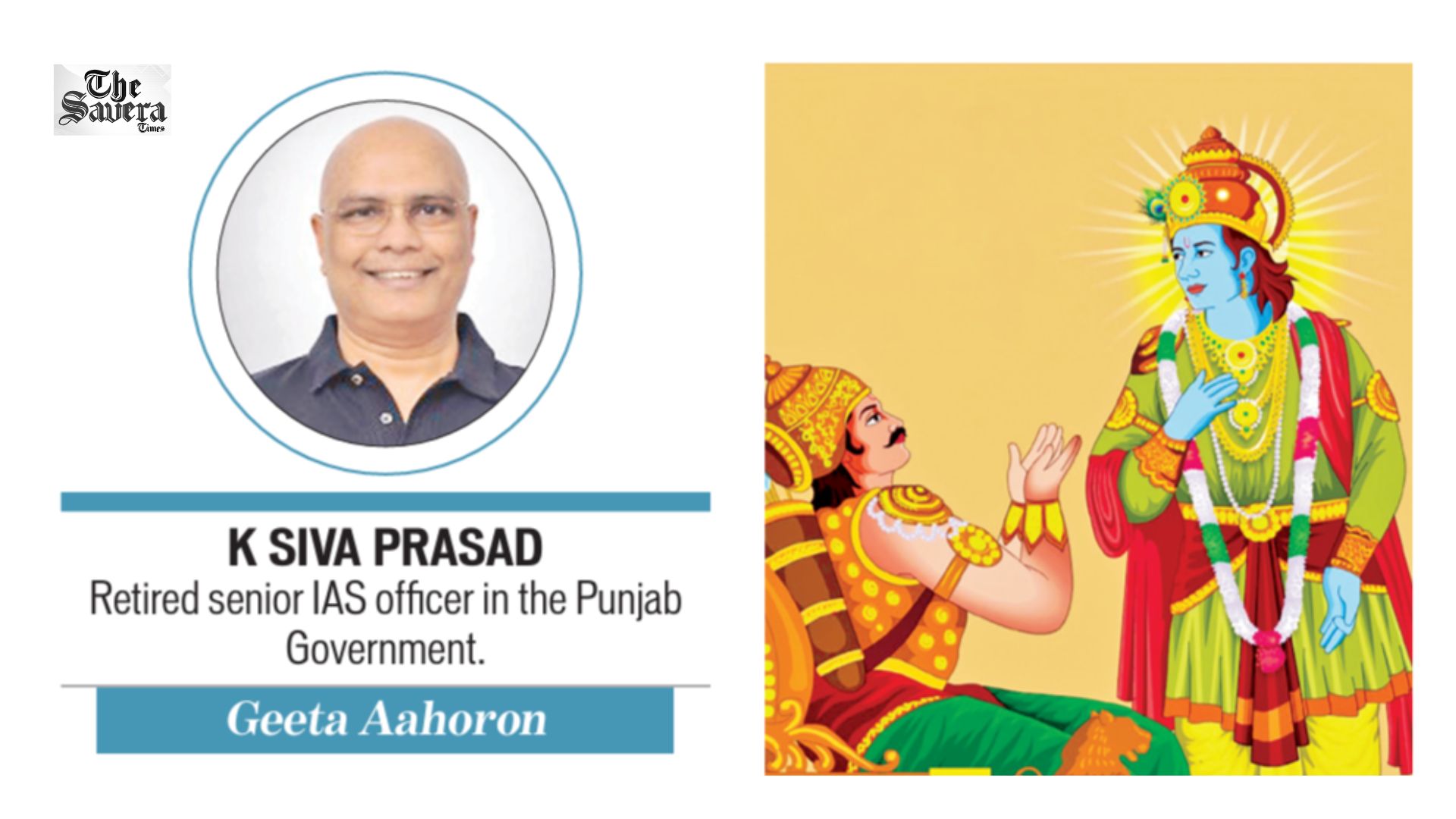
Concepts such as “Anasakti” (nonattachment) and “Veetarag” (freedom from attachment and aversion) lie at the core of the Gita’s teachings. While attachment (aasakti) and detachment (virakti) represent two poles, “Zanasakti” signifies transcending these very poles. Similarly, “Zveetarag” is neither attachment nor aversion, but something that lies beyond both.
These polarities are merely reflections of the ego; by relinquishing this ego, one transcends all dualities. This state is nothing but liberation. In this context, Sri Krishna says, “For one who is liberated, free from attachment, whose mind is established in knowledge, and who acts for the sake of “Yajna” (sacrificial offering/ selfless service), all actions dissolve” (4.23).
The ‘I’ is identified with our possessions, friends and enemies, likes and dislikes, as well as our thoughts and emotions. Letting go of these creates a temporary sense of emptiness, which often gives rise to pain, fear, anger, and resentment. Therefore, relinquishing the ‘I’ is no easy task. Interestingly, it is about letting go of the sense of ownership, identity, and doership—not necessarily the relationships, objects, or people themselves. Liberation dawns only when we grasp this subtle distinction. For the person who has renounced the ‘I’, all selfless actions become nothing but “Yajna”.
Literally, “Yajna” refers to a fire ritual in which offerings are made into the fire. Here, it is used as a metaphor for sacrifice, involving both the act of giving and the act of receiving. We offer oblations to the fire, which in turn provides heat—essential for life-sustaining purposes such as cooking, keeping water in a liquid state, and maintaining body temperature.
The functioning of the human body itself resembles a “Yajna”, where one organ gives and another receives, and all are mutually interdependent. That is why Shri Krishna says that the act of offering, the oblation, the fire, and the agent performing the ritual are all Brahman; indeed, even the destination or result attained is Brahman (424). Relinquishing the ego is the way to liberate oneself and attain Brahman.
One of the most common questions people ask these days is how to lose belly fat. Belly fat...

Turtle doves picking fallen grain from Paddy fields, Cicada chirping on willow trees and the cackle of migratory...

Andre Agassi became one of the greatest tennis players in the world. Agassi’s father, Mike, a former Olympic...

Have you ever wondered how the words you speak can influence your thoughts, emotions, behavior, relationships and even...

Ac There’s no doubt that smoking can cause serious health related problems and also up the risk of...

Are you one of those who exercise daily but are still unable to lose weight? We might have...

Aries: The day will be auspicious...