Last Updated: October 21, 2026
Last Updated: October 21, 2026





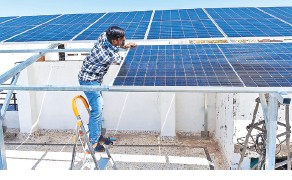
Southern states long regarded as India’s renewable energy leaders are showing an unexpected weakness when it comes to installing rooftop solar on government buildings. Data presented by the Union Ministry of New and Renewable Energy (MNRE) in Parliament reveals that Tamil Nadu and Karnataka, despite their vast solar and wind footprints, are among the country’s slowest performers in solarising public-sector infrastructure under the PM Surya Ghar: Muft Bijli Yojana.
As of November 4, 2025, Tamil Nadu has installed only 13.64 megawatt (MW) of rooftop solar across 1,489 government buildings. Karnataka has achieved 33.68 MW across 2,624 buildings. These numbers place both states well behind top performers such as Uttar Pradesh, which leads with 183.62 MW, followed by Delhi with 140 MW, Rajasthan with 109 MW and Bihar with 110.23 MW. The MNRE clarified that the dataset does not include household installations under PM Surya Ghar, launched in February 2024, and applies solely to government buildings.
The gap is striking because both states traditionally rank among India’s strongest renewable contributors. Tamil Nadu has long held India’s largest wind-energy capacity and continues to attract major investments in green power. Karnataka was an early mover in solar energy, developing the Pavagada solar park, one of the world’s biggest single-location solar projects. Yet this leadership has not translated into rooftop adoption on public buildings, which analysts consider one of the simplest and most cost-effective segments of decentralised solar expansion.
Officials and sector experts point to several factors behind the slow progress. One recurring issue is the fragmented procurement process, with different departments responsible for separate building categories. Budgetary constraints in local bodies and inconsistent inter-departmental coordination have further slowed execution. In some cases, administrative approvals and tendering cycles have dragged on for months, resulting in delayed installations and underutilised rooftop space.
Although Tamil Nadu and Karnataka are not the lowest performers in absolute output, their numbers fall well short of expectations given their large administrative footprints, dense urban infrastructure and overall maturity in renewable energy deployment. Smaller states such as Goa and Nagaland report lower rooftop totals, but they also have significantly fewer public buildings and far lower baseline expectations. The performance gap in the southern states is therefore seen as structural rather than circumstantial.
On December 2, MNRE minister of state Shripad Yesso Naik informed Parliament that no Central Financial Assistance is provided for rooftop solar installations on government buildings. The ministry considers rooftop solar financially viable for public institutions without subsidy support. States have been directed to utilise vacant rooftops more aggressively and have been offered technical support from central public sector enterprises that have experience in rooftop deployment. Despite this, implementation has remained inconsistent.
Rooftop solar is central to India’s plans for decentralised clean-energy growth, and government buildings are viewed as the lowest-hanging fruit due to their predictable consumption patterns and large, accessible rooftops. The slow uptake in Tamil Nadu and Karnataka therefore stands out as a significant policy gap. Their ability to accelerate installations will play a crucial role in determining whether India meets its distributed solar targets under the PM Surya Ghar programme.
State Bank of India has confirmed that 3,897 customer records containing personal information were found on the dark...

A fire in a hut in Nonapar village of Deoria district claimed three lives, including those of a...

Amit Shah paid tribute to police personnel who died in the line of duty at the National Police...

Reduced water levels at Har Ki Pauri and other Haridwar ghats have inconvenienced pilgrims during the Upper Ganga...

Six people returning from a Dussehra Mela were seriously injured when a car hit them on National Highway...

Two people were killed and ten injured after a passenger bus met with an accident at Gala Pachound...

Aries: The day will be auspicious...