Last Updated: October 21, 2026
Last Updated: October 21, 2026






In its recent report, the Environment Ministry has highlighted a “whole-of-government” and a “whole-of-society” approach. The submission, as part of a mandatory obligation, reaffirms India’s strong commitment to achieving the objectives of the Convention on Biological Diversity and delivering on global biodiversity goals by 2030 under the Kunming–Montreal Global Biodiversity Framework.
All 23 National Biodiversity Targets (NBTs) are currently “on track to achieve”, demonstrating strong alignment between national priorities and global biodiversity commitments.
It emphasizes a “whole-of-government” and “whole-of-society” approach, reflecting long-standing practices in India’s biodiversity conservation efforts. It highlights the engagement of 33 Central Ministries/Departments, integrating biodiversity safeguards across infrastructure, agriculture, forestry and coastal sector policies.
India has substantially strengthened biodiversity-inclusive land and seascape planning. Recorded Forest Area stands at 7,75,377 sq km (23.59 per cent of geographical area), of which forest cover constitutes 5,20,365 sq km (15.83 per cent).
Total Forest and Tree Cover has reached 8,27,356.95 km2 (25.17 per cent), reflecting sustained integration of spatial planning. The number of notified Ramsar wetlands of international importance has expanded from 26 in 2014 to 98 as of 2026.
The NR-7 presents a comprehensive, indicator-based national assessment aligned with India’s updated National Biodiversity Strategy and Action Plan (NBSAP 2024-2030) and the Kunming-Montreal Global Biodiversity Framework (KMGBF). The report is based on 142 national indicators mapped against 23 National Biodiversity Targets (NBTs). The assessment reflects coordinated inputs from 33 Central Ministries/Departments, State Governments, Statutory Authorities, Research Institutions and other stakeholders, said the statement issued by the Ministry of Environment, Forest and Climate Change. India’s conservation network now encompasses 58 Tiger Reserves, 33 Elephant Reserves, 18 Biosphere Reserves, 106 National Parks and 574 Wildlife Sanctuaries.
India supports 3,682 tigers (over 70 per cent of the global tiger population), 4,014 greater one-horned rhinoceroses, 22,446 wild elephants, 891 Asiatic lions, and about 718 snow leopards, as estimated through the first Snow Leopard Population Assessment (SLPAI)
Good Evening Viewers! Catch up on the day's biggest stories with The Savera Times Evening Bulletin. Get the...

Congress leaders continued their protest outside the Jaipur Police Commissionerate on Tuesday, demanding the registration of a zero...

On the auspicious occasion of Vijayadashami, Prime Minister Narendra Modi on Tuesday called on the countrymen to unite...

A historic milestone was achieved on Tuesday in the expansion of Chhattisgarh's rail networkA historic milestone was achieved...

Model Shraddha Dubey, one of the main accused in the death of Lucknow businessman Shiv Sharma, has been...

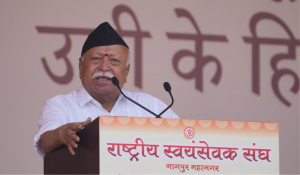
Rashtriya Swayamsevak Sangh (RSS) chief Mohan Bhagwat on Tuesday called for strengthening national unity, social harmony, indigenous practices...
Aries: The day will be auspicious...