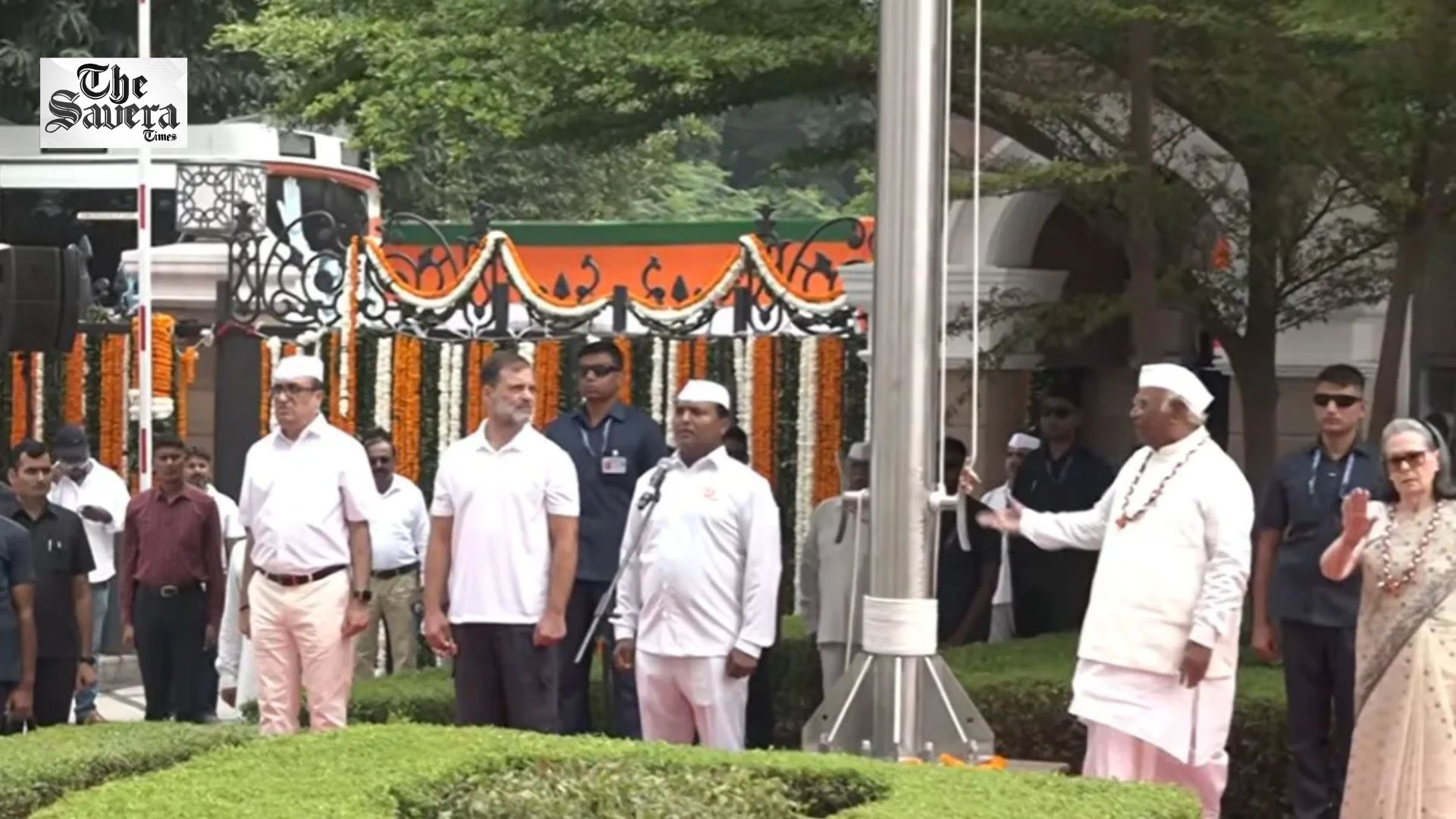
New Delhi: As India celebrated its 80th Independence Day, a political controversy erupted over the singing of the complete ‘Vande Mataram’ at the Congress headquarters in New Delhi on Saturday.
A video circulated on social media showed Congress leaders Sonia Gandhi, Rahul Gandhi and Mallikarjun Kharge during the rendition, with some users alleging that Sonia Gandhi and Rahul Gandhi had signalled for the song to be stopped. The Congress, however, clarified that Sonia Gandhi was asking for a chair for Kharge, who had continued standing during the flag-hoisting ceremony.
BJP demands apology from Congress
BJP MP Sudhanshu Trivedi condemned the alleged conduct of the Congress leadership and demanded an apology from the party.
Trivedi said that Vande Mataram was being sung in its entirety at the Congress headquarters and alleged that Sonia Gandhi, Rahul Gandhi and Kharge were seen conversing during the rendition.
He described the incident as an alleged insult to the national song and said the Congress should apologise to the nation.
Amit Malviya also attacks Congress
BJP leader Amit Malviya also criticised the Congress over the controversy. He alleged that Sonia Gandhi appeared to ask for the rendition to be stopped after the initial stanzas, while Rahul Gandhi also appeared to signal that it should end.
Malviya said the incident reflected what he described as the Congress’ discomfort with India’s cultural and civilisational identity.
However, the Congress’ explanation differs from the allegations being made by BJP leaders, with the party maintaining that Sonia Gandhi was asking for a chair for Kharge rather than seeking to stop Vande Mataram.
Full ‘Vande Mataram’ played at Red Fort
The complete version of Vande Mataram was also played during the Independence Day celebrations at the Red Fort on Saturday. An Army band performed the song before Prime Minister Narendra Modi hoisted the National Flag, followed by the National Anthem.
Vande Mataram, composed by Bankim Chandra Chattopadhyay, was later included in his novel Anandamath. Rabindranath Tagore first sang it at the 1896 Congress session in Calcutta, now Kolkata. The song subsequently became an important part of India’s freedom movement.