Last Updated: October 1, 2026
Last Updated: October 1, 2026





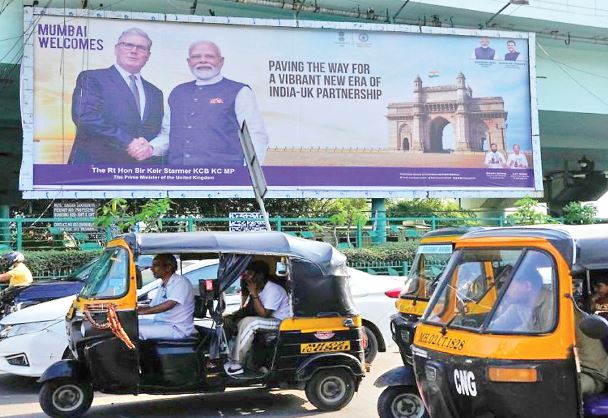
British Prime Minister Keir Starmer’s first visit to India combined elements of culture, business, and diplomacy, reflecting a comprehensive engagement between the two nations. After a first day filled with football and a visit to Mumbai’s Yash Raj Studios, where he announced that the studio would produce three major films in the UK starting 2026, Starmer began his second day with formal discussions with Prime Minister Narendra Modi at Raj Bhavan in Mumbai.
Starmer arrived in Mumbai on October 8 and was scheduled to return to the UK on October 9 after a series of high-level meetings and his address at the Global Fintech Fest 2025. His visit, marked by large public displays and banners across parts of Mumbai, is seen as a significant step in deepening the India-UK partnership.
During a joint press briefing following their talks, both leaders described the visit as an opportunity to strengthen ties across trade, defence, education, and culture. Starmer said the two countries were building a “new, modern partnership” based on shared values of democracy, freedom, and the rule of law. He noted that the visit symbolised the future-oriented nature of India-UK relations.
One of the key highlights of the discussions was trade and investment. Starmer reaffirmed his government’s commitment to enhancing bilateral economic cooperation, calling his delegation “the largest UK trade mission in a decade.” The 100-member group included business leaders, cultural representatives, and university vice-chancellors, reflecting the broad scope of engagement between the two countries.
Referring to the Comprehensive Economic and Trade Agreement signed in July, Starmer said the goal of his visit was to “double down on the trade deal” by promoting investments and job creation in both nations. He added that reducing tariffs and improving market access would drive growth and innovation, benefitting industries and consumers on both sides.
Prime Minister Modi echoed this sentiment, saying the agreement would reduce import costs, generate employment opportunities, and increase trade volumes. He described Starmer’s visit, accompanied by the largest UK business delegation in recent years, as a sign of renewed energy in bilateral relations. Modi said the new phase of economic cooperation would support industrial growth and youth employment.
Starmer also praised India’s economic performance, describing its growth story as “remarkable.” He said that India, under Modi’s leadership, appeared to be on track to achieve the vision of Viksit Bharat by 2047. “Everything I have seen since I have been here is proof that you are on track to succeed,” Starmer said, adding that the UK wished to be a partner in that journey. He also congratulated Modi for steering India towards becoming the world’s third-largest economy by 2028.
Defence cooperation formed another major component of the talks. Modi announced that both countries were moving towards joint defence production and linking their defence industries. A new agreement on military training will see Indian Air Force instructors working with the UK’s Royal Air Force. Modi said the collaboration would boost interoperability and enhance strategic ties, particularly in the Indo-Pacific region.
Starmer reaffirmed the UK’s support for India’s bid for a permanent seat on the United Nations Security Council, saying both countries shared platforms like the Commonwealth and G20 and that it was time India took its “rightful place” in the UNSC. India has long sought permanent membership of the Council and continues to advocate reforms to make the body more representative.
In one of the most significant announcements of the day, Modi revealed that nine leading British universities would open campuses in India. The move aligns with India’s National Education Policy 2020 and aims to give students access to world-class education without leaving the country. It also seeks to promote collaborative research and strengthen academic-industry links.
The University of Southampton has already inaugurated its Gurugram campus, with the first batch of students enrolled. Other institutions set to open campuses include the University of Liverpool in Bengaluru, the University of York, the University of Aberdeen, and the University of Bristol in Mumbai. The University of Surrey has received in-principle approval to set up in GIFT City, Gujarat, while Lancaster University plans a campus in Bengaluru. Modi said the initiative would benefit both nations by fostering innovation and skill development.
Cultural cooperation also received attention during Starmer’s visit. Following his tour of Yash Raj Studios, the British Prime Minister announced that the studio would shoot three major productions in the UK from early 2026, creating around 3,000 jobs and contributing significantly to the British economy. “Bollywood is back in Britain, bringing jobs, investment, and opportunity,” Starmer said.
The collaboration marks a revival of a long-standing creative connection between Bollywood and the UK, as Yash Raj Films has not shot a movie in the country for the past eight years. A new cooperation agreement between the British Film Institute and India’s National Film Development Corporation was also signed, promoting co-production and shared resources between filmmakers from both nations.
In their closing remarks, both leaders underlined the importance of people-to-people connections. Modi referred to the 1.8 million-strong Indian community in the UK as a “living bridge” that strengthens friendship and cooperation between the two nations. Starmer, in turn, extended Diwali greetings and expressed condolences for those who lost their lives in the Air India crash earlier this year.
The visit, combining trade, education, defence, and culture, underscored a broader goal of redefining the India-UK relationship as one rooted in shared democratic values and mutual opportunity. As Starmer concluded his trip, the message from both leaders was clear: India and the United Kingdom are moving toward a deeper, more modern partnership built for the future.
The Savera Times Evening Wrap brings you the top India and world news, covering major developments across politics,...

Pakistan-based LeT terrorist Mohammad Asif alias Hashim Moosa, wanted in the Pahalgam terror attack case, was killed in...

The Supreme Court has ruled out both a complete firecracker ban and unrestricted 24-hour use, indicating that permissible...
The Centre has approved higher MSP for all mandated Rabi crops for the 2027-28 marketing season, with safflower...
Traders’ organisations have withdrawn the October 2 “No UPI Day” protest after meeting Finance Minister Nirmala Sitharaman over...

Ahmedabad: A Nigerian national allegedly acted as a link between a Gujarat-based wanted accused and a wider drug...
Aries: The day will be auspicious...