Last Updated: October 22, 2026
Last Updated: October 22, 2026





Parneet Sachdev
When firms are flush with cash, the question isn’t merely how to reward shareholders but how to safeguard the future. Share buybacks have long been the favoured method to return surplus capital. They are efficient, tax-friendly, and provide an immediate boost to earnings per share. Yet, in a world where artificial intelligence is rewriting the rules of engagement and tariffs threaten supply chains, buybacks risk becoming a shortcut that substitutes optics for strategy.
Infosys, one of India’s largest IT service providers, recently announced a ₹18,000 crore buyback programme. Markets applauded, the stock price ticked higher, and management projected confidence. But peeling back the layers of this decision reveals a deeper dilemma: is this a prudent use of capital or a retreat from harder, riskier bets that could define the next decade?
The answer lies in understanding why companies repurchase shares in the first place—and whether those reasons still hold water in today’s shifting environment.
THE TWO FACES OF BUYBACKS
Historically, buybacks are pursued when companies believe their shares are undervalued by the market and see repurchase as an efficient way to deploy capital while reinforcing investor sentiment. Secondly, firms lacking attractive avenues for growth resort to buybacks to reward shareholders without compromising liquidity.
For Infosys, neither explanation appears wholly persuasive.
Its trailing P/E ratio of approximately 23 stands only modestly below the Nifty IT index’s 26, hardly a sign of panic. On valuation grounds alone, a buyback does not signal distress or undervaluation. As for the alternative explanation—insufficient growth avenues—the case is equally tenuous. The company operates in one of the most dynamic sectors of the global economy, where artificial intelligence, automation, and geopolitical volatility promise both peril and opportunity.
ARTIFICIAL INTELLIGENCE: A STRUCTURAL DISRUPTOR
Infosys and its peers are contending with perhaps the most profound technological disruption in decades. According to a Gartner study (2024), AI-driven automation is expected to influence nearly 60% of enterprise IT workflows by 2028, with lower-level support tasks such as code maintenance, testing, and documentation most exposed. Similarly, McKinsey’s Global Institute estimates that AI could automate or augment up to 30% of tasks across the technology services industry by 2030.
For Indian IT firms, whose revenue streams are heavily dependent on labour arbitrage and outsourced service delivery, this poses a direct threat to pricing power and operational leverage. A case study by Forrester Consulting (2023) found that in companies that aggressively integrated AI tools into service delivery, project timelines reduced by up to 40%, while cost-per-ticket metrics fell by 25%. Such productivity gains, while beneficial to clients, can erode billable rates if firms fail to develop proprietary solutions or reposition themselves in higher-value segments.
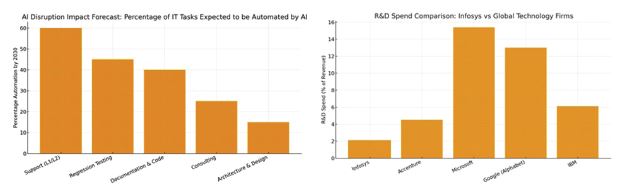
Infosys faces such an inflection point. According to a synthesis of industry reports, 60% of workflows are expected to be automated in support tasks. In documentation and code generation, 40% is at risk of automation. In consulting, 25%vmaybe taken over by AI and in architecture and design, 15% maybe affected as domain-specific AI tools become more sophisticated.
The implication is clear, automation may hollow out the service delivery pyramid where Indian IT’s historical edge has resided.
Despite the urgency, Indian IT companies have historically underinvested in research and development. Infosys’ R&D spend of just 2.1% of revenues in FY2023 is below global peers, where allocations range from 4% to as high as 15% in technology-driven sectors.
This gap may have been sustainable when labour arbitrage and process discipline were differentiators. However, as McKinsey’s 2023 report on AI disruption highlights, firms that fail to invest in proprietary platforms risk becoming implementation arms for technology providers rather than creators of differentiated services.
From the above chart, it is clear that Indian companies, in this case Infosys, spend much less on R&D spend vis-a-vis global technology giants. Infosys, 2.1% of revenues, Accenture: 4.5% of revenues, IBM: 6.1% of revenues, Google (Alphabet): 13.0% of revenues and Microsoft: 15.4% of revenues.
The contrast is stark. Leading technology players are investing at multiples of Infosys’ pace, deepening their innovation pipelines and creating proprietary tools that command higher margins.
Some experts opine that companies like Infosys should invest more heavily into R&D. Hypothetically speaking, if Infosys diverted half of its buyback allocation—approximately ₹9,000 crore—towards AI research, automation tools, and cybersecurity platforms, it could accelerate product development, enhance client retention, and build intellectual property that withstands competition.Infosys’ total cash reserves of ₹43,000 crore at the end of FY2024 could comfortably support multi-year investments in new platforms while maintaining operational flexibility.
TARIFFS AND THE CASE FOR LIQUIDITY AS INSURANCE
Beyond technological shifts, Infosys faces geopolitical uncertainty. The United States accounts for more than 60% of its revenue, with government procurement, visa regimes, and service imports subject to fluctuating political winds. Recent proposals for tariff hikes on cross-border services could affect contracts worth upwards of $60 billion annually, according to the U.S.-India Business Council.Liquidity in this environment is not merely comfort—it is insurance. Firms with robust cash reserves can weather tariff shocks, absorb short-term margin squeezes, or sustain hiring cycles without resorting to layoffs that damage client trust.A resilient cash position allows companies to absorb disruptions, invest in product pivots, and navigate regulatory changes without succumbing to market panic.
A COMPARATIVE LENS: LESSONS FROM THE PAST
A glance at past disruptions offers valuable perspective. During the early 2000s, companies such as IBM and Accenture significantly increased R&D investments during downturns, emerging stronger and more competitive. By contrast, firms that prioritized shareholder payouts over innovation, such as Nortel Networks, lost market relevance and eventually collapsed. Infosys had ₹43,000 crore in cash and equivalents at the end of FY2024, enough to fund R&D investments for several years without jeopardizing operational liquidity. Approximately 62% of Infosys’ revenue originates from North America, with the U.S. being the largest single market. This concentration exposes the firm to trade policy volatility. Infosys services over 1,500 clients globally, with around 600 contracts above $1 million. The largest clients contribute significantly to revenue, making long-term relationships a strategic imperative. According to industry forecasts by Everest Group (2024), margin pressure across traditional IT services is expected to intensify as AI tools reduce the need for human intervention, potentially squeezing profitability by 3–5 percentage points over the next five years.
Infosys’ current position mirrors that fork in the road. The choice is not between generosity and prudence but between reinforcing transient investor sentiment and laying the groundwork for long-term defensibility.
A NEW STRATEGIC IMPERATIVE
It would be naïve to claim that buybacks are intrinsically harmful. They serve legitimate purposes, especially in stable environments where capital can be returned without undermining growth prospects. However, today’s uncertainty demands more nuanced thinking.
For shareholders, the choice is stark. Would you prefer a modest uplift in EPS this quarter or the assurance that the business can sustain and defend its relevance a decade hence? Infosys’ decision offers a cautionary tale: cash returned today may ease nerves, but capital deployed wisely can secure tomorrow’s resilience.
In the final analysis, buybacks may remain a tool, but not the answer. The smarter money is on invention and insurance—the twin pillars that will determine whether Indian IT remains a global leader or merely a cost centre in the age of algorithms.
(Views expressed are the author’s own).
Parneet Sachdev, IRS is the Chairman of Real Estate Regulatory Authority and a leading author.
Good Evening Viewers! Get the latest updates from India and around the world with The Savera Times Evening...

Bharatiya Janata Party (BJP) National General Secretary Smriti Zubin Irani launched a scathing attack on Congress MP and...

New Delhi: Cockroach Janata Party (CJP) leaders Saurav Das and Ashutosh Ranka will be released from judicial custody...

According to police, three suspicious young men are seen in CCTV footage. Efforts are underway to identify them....

A video has surfaced of an alleged attempted assault on Jan Suraj Party's Bihar president Manoj Bharti. The...

Two accused have been convicted and sentenced to 10 years of rigorous imprisonment in a 2017 drug trafficking...

Aries: The day will be auspicious...