Last Updated: October 15, 2026
Last Updated: October 15, 2026





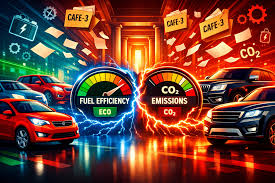
India’s revised Corporate Average Fuel Efficiency-III (CAFE-III) norms have drawn attention after automakers reportedly agreed to new fuel efficiency and emissions targets proposed by the Bureau of Energy Efficiency (BEE). While the updated framework aims to reduce carbon emissions from the transport sector, experts say the changes may fall short of driving a major shift towards cleaner mobility.
The revised standards set a reduction target from about 113 grams of CO2 per kilometre under CAFE-II to 77 g/km by 2031–32. The new cycle is scheduled to run from April 2027 to March 2032. However, analysts point out that the structure of the policy includes several flexibility measures that could weaken its overall impact.Earlier proposals that effectively eased requirements for small cars have been removed. However, new compliance options have been introduced, including credits for higher ethanol blending and incremental efficiency technologies such as start-stop systems and regenerative braking. Critics argue these measures offer limited emission reductions compared to a full transition to electric vehicles.he framework also allows super-credits, where certain technologies like electric vehicles are counted multiple times for compliance. Credit banking and trading mechanisms further permit manufacturers with surplus credits to sell them to others, reducing immediate pressure on lagging companies.
In addition, compliance will now be assessed over three-year periods instead of annually, allowing manufacturers to average performance over time. Experts say this reduces the urgency for immediate action and weakens regulatory pressure.
While the transport sector remains one of India’s largest sources of greenhouse gas emissions, concerns have been raised that the current structure may slow down the shift towards electrification. Observers argue that marginal improvements alone may not be sufficient to meet long-term climate goals.
Critics caution that although the framework appears progressive on paper, its flexible design could limit real-world impact. They stress that stronger incentives for electric mobility are needed if India is to achieve meaningful decarbonisation of the transport sector and reduce its dependence on fossil fuels.
Singapore: Two Singapore-registered container vessels were reportedly struck by unknown projectiles while transiting the Strait of Hormuz on...

Shimla: The Himachal Pradesh government has constituted a four-member commission to examine the reorganisation of administrative units in...

New Delhi: The Supreme Court on Wednesday listed for November 17 the appeal filed by self-styled godman Asaram...

Ranchi: Doctors in Jharkhand launched a protest on Wednesday over a slew of demands concerning their safety and...

Greater Noida: Police and Anti-Narcotics Team in Uttar Pradesh’s Greater Noida have seized ‘ganja’ worth Rs 1 crore...

New Delhi: The Enforcement Directorate (ED) has attached assets worth Rs 2,032.81 crore belonging to Reliance Power Ltd...
