Last Updated: October 5, 2026
Last Updated: October 5, 2026





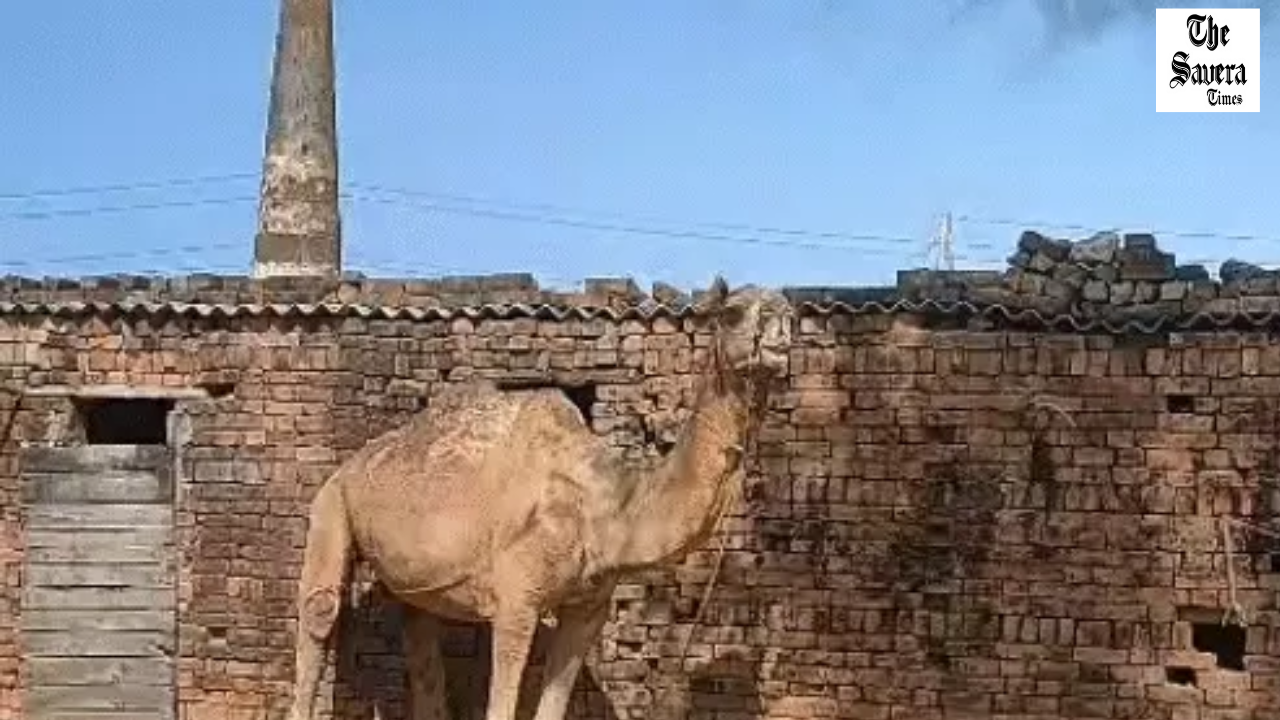
This is not just a confession on camera. The evidence is of the smuggling racket which is active in many districts of Rajasthan including Alwar, Dausa, Jaipur Rural, Karauli-Gangapur City.
The gang buys camels from cattle farmers for just Rs 1500-2000. If no one gives it, they steal it from the village or brick kilns in the dark of night. The fear of the gang is such that the cattle herders are afraid to graze camels in the desert.
After the camels are found, they are stuffed in trucks and cut in illegal slaughterhouses built in Salamba-Ghaseda of Nuh, Haryana. After this, meat, leather and other parts are sold at different manifold prices.
In 3 months, 5 cases of camel smuggling have been caught. Due to illegal slaughterhouses, camels (state animal) have decreased fivefold in 20 years.
Daily Bhaskar’s ground investigation, police FIR, actions on the expressway, and on-camera confessions of the caught smugglers have revealed the layers of this entire network.
The driver spoke on camera – ‘We are taking the camels to be slaughtered.’
During the investigation, Bhaskar received a video. In it, the driver Rajendra, who was transporting 3 camels in a pickup to Haryana, admitted that he was taking the camels to Salamba.
When asked the reason, he said – ‘For slaughtering.’ Rajgarh Station House Officer Rajesh Kumar Meena said that 2-3 such cases have come up in the area since January.
In most cases, camels were being smuggled to the direction of Nuh for slaughtering. The case is being investigated from every angle.
Ground Report: Lack of Grazing and Expensive Fodder, Fear of Smugglers
Bhaskar’s investigation revealed that camels are smuggled from Jaipur rural and Dausa belts. To understand the reality, the team reached Papad village in Kanota, Jaipur.
Camel caretaker Girraj, whom they met there, said that his family has been rearing camels for three generations. They have 30 to 40 camels but managing them is becoming difficult now.
During grazing, camels scatter around. There is always a fear that they might go missing. Several times, incidents of camel theft or attempts to take them away have occurred, but complaints could not be registered.
Smugglers become active in the darkness of night. It is difficult to identify them. Even the police cannot take action without solid information. In such situations, livestock owners remain quiet, enduring the losses.
Investigation revealed that outsiders come to the villages. They try to buy old, sick, or injured camels at cheap prices. There is a suspicion that these purchases are carried out to slaughter the camels. Some people avoid them, while others make the deal due to economic necessity.
In Naila of Jaipur itself, five camels were tied at a brick kiln. The young man taking care of them said that only one camel belongs to him, the rest belong to different families.
The young man said that very often buyers come with vehicles from outside to purchase camels. He mentioned that the fodder cost for one camel is 1800 to 1900 rupees per sack. The cost of water and care is separate.
During the rainy season, work stops, and income completely stops. In such cases, raising a camel becomes difficult. Out of compulsion, they sell them at cheap prices or let them go free. This economic pressure becomes the biggest opportunity for smugglers.
Number of camels has decreased by up to 70%
In 1983, there were more than 750,000 camels in the state. In the 2012 livestock census, this number decreased to 325,000. After this, the decline accelerated.
In the 2019 livestock census, only 213,000 camels remained. According to recent estimates, this figure appears to be confined between one and a half to two lakh. The data clearly shows that in the last 30 to 40 years, the number of camels in Rajasthan has decreased by more than 70 percent.
Camels are trafficked from many districts of Rajasthan
In Rajasthan, for camel trafficking, Dausa (Lalsot), Jaipur Rural (Bassi, Kanota), and Karauli-Gangapur belt are considered the main source areas for camels, while western districts like Barmer and Jaisalmer are now also seen joining this network.
From here, camels are bought for smuggling. After this, they are sent to Haryana via border districts like Alwar (Rajgarh, Tijara, Behror) and Bharatpur-Dig, which is turning the entire state into a major smuggling corridor.
Why does camel smuggling happen?
There are several illegal slaughterhouses in Nuh, where cattle are cut up and everything from their meat to bones is sold. This entire network of camel smuggling runs purely based on profit…
1. Buy cheap, supply expensive
According to police investigations and ground reports, camels are bought from villages for 1,500-3,000 rupees. Sometimes they are also stolen. After this, they are sold in Haryana or other areas at several times the price.
2. Big profit from slaughter
After buying from smugglers, those running the slaughterhouses slaughter the camels. Then they sell the meat, hide, and other parts separately. This gives them huge profits.
Taking a camel to another state also requires the collector’s permission
Advocate Bismat Kaur explains – To prevent camel smuggling and slaughter in Rajasthan, the Rajasthan Camel (Prohibition of Slaughter and Export Regulation) Act, 2015 is in force.
Under this law, camel slaughter is completely prohibited. Additionally, keeping, selling, or transporting camel meat is also considered a crime.
Taking a camel out of the state without the collector’s permission is also illegal. In such cases, all accused individuals—whether the driver or the owner—are subject to action.
Under the law, smuggling or slaughtering camels can result in imprisonment from 1 to 5 years and a fine, while illegal transportation or violation of rules also carries provisions for jail and fines.
Now read about the 5 recently surfaced smuggling cases
1. Mokhampura, Jaipur, January 10, 2026
The Mokhampura police station of Jaipur Rural District caught a major camel smuggling gang. Near the Savarda culvert on National Highway-48, 13 camels were rescued and three smugglers were arrested. The smugglers had bought the camels from a fair in Barmer without any documents. They were taking them to Nuh.
2. Rajgarh, Alwar, February 15, 2026
The police stopped a Haryana-registered pickup at Moonpur culvert in Alwar. It was carrying 3 camels. The drivers, Tariq Khan, Ayub Khan, and Arbaaz Khan, could not show valid documents. The vehicle was seized on the spot and the camels were freed.
3. Govindgarh, Alwar, March 17, 2026
During a checkpoint on the Delhi-Mumbai Expressway, a suspicious vehicle was stopped. It was transporting 1 camel illegally. The vehicle was seized and the camel was safely freed, while the accused fled the scene.
Govindgarh police officer Dharm Singh stated that the absconding accused Anish, son of Rahmat Mew, was arrested on April 9. The accused did not have any documents related to the purchase of the camel.
4. Sarund, Kotputli, March 22, 2026
The Sarund police station in Kotputli had rescued 27 camels and female camels. Additionally, two suspects were also arrested. The animals were seized from a truck without any documents.
The accused, Talim (23) resident of Mewat, Haryana and Kamil (27) resident of Muzaffarnagar, Uttar Pradesh, were taking the camels to Nuh, Haryana, tied with ropes.
5. 14 camels purchased from Rajasthan were ready to be slaughtered in Nuh
On April 14, the police conducted a raid in the village of Salamba in Nuh district, exposing an organized network of camel slaughtering. During this, a total of 14 animals, including 13 camels and one female camel, were recovered in inhumane conditions. The camels were tied separately to the branches of Kikar trees with ropes. All the animals were very weak and in poor conditions.
The police also admitted that there is large-scale erosion in Nuh
Bhaskar spoke to Satyanarayana, the investigating officer of Nuh police station, in this case. The accused have confessed that all the 14 camels rescued in Salamba village of Nuh were bought from Rajasthan, he said.
However, from where they were brought has not yet been revealed. He said that camels are slaughtered on a large scale in Salamba-Ghaseda village of Nuh area.
The JDA has launched an anti-encroachment drive on New Sanganer Road in Jaipur, targeting illegal constructions linked to...
Jaipur: Rajasthan will hold its 2026 Panchayati Raj elections in four phases, with voting beginning on October 23 and...
Since taking charge as Mayor of the Jaipur Municipal Corporation, Sunil Kothari has stepped up field inspections of...
Sabarkantha Police seized 967 cannabis plants weighing 345.6 kg and valued at ₹1.72 crore from a farm in...

Rajasthan ACB arrested a Railway Senior Section Engineer and two Jaipur Discom officials in a ₹10,000 bribery trap...

Jaipur: Rajasthan Police arrested three men from Madhya Pradesh in connection with the alleged recording and circulation of...