Last Updated: October 21, 2026
Last Updated: October 21, 2026





Parneet Sachdev
Chairman of Real Estate Regulatory Authority and a leading author
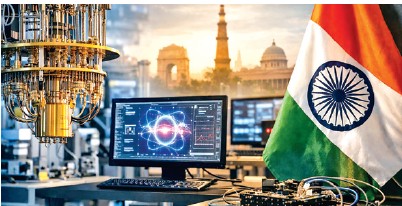
Over the past decade, quantum technology has moved from a laboratory-centred endeavour into a strategically financed industrial race. The best single quantitative map of this transition is the joint OECD–EPO work released on 17 December 2025. It finds that international patent families in quantum increased sevenfold between 2005 and 2024, and that since 2014 quantum patenting has expanded at roughly 20% CAGR, far above the ~2% growth rate across most technologies. It also records a decisive shift inside the field: quantum computing has become the most dynamic area, with patenting activity rising nearly twentyfold since 2014 and overtaking quantum communication in annual patent families in 2022 (link.epo.org).
For the record, IQM explains that unlike classical bits (which are either 0 or 1) used in the computers we all know today, quantum bits or qubits can exist in a state of superposition, meaning they can be both 0 and 1 simultaneously. Entanglement allows qubits to correlate in ways that classical bits cannot. Putting it in simple terms, quantum computers have the potential to compute complex problems much faster compared to classical computers. The idea of a quantum computer was first proposed in the 1980s, but practical developments have only gained momentum in recent years (IQM).
Quantum technology possesses the potential to improve processing speeds and efficiency by hundreds of fold. The implications of this are almost unlimited.
The OECD–EPO release is explicit that the sector is entering a more disciplined phase. Investment volumes peaked in 2021, fell in 2022–23 amid the global venture-capital downturn, and then partially recovered in 2024. Firm entry, which accelerated until 2021, now looks closer to a plateau than a continued surge (OECD). The implication is not that quantum is weakening, but that it is behaving like a deep-technology industry that is moving from rapid experimentation into selective scaling.
WHO LEADS QUANTUM IN THE REAL WORLD: INCUMBENTS FIRST, PURE-PLAYS SECOND
A practical way to understand “top companies” in quantum is to separate (i) platform-scale incumbents that can sustain very long R&D cycles and then commercialise, and (ii) pure-play quantum firms that generate the most “quantum-native” products today but remain small in turnover.
Among the incumbents, the leaders are the large computing and industrial firms that can afford patient capital and can integrate quantum into cloud, cybersecurity, and specialised hardware ecosystems. IBM is widely treated as a reference point in cloud-delivered quantum experimentation and enterprise pilots; its capacity to fund this effort is underpinned by FY2024 revenue of USD 62.8 billion (SEC). Microsoft positions quantum as an eventual cloud workload through its platform strategy and partner ecosystem; it reported over USD 245 billion in annual revenue (FY2024) in its annual reporting (Microsoft). Alphabet (Google) remains a research heavyweight in quantum computing; Alphabet reported USD 350 billion revenue for 2024 in its investor communications. (Alphabet Investor Relations). Amazon is structurally important because quantum access is being normalised through cloud marketplaces and managed services; Amazon reported USD 638.0 billion net sales in 2024, giving it the scale to keep quantum as a strategic option within AWS (ir.aboutamazon.com).
A second cluster of incumbents matters because quantum is not only about computing. It is also about materials, control electronics, precision sensors, photonics, and security.
Honeywell is a prominent example because its quantum activity has been commercialised via Quantinuum (a major integrated quantum company). Honeywell’s own scale is indicated by its outlook and reporting for a roughly USD 40 billion revenue base (with 2025 sales guidance in the ~$39.6–$40.6 billion range after full-year 2024 results) (Honeywell International Inc.). Another strategic enabler is NVIDIA, which is increasingly positioning itself around quantum-classical integration and partnerships; it reported USD 130.5 billion revenue for fiscal 2025 and has also been publicly linked to Quantinuum’s funding ecosystem (NVIDIA Newsroom).
The pure-play quantum companies, by contrast, provide the clearest “quantum product” line items, but their turnovers remain small—an important reality check for anyone expecting near-term mass-market revenue. IonQ reported USD 43.1 million revenue for full-year 2024, underscoring both growth and the still-early commercial base for quantum computing hardware and services (investors.ionq.com). Rigetti reported USD 10.8 million revenue for the year ended 31 December 2024, again illustrating that the sector’s listed specialists are still in a pre-scale phase (investors.rigetti.com).
Quantinuum, one of the most watched integrated players, is also a useful signal of where value may accrue. In September 2025, Honeywell announced a ~USD 600 million equity raise for Quantinuum at a USD 10 billion pre-money valuation, with Reuters reporting participation including NVentures (NVIDIA’s venture arm) and others (quantinuum.com).
WHAT “PRODUCTS” MEAN IN QUANTUM: THREE MARKETS WITH VERY DIFFERENT CLOCKS
Quantum is often discussed as if it is one product category. In reality, it is three distinct technology markets—quantum computing, quantum communication, and quantum sensing—each maturing at different speeds and with different buyers. The OECD–EPO mapping suggests that while quantum communication remains central, quantum computing is currently the fastest-moving domain (link.epo.org).
In quantum computing, the core products today are not consumer devices; they are combinations of specialised hardware, control stacks, error-mitigation software, and cloud access models that allow researchers and enterprises to experiment on real machines.
In quantum communication, the most mature near-term product logic is security: quantum key distribution (QKD) networks, quantum-safe key management architectures, and post-quantum transition planning in critical infrastructure. Governments and defence-linked buyers are often early adopters because the value proposition is strategic rather than purely economic.
In quantum sensing, ultra-precise sensing for navigation, gravimetry, medical instrumentation, and materials evaluation is often where “quantum advantage” can appear earlier, in narrower and more measurable forms.
IS INDIA IN THE RACE: YES, BUT LARGELY VIA MISSION FUNDING AND SECURITY-FOCUSED START-UPS
India’s position is best described as “serious intent with uneven industrial depth.” The government’s anchor is the National Quantum Mission, approved at a total outlay of Rs. 6,003.65 crore for 2023–24 to 2030–31, explicitly aimed at seeding and scaling scientific and industrial R&D to build a domestic ecosystem. (Press Information Bureau).
On the company side, India has credible early players, but the market is still too young for consistent, audited “quantum turnover” disclosures. QNu Labs, for example, positions itself as an Indian quantum-cryptography company providing solutions across quantum key distribution and related quantum security offerings (QNu Labs). QpiAI, a Bengaluru-based firm pursuing a “full-stack” approach, has attracted meaningful attention and funding; Economic Times reported in July 2025 that it raised $32 million in a round led by Avataar Ventures and India’s National Quantum Mission. The Economic Times The more candid conclusion is that India’s near-term commercial strengths are likely to appear first in software, applications, and quantum-safe security—areas that leverage India’s existing IT depth—while hardware scale remains harder because it depends on fabrication ecosystems, advanced materials, and supply-chain resilience.
WHAT GROWTH CAN WE EXPECT: DISCIPLINED SCALING, NOT A SINGLE “QUANTUM MOMENT”
If the last decade was defined by explosive patent growth and a rush of entrants, the next decade is more likely to be defined by a smaller number of firms building durable positions. The OECD–EPO evidence already points in that direction: as patenting accelerates, firm creation has begun to level, and investment has become more selective after the 2021 peak. OECD+1
For markets, this means quantum’s early revenues will disproportionately come from government, defence, critical infrastructure, and a thin band of high-value industrial use cases. The firms best placed to capture those revenues are the likes of IBM, Microsoft, Google/Alphabet, Amazon, Honeywell/Quantinuum, and NVIDIA in the practical landscape today (NVIDIA Newsroom).
India may not have missed the quantum bus, but it surely needs to move to the front seats.
(Views expressed are the author’s own).
Start your day with The Savera Morning Brief, bringing you the latest news from India and around the...

Union Home Minister Amit Shah will pay tribute to police martyrs at the National Police Memorial in New...

Four more people, including two women, have been arrested in the Tiger Shroff firing case. Delhi Police are...

We are very proud that at present India is the number one country in the world by surpassing...

Every investor wants the wealth-creating power of equity and the reassuring stability of debt. Balanced Advantage Funds attempt...
Tourism is a major source of government revenue in our country. There are different types of tourism. Scenic...

Aries: The day will be auspicious...