Last Updated: October 21, 2026
Last Updated: October 21, 2026





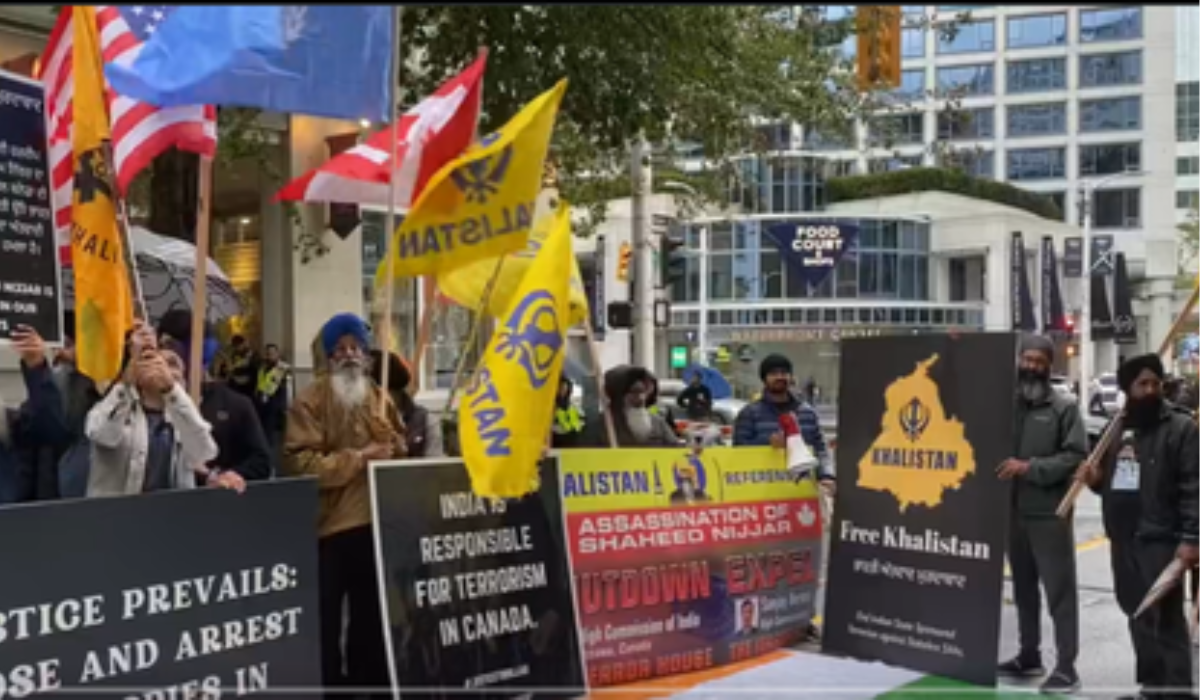
Ottawa: Canada’s recent legislation, Bill C-9, the ‘Combating Hate Act’, directly addresses the kinds of incidents promoted by Khalistani extremists that have caused concern among Indian diaspora communities by criminalizing the intimidation or obstruction of individuals seeking to access religious or cultural spaces, a report said on Monday.
Trust will depend on the effect of the law
Writing for India Narrative, India’s former High Commissioner to Canada, Sanjay Kumar Verma said that the effectiveness of law will hinge on its consistent enforcement, the confidence it builds among the public, and its capacity to restore normalcy in the lives of the diaspora.
“In recent years, the Indian diaspora in Canada has found itself navigating a climate that feels increasingly charged, performative, and at times, openly hostile, driven by Canada-based Khalistani extremism. What once appeared as the fringes of political expression has, in several instances, crossed into the realm of intimidation, incitement to violence and hate speech, directed not only at symbols of India but at individuals representing the Indian state,” Verma wrote.
Limitations of the legal framework and need for change
Until recently, the seasoned diplomat wrote, Canada’s legal framework struggled to respond decisively to such developments. The system, he opined, was designed to intervene only when speech crossed into clear and demonstrable harm.
“The difficulty, as events since 2022 have shown, is that contemporary forms of intimidation do not always fit neatly within those categories. The display of threatening imagery, the strategic use of public demonstrations to target specific communities or institutions, and the obstruction, implicit or otherwise, of access to religious spaces often fall into a gray zone. They create an environment of pressure and discomfort without always meeting the legal standard required for prosecution.”
The importance of Bill C-9 and the challenge of balance
Highlighting the relevance of Canada’s Bill C-9, he highlighted that the legislation is not simply an update to existing law; it is an acknowledgment that the nature of harm has evolved and that the legal framework must evolve with it.
“By criminalising the obstruction of access to places of worship and recognizing the role of symbolic hate in creating insecurity, it offers a form of legal acknowledgment that these concerns are neither exaggerated nor isolated. It affirms that safety is not limited to protection from physical violence, but includes the ability to participate in community life without intimidation.
“At the same time, the legislation raises important questions about balance. The Indian diaspora, like other communities in Canada, values the country’s tradition of robust free expression. The challenge for Canadian authorities will be to ensure that enforcement remains precise, targeting genuine instances of hatred without casting an unnecessarily wide net,” he stated.
Rising extremism and insecurity in the community
Highlighting the growing threat of Khalistani extremism, Verma said that, as India’s High Commissioner in Canada, he saw firsthand how several acts, which once appeared as the fringes of political expression, crossed into the realm of intimidation, incitement to violence and hate speech.
He recalled the “disturbing tableau” at a Nagar Kirtan procession in Toronto which depicted the violent assassination of former Indian Prime Minister Indira Gandhi, not as history to be reflected upon, but as a spectacle to be re-enacted. In another instance, a poster bearing the image of India’s then High Commissioner was displayed with simulated bullet marks, a gesture that was meant to incite violence and hatred.
“Effigies of Indian leadership grotesquely displayed in public protests, incendiary slogans calling for violence, and demonstrations staged in close proximity to Indian diplomatic missions have created a pattern that goes beyond dissent,” he stated.
“In some cases, threats, both implicit and explicit, have been directed at India’s High Commissioner and other diplomats. This is not dissent stretching its voice; it is dissent testing how far intimidation can travel before the law catches up. When violence is staged as memory and threat is aestheticised as protest, the question is no longer about freedom of expression but about the erosion of its boundaries,” he added.
According to Verma, the cumulative effect for the Indian diaspora has been a growing sense of insecurity, with community spaces not immune to this atmosphere. He stressed that these are not isolated incidents but calculated performative acts that blur the boundary between expression and intimidation, testing the extent to which public space can normalize threat.
“Hindu temples have been vandalised with graffiti carrying extremist messaging, often designed less to persuade than to provoke.
Nearly 100 new cases of dengue have been reported in Pakistan's Khyber Pakhtunkhwa province in the last 24...

Following violent protests and looting in France, the government has decided to impose new curfews in different areas...

North Korea on Tuesday strongly criticized the ongoing joint military exercises between South Korea and the United States,...

US Secretary of State Marco Rubio said on Tuesday that India and the US are very close to...

US Secretary of State Marco Rubio arrived in Mumbai on Tuesday for his second visit to India. During...

Defense Minister Rajnath Singh on Tuesday described terrorism as one of the most serious threats to peace and...
Aries: The day will be auspicious...