Last Updated: October 21, 2026
Last Updated: October 21, 2026





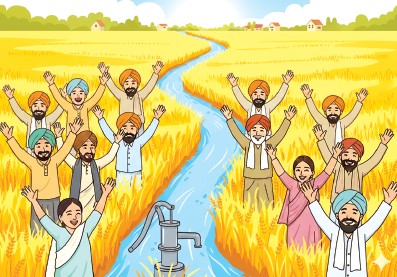
Punjab has witnessed a remarkable transformation in its irrigation landscape under the leadership of Chief Minister Bhagwant Singh Mann. After decades of underutilized canal networks and reliance on groundwater, the state is now seeing water flowing into fields that had gone thirsty for generations. The resurgence of canal water usage marks a significant milestone in Punjab’s agricultural history and promises to bring lasting benefits to farmers, the environment, and the state economy.
For the first time since Independence, canal water has reached 94 villages, transforming the irrigation scenario for communities that had long relied solely on tubewells. In another 49 villages, water has returned after a gap of 35-40 years. Across the Majha and Malwa regions, 20 major canals, long dormant for decades, have been revitalized, breathing life into 916 minor canals and watercourses that had fallen into disuse. The sheer scale of this achievement is underscored by the transformation in water availability: Punjab’s canal water utilization for irrigation has jumped to 84 percent as of August 2024, compared to just 21 percent in March 2022. This nearly fourfold increase in just two and a half years is a testament to the government’s focused efforts in rejuvenating the state’s water infrastructure.
The implications of this transformation extend beyond improved irrigation. Punjab has approximately 14 lakh tubewells, many of which extract groundwater indiscriminately, often leading to a depletion of aquifers and increased electricity consumption for pumping. With the widespread availability of canal water, the state anticipates a gradual closure of lakhs of these tubewells, resulting in both environmental and economic benefits. Experts estimate that the move could save over ₹5,000 crore annually in electricity subsidies alone, while simultaneously conserving groundwater for future generations.
Minister for Rural Development and Panchayats, Tarunpreet Singh Sond, emphasized the holistic impact of the government’s efforts. “Under the leadership of Chief Minister Bhagwant Singh Mann, we have taken decisive steps to restore Punjab’s aging irrigation infrastructure. By reviving abandoned canals and watercourses, we are ensuring that water reaches every farmer who needs it,” Sond said. He noted that the state is on track to achieve 100 percent utilization of canal water in the near future, reducing dependence on costly and unsustainable tubewell irrigation.
The revival of canals has not only increased water availability but also improved the efficiency and sustainability of agriculture in Punjab. Farmer feedback has been overwhelmingly positive, with many noting the superior quality of canal water compared to groundwater. Canal water helps maintain soil health, reduces salinity, and ensures more consistent crop yields. “For the first time in decades, our fields are getting water on time,” said a farmer from Raikot. “This is better for our crops and our income. We no longer have to rely solely on expensive electricity to pump water from tubewells.”
The tangible impact of these efforts can be seen in figures as well. Out of 42 lakh hectares of agricultural land in Punjab, 31.38 lakh hectares are now irrigated using canals. Daily water flow has increased by 40 percent, rising from 26,000 cusecs to 36,000 cusecs in 2025. This improved water flow has rejuvenated soil, strengthened irrigation reliability, and restored faith among farmers who had long struggled with erratic tubewell supplies.
The government’s plan is not limited to canal water. Minister Sond also announced a state-wide campaign to clean village ponds before the monsoon season. This process involves emptying ponds, de-silting them, tapering the banks, and planting grass along the edges to prevent erosion. Cleaned ponds not only act as additional water storage for irrigation but also support local biodiversity and groundwater recharge. By integrating canals and ponds into the irrigation network, Punjab is creating a resilient system capable of withstanding climate variability and seasonal fluctuations.
The revival of canal irrigation has also had broader social and economic impacts. Farmers no longer face the unpredictability of groundwater availability, which often led to disputes and inefficiencies. With the assurance of canal water, agricultural planning has become more reliable, allowing for better crop choices, timely sowing, and higher productivity. Villages previously disconnected from irrigation networks are now seeing new economic opportunities as agriculture stabilizes and ancillary activities flourish.
Beyond the numbers and statistics, the human element of this success story is evident in the expressions of hope and satisfaction among farmers. Social media and news reports have captured moments of celebration as villagers watch long-dry canals flow for the first time in decades. This revitalization is a reminder that public infrastructure, when properly maintained and modernized, can directly improve the quality of life for citizens and create sustainable economic growth.
The government has also emphasized transparency and efficiency in managing these initiatives. By monitoring water flow, coordinating with farmers, and ensuring that all canals and watercourses function optimally, Punjab aims to maintain the gains achieved so far. Minister Sond expressed confidence in the administrative machinery, highlighting the collaboration between state departments and local bodies in executing these projects.
The restoration of canal irrigation in Punjab is a significant achievement that will resonate for decades. It demonstrates the power of strategic planning, government commitment, and community engagement. With 84 percent of canal water now utilized and a target of 100 percent on the horizon, Punjab is set to reduce its dependence on unsustainable groundwater, conserve resources, and improve agricultural productivity. For farmers and rural communities, the revival of these canals represents not just water, but hope, opportunity, and a brighter future.
Punjab government employees are observing a two-day mass casual leave protest on October 21 and 22. The agitation...

Punjab Police have arrested seven people in a suspected drug, arms and explosives smuggling case in Amritsar. A...

Punjab has reported 404 stubble-burning incidents, with Tarn Taran and Amritsar accounting for the highest numbers. Authorities have...

The CBI has taken over the investigation into anti-drug activist Parvinder Singh Jhota’s killing in Mansa and registered...

Punjab Chief Minister Bhagwant Mann was allegedly detained for three hours at Delhi airport upon his return from...

The Punjab Vigilance Bureau (VB) during its ongoing drive against corruption in the state, has apprehended Inspector Gulshan...

Aries: The day will be auspicious...