Last Updated: October 21, 2026
Last Updated: October 21, 2026





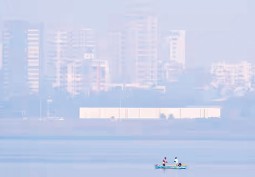
Two of India’s largest metro cities are grappling with hazardous air as dense haze continues to cover Delhi and Mumbai. On Monday, the Air Quality Index in both cities remained in the dangerous range, raising concerns about residents’ health and mobility. While Mumbai has enforced the strictest Graded Response Action Plan measures, Delhi recently rolled back certain curbs despite recording worse pollution levels.M
umbai saw a heavy blanket of smog through the day, although the AQI improved marginally to 111, falling in the moderate category. On Sunday, it stood at 103. The city recorded its worst air quality of the season on Friday, when the AQI climbed to 222 in several pockets. Following this spike, the Brihanmumbai Municipal Corporation imposed Grap 4 restrictions in eight localities where air quality slipped into the very poor and severe categories. All dust-generating and construction activities in these areas have been halted. The civic body has issued stop-work notices to more than 50 construction sites found violating dust control rules. Small industries have been directed to adopt cleaner technologies. BMC has also deployed flying squads equipped with GPS-enabled vehicles to monitor emissions, inspect construction sites and prevent open burning of waste.
Delhi continued to suffer heavy smog on Monday as visibility dropped sharply. The AQI deteriorated to 301, placing the city back in the very poor category, driven by elevated PM 2.5 and PM 10 levels. This came a day after a brief improvement when the reading stood at 279. Despite the persistent pollution, the Commission for Air Quality Management last week lifted stage 3 restrictions in the National Capital Region, allowing BS 3 petrol and BS 4 diesel vehicles back on the roads. Delhi faces this pattern every winter, with air quality sinking ahead of the cold season. A recent assessment linked pollution to more than 17,000 deaths in the capital in 2023.
Fresh analysis of AQI data from 2015 to 2025 shows Delhi has been the country’s most polluted city across the decade. Its annual mean AQI peaked above 250 in 2016 and stood at 180 in 2025. Lucknow, Varanasi, Ahmedabad and Pune followed. Mumbai and southern cities such as Chennai and Visakhapatnam recorded better air quality in the 80 to 140 range, while Bengaluru logged the cleanest air among the 11 cities studied.
Experts attribute the gap to geography. Northern cities lie within the Indo-Gangetic Plain, where pollutants get trapped by surrounding mountains and dense urban structures. Winter inversion further restricts dispersion as cooler air settles near the surface. These factors make Delhi especially vulnerable during winter months, deepening the political debate over the city’s recurring pollution crisis.
State Bank of India has confirmed that 3,897 customer records containing personal information were found on the dark...

A fire in a hut in Nonapar village of Deoria district claimed three lives, including those of a...

Amit Shah paid tribute to police personnel who died in the line of duty at the National Police...

Reduced water levels at Har Ki Pauri and other Haridwar ghats have inconvenienced pilgrims during the Upper Ganga...
Six people returning from a Dussehra Mela were seriously injured when a car hit them on National Highway...

Two people were killed and ten injured after a passenger bus met with an accident at Gala Pachound...

Aries: The day will be auspicious...