Last Updated: October 15, 2026
Last Updated: October 15, 2026





Parneet Sachdev
Chairman of Real Estate Regulatory Authority and a leading author
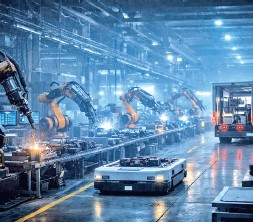
The industrial skyline of China is changing in profound ways. Across the country, manufacturing plants once filled with human labour, fluorescent lighting and repeated shifts are being replaced by “dark factories”; fully automated facilities that operate without human presence or traditional lighting. Visitors to some of China’s industrial zones describe walking beside conveyor belts for nearly a kilometre, the only movement coming from machines, and finally seeing a truck drive out carrying finished products.
That surreal scene is no science fiction. By 2024, China’s deployment of industrial robots surged from approximately 189,000 units in 2014 to over two million (Business Today, 11 November 2025). The term “dark factory” has emerged to capture the essence of a production line that requires neither workers nor lights and works around the clock in darkness. (FT, 2 September 2025).
These factories are built on the convergence of several technological advances. At the heart are robot arms that weld, paint, assemble, inspect and polish. They are supported by autonomous guided vehicles (AGVs) that move components around the plant, sensors that continuously monitor status and defects, and artificial-intelligence systems that optimise flow and predictive maintenance (IEN, 27 August 2025). The elimination of the human shift structure means the factory can run 24×7, with no breaks for meals, no lighting needed once machines are programmed and no wage shifts to worry about.
HOW THE MODEL WORKS: MECHANICS AND ECONOMICS OF THE DARK FACTORY
First comes the input side. Machines receive raw materials from upstream suppliers, often via automated logistics. Conveyors move parts to robotic stations where arms perform very specific tasks: welding, bolting, painting, inspection and packaging. Meanwhile autonomous vehicles shuttle components between cells, sometimes even from one building to another. These vehicles operate using laser-navigation, simultaneous localisation and mapping (SLAM) or vision-based guidance. The lighting requirement is minimal because machines do not require human visibility; sensors and cameras do the quality checks.
Second, the connective layer: Internet of Things (IoT) sensors, edge-computing nodes and central AI systems monitor performance in real time. Deviations trigger immediate corrective action, robots are recalibrated, predictive maintenance executed. The shift to “Autonomy 2.0” (machines that scale with data and compute rather than simply adding more engineers) drives large economies of scale (Wu et al., 2023).
Third, the cost structure. Although the upfront capital investment is high (robots, AGVs, sensors, software, infrastructure), the marginal cost of production falls sharply. Labour costs decline nearly to zero per unit of output, and the precision reduces defects, rework and scrap. Domestic robot makers now meet about half of China’s robot demand and undercut global rivals on price (FT, 2 Sept 2025).
From an economic perspective, labour costs, once a key competitive advantage for manufacturing in China, are being gradually eroded by automation. Through automation, yield improvements of 20-30 % are common. A factory producing electric-vehicle chassis in Sichuan described how automation allowed it to win contracts from both Africa and Southeast Asia due to lower costs and higher consistency (FT, 2 Sept 2025). China is now producing can produce high-quality goods, even in labour-intensive sectors, at cost levels traditionally associated with lower-wage countries. For global buyers, this is attractive.
Historically many manufacturing firms moved from high-wage zones (Europe, Japan, Korea) to China, then to lower-cost countries like Vietnam, Bangladesh or India. But if China offers near-low-cost production with high automation and high quality, the incentive to locate elsewhere erodes. The dark factory becomes a new competitive frontier.
China’s robot installation surged to some 280,000 units in recent years representing more than half the global total (FT, 2 Sept 2025). In 2024 alone China installed 295,000 robots, nearly ten times the U.S. number of 34,200 (NY Post, 29 Sept 2025). With such capacity, China’s manufacturing output can expand rapidly and at lower marginal cost.
INDIA’S CATCH-UP IMPERATIVE: WHY “CHINA PLUS” MAY NEED RETHINKING
For India the emergence of China’s dark factories raises urgent strategic questions. India’s aim of being a manufacturing hub; often expressed as the “China Plus” strategy (that is, companies locating manufacturing in India in addition to or instead of China) may face a harder competitive environment than previously assumed.
India’s manufacturing share of GDP has actually fallen from about 17.5% in the early 2010s to roughly 12–13% today (Business Today, 11 Nov 2025). The logic of relocating labour-intensive operations away from China becomes weaker if China itself automates away labour cost advantages.
India needs not just favourable labour costs but automation ecosystems, robotics supply chains, sensors, AI software, logistics networks and energy reliability. Without them, India risks becoming a low -productivity, low-margin location rather than a hub of high-quality manufacturing (DTNext, 10 Nov 2025).
India must offer quality, reliability and agility. India’s services sector strength gives it an advantage: integrating digital manufacturing, supplying automation tools, and hacking labour- intensive operations with smarter technology. But the clock is ticking.
STRATEGIC ECONOMIC AND POLICY STEPS FOR INDIA
China’s advantage is that domestic robot makers undercut foreign rivals and drive down costs (FT, 2 Sept 2025). India should also support robotics start-ups, component manufacturing (actuators, drives, sensors), local software platforms and integrate smart manufacturing into its “Make in India” vision. The goal is not to replace labour entirely, but to move to higher productivities per worker. The graduate unemployment problem (currently very high, possibly ~29%) underscores the urgency of offering new pathways.
Dark factories require reliable 24×7 power, predictable logistics, minimal downtime. India must invest in energy infrastructure, stable grid supply, smart factories’ connectivity, and logistics corridors. Without these, automation premiums cannot be realised.
GLOBAL PRODUCTION AND THE CHINA-PLUS NEXUS
Looking ahead, global production will still be multi-polar. Not all goods warrant a dark-factory build. India can still carve a role, especially if it combines automation with flexibility, small-batch customisation, regional supply-chain access (to Africa, Middle East, South Asia) and services-led manufacturing ecosystems.
The rise of China’s dark factories marks more than a technological milestone. The window to claim the next wave of manufacturing expansion is narrowing because China is transforming the playing field beneath its feet.That does not mean India is doomed to second-tier status. If India accelerates its adoption of smart manufacturing, invests in its robot ecosystem, builds the infrastructure and skills necessary for 24×7 production, then the China Plus strategy can still succeed. Over the past few years, China’s industrial machine has played a surprising role in bolstering Russia’s defence-industrial base even in the face of sanctions. A detailed study by Carnegie Endowment for International Peace reports that China became the supplier of roughly 90 % of Russia’s microelectronics imports and a majority of high-priority machine-tools needed for missiles and armoured vehicles by 2023 (US-China Review Commission). That shift has eroded the bargaining power and market share of Western machine-tool suppliers and chip-vendors in those geographies.
Meanwhile, in the United States and Europe, the so-called “China shock” effect has been widely documented: for example, studies estimate that from 2000 to 2007, U.S. regions most exposed to Chinese imports lost between roughly 550,000 to 2.4 million manufacturing jobs.
More recently the European Central Bank flagged that increased competition from Chinese manufacturers has contributed to job losses in the euro-area automobile and chemical industries, and that Chinese exports to Europe surged between 2019 and 2024 by up to 150 % in some sectors (The Wall Street Journal).
In a world where factories maybe no longer need lights and human shifts vanish, the new frontier is speed, precision, cost and scale. The question then is: will India build its dark factories, or watch them be built around it?
(Views expressed are the author’s own)
Singapore: Two Singapore-registered container vessels were reportedly struck by unknown projectiles while transiting the Strait of Hormuz on...

Shimla: The Himachal Pradesh government has constituted a four-member commission to examine the reorganisation of administrative units in...

New Delhi: The Supreme Court on Wednesday listed for November 17 the appeal filed by self-styled godman Asaram...

Ranchi: Doctors in Jharkhand launched a protest on Wednesday over a slew of demands concerning their safety and...

Greater Noida: Police and Anti-Narcotics Team in Uttar Pradesh’s Greater Noida have seized ‘ganja’ worth Rs 1 crore...

New Delhi: The Enforcement Directorate (ED) has attached assets worth Rs 2,032.81 crore belonging to Reliance Power Ltd...
