Last Updated: October 15, 2026
Last Updated: October 15, 2026





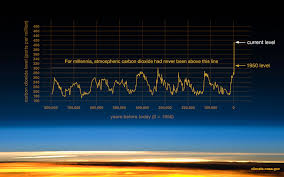
Global carbon dioxide (CO2) levels have reached their highest point in 800,000 years due to global warming, according to the State of Climate 2024 report released by the World Meteorological Organization (WMO) on March 19, 2025. The report states that in 2023, CO2 levels were recorded at 420 parts per million (ppm), marking a dangerous milestone in the climate crisis.
Along with CO2, other greenhouse gases (GHGs), including methane (CH4) and nitrous oxide (N2O), also reached their highest recorded levels in the past 800,000 years. The accumulation of these gases in the atmosphere has led to unprecedented temperature increases and extreme climate events worldwide.
The WMO report highlights that 2024 saw record-breaking global temperatures, exacerbated by the natural climate phenomenon El Niño, which occurred in the early months of the year. The global mean near-surface temperature was recorded as 1.55°C above pre-industrial levels (1850-1900), according to an analysis of six international datasets. This made 2024 the first year in history to surpass the critical 1.5°C warming threshold set by the Paris Agreement on an annual basis.
Celeste Saulo, Secretary-General of WMO, emphasized the gravity of the situation, stating, “While a single year above 1.5°C of warming does not mean the long-term goals of the Paris Agreement are unachievable, it is a wake-up call that we are increasing risks to our lives, economies, and the planet.”
Despite this alarming increase, the report notes that long-term warming remains between 1.34°C and 1.41°C above pre-industrial levels. WMO used multiple scientific methods to reach these conclusions while acknowledging some uncertainty in global temperature measurements.
Recent studies suggest that the world may already be approaching a permanent breach of the 1.5°C warming limit. A recent analysis by the European Union’s Copernicus Climate Change Service (C3S) warns that if the current temperature trend continues, the threshold could be permanently crossed as early as September 2029.
Chris Hewitt, Director of WMO’s Climate Services branch, highlighted a shocking revelation from the report: “Each of the last 10 years is now among the 10 warmest years on record since 1850. This has happened for the first time in recorded history and is one of the most surprising findings of the WMO report.”
The warming of the planet is not only affecting land temperatures but also causing significant changes in ocean heat content. The last eight years have seen record-breaking levels of ocean heat absorption, with the world’s oceans taking in 90% of the excess heat trapped by GHGs.
Saulo pointed out the severe consequences of these changes: “Data for 2024 show that our oceans continued to warm, and sea levels continued to rise. The frozen parts of Earth’s surface, known as the cryosphere, are melting at an alarming rate: glaciers continue to retreat, and Antarctic sea ice reached its second-lowest extent ever recorded. Meanwhile, extreme weather continues to have devastating consequences worldwide.”
The WMO report states that seven of the past 10 years have witnessed the highest negative mass balance of glaciers, meaning glaciers are losing more ice than they gain. The Arctic and Antarctic regions are particularly affected, with record-low sea ice extents, further intensifying global sea level rise.
Karina von Shuckmann, an ocean expert with WMO, highlighted another major concern: “We expected ocean warming to slow down towards the end of 2024, but that did not happen. Instead, we observed an acceleration of ocean warming in recent decades. This needs to be studied further.”
The report also warns that the rate of sea level rise has doubled since satellite measurements began. The combination of rising sea levels and increasing temperatures has intensified extreme weather events, including tropical cyclones, extreme rainfall, floods, and droughts.
These extreme weather conditions have had devastating consequences for communities around the world. According to the report, the number of people displaced by climate-related disasters in 2024 was the highest since 2008. The findings of the WMO report highlight the urgency of addressing climate change through immediate and significant action. The continued rise in CO2 levels, global temperatures, ocean heat, and sea levels underscores the need for stronger climate policies and reduced dependence on fossil fuels.
With warnings that the 1.5°C threshold may soon be permanently breached, experts stress the importance of transitioning to renewable energy sources, enhancing climate resilience, and implementing stricter measures to
The Supreme Court is set to hear opposition leaders’ petition seeking transparency in the Election Commission’s SIR decisions,...

Congress MP Angomcha Bimol Akoijam has been summoned by Delhi Police for questioning over sexual harassment allegations involving...

President Droupadi Murmu will inaugurate the national-level SARAS Mela at Punnami Ghat in Vijayawada on October 15. The...

Ankita Bhandari’s parents were detained during an overnight protest near India Gate in Delhi and released around 5...

New Delhi: Prime Minister Narendra Modi is scheduled to interact with the Indian contingent that participated in the...

New Delhi: The Central government has defended its decision to suspend mobile internet services in parts of central...

Aries: The day will be auspicious...