Last Updated: October 21, 2026
Last Updated: October 21, 2026





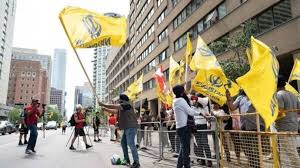
Intelligence agencies have flagged a sharp surge in Khalistan-linked activities in Australia, even as Canada and the United Kingdom tighten the screws on pro-Khalistan elements, forcing them to divert operations to a new geography. Security officials say that Khalistan-related activity has shown significant rise in Canada and the UK following diplomatic pressure from India and increased scrutiny by local authorities. With space shrinking in these countries, Australia has emerged as the new operational hub for separatist groups. Officials confirm that resources, manpower and propaganda machinery are being systematically shifted to Australia, a move reflected in the recent spike in vandalism, provocative protests and anti-India graffiti across several Australian cities.
While so-called “referendums” had earlier been conducted in Australia, the scale and frequency of Khalistan activity have risen sharply in recent months, triggering serious security concerns. Investigations reveal that social media campaigns by groups such as Sikhs for Justice (SFJ) are now largely Australia-centric, with repeated online calls to vandalise Indian symbols, target the Indian community and raise incendiary anti-India and anti-Prime Minister Narendra Modi slogans. Intelligence officials said these acts are deliberate and tactical.
Australia offers a fresh ground where they hope to operate under the shield of free speech,” the official said. India has formally raised the Khalistan issue with both Canada and the UK, and both governments have acknowledged the problem and committed to closer cooperation. In recent months, visible action against Khalistan elements in these countries has pushed the network to seek refuge elsewhere — primarily Australia.
Khalistan-related incidents have been openly visible in Australia during July, August and December, with separatist flags waved at protests and slogans raised against India. These demonstrations have frequently turned provocative, including acts of vandalism, trampling of the Indian flag and its public desecration. In December, a protest saw the Indian national flag torn, with videos circulated widely on social media platforms — a tactic officials say is routinely used by SFJ to incite unrest and provoke the Indian diaspora.
Unlike Canada and the UK, Khalistan groups in Australia are now facing strong pushback from the Indian community. Chants of “Khalistan Zindabad” have been met with resounding slogans of “Bharat Mata Ki Jai”, signalling growing resistance. Officials warn that provocation is the core strategy. “These acts are designed to trigger confrontation and then play victim,” an officer said.
During an Independence Day protest in August, Khalistani elements attempted to provoke Indians, but swift intervention by Australian police prevented a street clash. Officials say a violent confrontation would have served the separatists’ narrative.In July, a Melbourne gurdwara was vandalised with anti-India graffiti, and images of Adolf Hitler were pasted to insult Indian leadership, further escalating tensions. Australia’s large Indian population — around 800,000 people — has made the country an attractive target. Officials warn that such incidents risk alienating the wider Indian community, with locals often unfairly associating all Indians with these extremist actions.
As in Canada and the UK, Khalistan groups in Australia exploit the broad interpretation of free speech, often escaping accountability while spreading hate and incitement. Security agencies caution that unless firm and timely action is taken, the problem could spiral beyond control. Australian Foreign Minister Penny Wong acknowledged the concern, stating: “We uphold free expression but draw firm lines at violence or incitement, and continue engaging with Indian counterparts on these matters.”
Officials, however, stress that words must now translate into action, warning that Australia risks becoming the next major staging ground for Khalistan extremism if decisive steps are delayed.
We are very proud that at present India is the number one country in the world by surpassing...
Every investor wants the wealth-creating power of equity and the reassuring stability of debt. Balanced Advantage Funds attempt...

Tourism is a major source of government revenue in our country. There are different types of tourism. Scenic...
Good Evening Viewers! Catch up on the day's biggest stories with The Savera Times Evening Bulletin. Get the...

Congress leaders continued their protest outside the Jaipur Police Commissionerate on Tuesday, demanding the registration of a zero...
On the auspicious occasion of Vijayadashami, Prime Minister Narendra Modi on Tuesday called on the countrymen to unite...
Aries: The day will be auspicious...