Last Updated: November 8, 2026
Last Updated: November 8, 2026





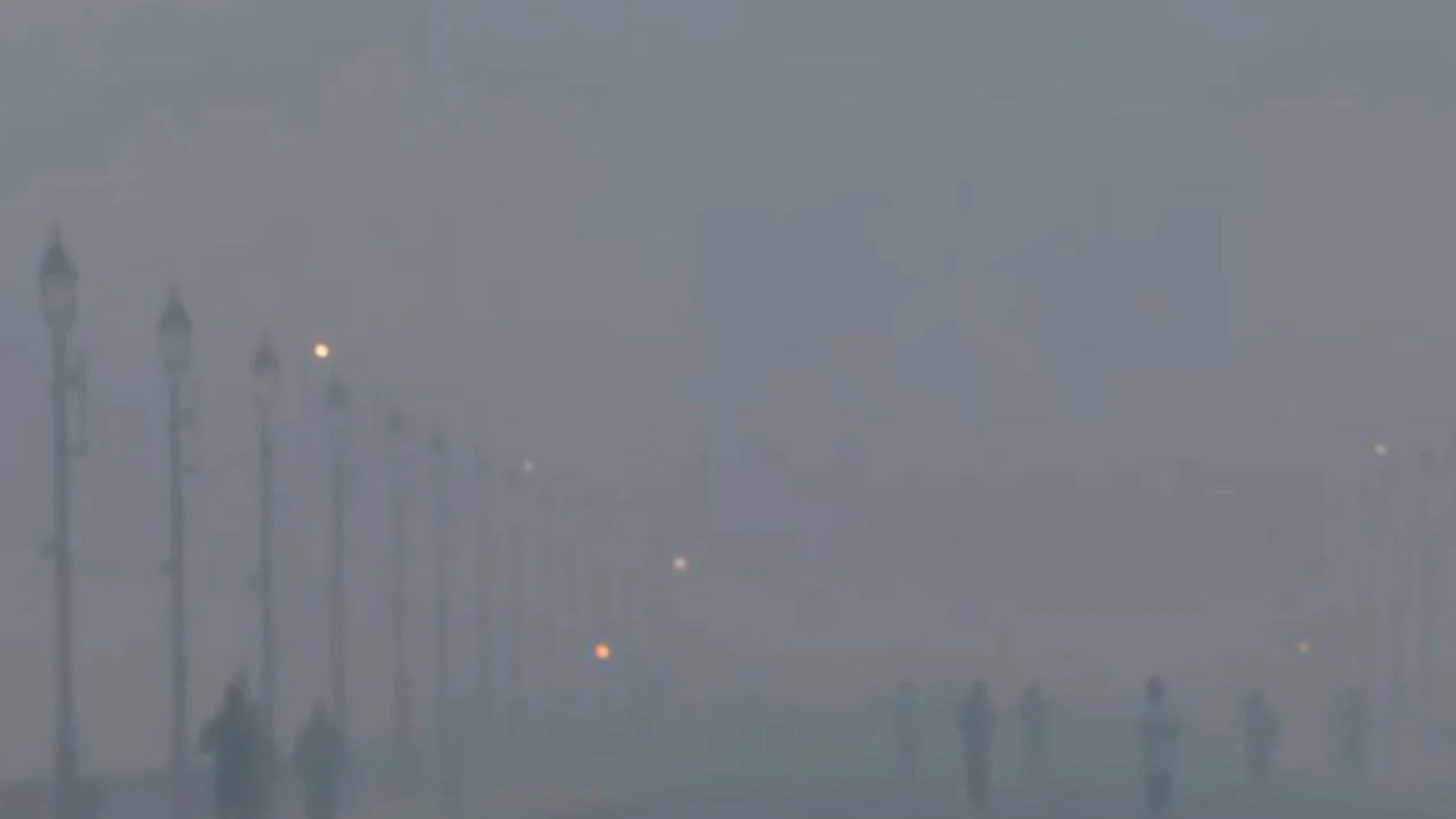
New Delhi: A sharp drop in air quality was recorded in the capital Delhi on Sunday morning. According to data from the Central Pollution Control Board (CPCB), Delhi’s average Air Quality Index (AQI) reached 483 at 8:10 am, which falls in the ‘severe’ category. In many areas of the capital, the AQI exceeded 400.
In view of the deteriorating air quality in Delhi, the Commission for Air Quality Management (CAQM) implemented the third phase of the Graded Response Action Plan (GRAP), i.e., GRAP-3, in Delhi-NCR on Friday. This decision was taken two days before Diwali to prevent further increase in pollution levels during the festival.
AQI exceeds 400 in many areas of Delhi
According to CPCB data, on Sunday morning, the AQI was recorded at 446 in Bawana, 449 in Punjabi Bagh, 448 in RK Puram, 445 each in IIT Delhi and Rohini. Chandni Chowk recorded 420, Patparganj 421, and Alipur 413. All these areas remained in the severe pollution category.
On the other hand, the AQI in Anand Vihar was recorded at 328 and Narela 395, both falling in the very poor category. The air quality index around India Gate was recorded at 398 and around the Akshardham Temple at 336, both areas also falling in the very poor category.
A thick layer of smog enveloped many parts of Delhi on Sunday morning. With the onset of winter, increased air pollution and reduced visibility have increased public concern.
Delhi’s air quality deteriorates sharply in a single day
Delhi’s average AQI was recorded at 483 on Sunday morning, compared to 364 at 8 am on Saturday. This means that in just one day, the air quality has deteriorated significantly, moving from very poor to severe.
According to the CPCB, the AQI classification is as follows:
– 0 to 50: Good
– 51 to 100: Satisfactory
– 101 to 200: Moderate
– 201 to 300: Poor
– 301 to 400: Very Poor
– 401 to 500: Severe
Restrictions on several activities under GRAP-3
Following the CAQM’s decision to implement GRAP-3, the restrictions imposed under Phases 1 and 2 will continue. Additionally, additional steps will be taken to control pollution. This emergency action plan is in effect in Delhi as well as the NCR districts of Haryana, Uttar Pradesh, and Rajasthan.
GRAP is implemented in coordination with the CAQM, CPCB, and the respective state governments. Restrictions are gradually tightened as air quality deteriorates.
– GRAP-1: Applies when the AQI is between 201 and 300. This includes measures such as controlling road dust, enforcing pollution regulations, and prohibiting open burning of garbage.
– GRAP-2: Applies when the AQI is between 301 and 400. This includes enhanced dust control measures, increased parking fees, and possible changes to office timings.
– GRAP-3: Applies when the AQI is between 401 and 450. This includes strict vehicle restrictions, a moratorium on construction activities, and hybrid learning for primary classes.
– GRAP-4: Comes into effect when the AQI exceeds 450. It bans heavy goods vehicles and takes emergency measures to control traffic and industrial pollution.
Ban on BS-III Petrol and BS-IV Diesel Vehicles
Under GRAP-3, the operation of four-wheelers running on BS-III petrol and BS-IV diesel is prohibited in designated districts of Delhi and NCR.
In addition, stricter restrictions have been imposed on the entry of old light and medium goods vehicles and diesel commercial vehicles not registered in Delhi into the capital.
To control dust emanating from construction, non-essential construction activities have been banned. This includes activities such as large-scale excavation, earthwork, demolition, and road construction. Essential projects are allowed to continue work subject to strict dust control regulations.
Additionally, dust-producing activities such as stone crushers and mining have also been ordered to be shut down or banned.
The administration aims to control pollution levels in Delhi-NCR through these measures and prevent air quality from deteriorating further during Diwali.
India defeated New Zealand by four runs under the DLS method in a rain-hit second ODI at Wellington....

New Delhi: Hockey India on Saturday paid tribute to former India women’s chief coach Gurdial Singh Bhangu, who...

A Special Railway Magistrate in Jammu dismissed an application seeking an FIR against BCCI President Mithun Manhas over...

New Delhi: The cricket fraternity came together to celebrate Mohammed Shami’s contribution to Test cricket after the veteran...

Jaipur: In a major boost to sportspersons in Rajasthan, the Chief Minister Bhajanlal Sharma government has approved out-of-turn...
Rain could disrupt the second India-New Zealand ODI in Wellington on Saturday. A 60 per cent chance of...