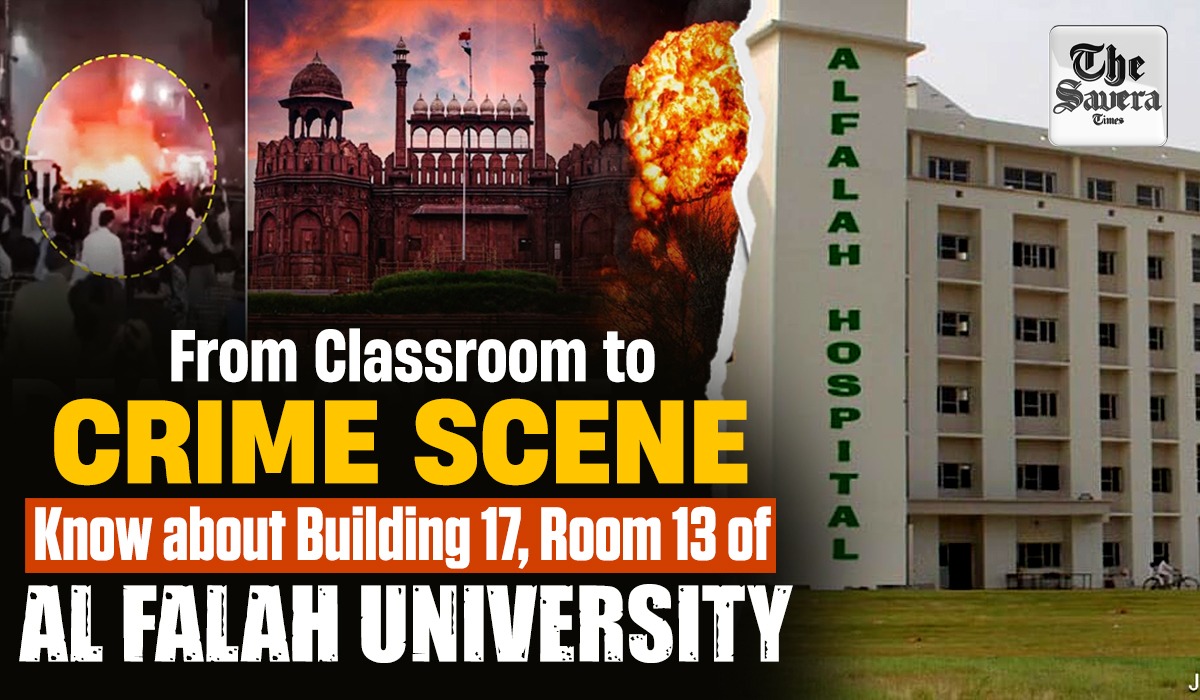
New Delhi: What looked like an ordinary, damp hostel room on a quiet Haryana campus has now been unmasked as the centre of a chilling terror plot. Investigators have identified Room No. 13 in Building 17 of the boys’ hostel at Al-Falah University, Faridabad, as the meeting point of a radicalised group of doctors who allegedly plotted a series of attacks in Delhi and Uttar Pradesh.
From a Hostel Room to a Terror Hub
The investigation into the Red Fort blast that killed 13 people has revealed shocking details. The prime accused, Dr. Umar Nabi, a doctor employed at Al-Falah University and Hospital, is believed to have executed the explosion near the iconic Delhi monument on Monday.
His close associate, Dr. Muzammil Shakeel, a native of Pulwama in Jammu & Kashmir, occupied Room No. 13 — now sealed by police — where the group is said to have held covert meetings and prepared explosive materials.
A day before the blast, officials seized 2,900 kilograms of IED-making material from Dr. Muzammil’s rented premises. According to investigators, the “white-collar terror module” consisted of educated professionals using their expertise to plan and execute large-scale attacks.
Plot Linked to December 6 Anniversary
Interrogation of the arrested accused has revealed that the group intended to carry out coordinated explosions around December 6, the anniversary of the Babri Masjid demolition.
Sources say the conspirators discussed ways to procure chemicals from the university’s laboratories and transport them secretly to the hostel. Forensic teams found chemical residues in Room No. 13, believed to have been used to mix ammonium nitrate and metallic oxides for explosive preparation. Preliminary reports confirm the use of Ammonium Nitrate Fuel Oil (ANFO) in the Red Fort blast.
Doctors Turned Extremists
Investigators have identified several key figures linked to the plot. Besides Dr. Umar and Dr. Muzammil, Dr. Shaheen Shahid — another Al-Falah employee — is suspected to have been working on setting up the women’s wing of Pakistan-based Jaish-e-Mohammed (JeM) in India.
Police believe Dr. Umar and Dr. Shaheen helped transport chemicals from the university to rural hideouts in Dhauj and Taga villages of Faridabad, where explosives were being assembled.
University Denies Any Role
After remaining silent for two days, Al-Falah University issued a statement denying any institutional involvement in the terror plot. The administration asserted that “no unauthorised chemicals or materials were ever used or stored” in its laboratories.
While the investigation continues, the shocking transformation of a university hostel room into a terror command centre has left authorities and students in disbelief. As police expand their probe across Delhi, Haryana, and Uttar Pradesh, Room No. 13 stands sealed — a grim reminder that terror can hide even in the most ordinary places.