Last Updated: October 1, 2026
Last Updated: October 1, 2026





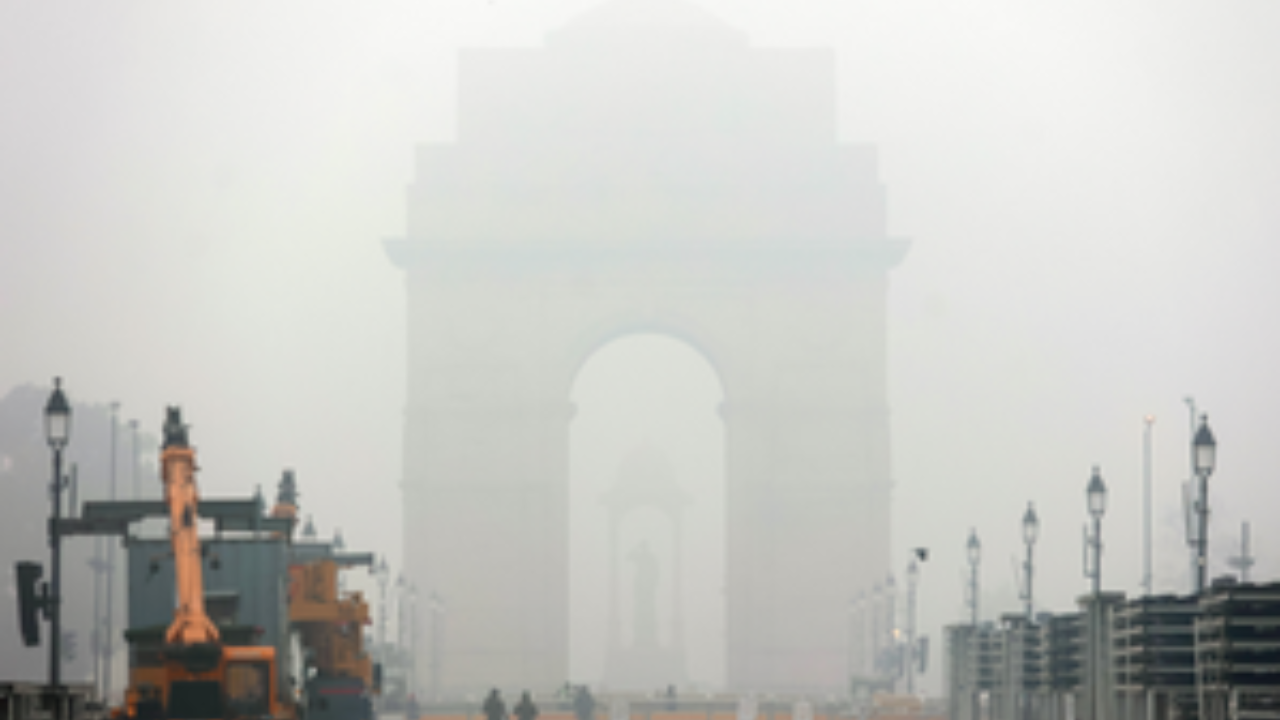
New Delhi: Delhi’s Air Quality Index (AQI) remained in the ‘very poor’ category for the fourth consecutive day, according to data from the Central Pollution Control Board (CPCB). On Wednesday morning at 8 a.m., the national capital recorded an AQI of 328, days after Diwali festivities filled the skies with smog.
AQI Touches Seasonal High
On October 22, Delhi’s 24-hour average AQI reached 353 at 4 p.m. — the highest level recorded this season — up from 351 on October 21 and 345 on October 20.
NCR Cities Also Choke
Air quality across the Delhi-NCR region remained unhealthy. Gurugram recorded an AQI of 280, while Ghaziabad’s was 324. Noida and Greater Noida reported AQIs of 336 and 316 respectively, all falling under the ‘very poor’ category.
Anand Vihar continued to be the most polluted area, recording an AQI of 428 on Thursday morning. Akshardham registered 350, while the area around the All India Institute of Medical Sciences (AIIMS) recorded 342, according to CPCB data.
Smog Lingers as Winds Slow
A dense smog shrouded the city through the day, with wind speeds failing to exceed 7 kmph, hindering the dispersion of pollutants. The India Meteorological Department (IMD) said no immediate relief is expected, as meteorological conditions remain unfavourable for air clearing in the coming days.
Wind speeds briefly improved on October 22, helping disperse firecracker emissions, but declined again as temperatures dropped. Forecasts from the Centre’s Air Quality Early Warning System (EWS) suggest that Delhi’s AQI will remain in the ‘very poor’ range until Saturday and may fluctuate between ‘poor’ and ‘very poor’ for the following week.
GRAP Stage-II Measures in Force
The Commission for Air Quality Management (CAQM) has directed that all actions under Stage I and Stage II of the Graded Response Action Plan (GRAP) be strictly enforced across the National Capital Region.
Authorities have been instructed to intensify dust control operations, monitor construction and demolition sites, and ensure compliance with citizen guidelines under GRAP. The CAQM has emphasised the need for strict implementation to prevent further deterioration in air quality.
Bengaluru: Karnataka Transport Minister Byrathi Suresh on Thursday indicated that bus fares of the state-run Road Transport Corporations...

Patna: The flood situation in Bihar has worsened following heavy rainfall in Nepal’s Gandak basin, with the river...
New Delhi: India’s retail real estate sector continued to see active occupier demand in Q3 2026 with gross...

The Registration of Births and Deaths (Amendment) Act, 2026, came into effect on Thursday, making provisions of delayed...
Kabul: At least nine civilians, including women and children, were killed, and 11 others were injured after Pakistani...
Mangaluru: The Special Investigation Team (SIT) constituted by the Karnataka government to reinvestigate the alleged 2012 Dharmasthala gang...