Last Updated: September 30, 2026
Last Updated: September 30, 2026





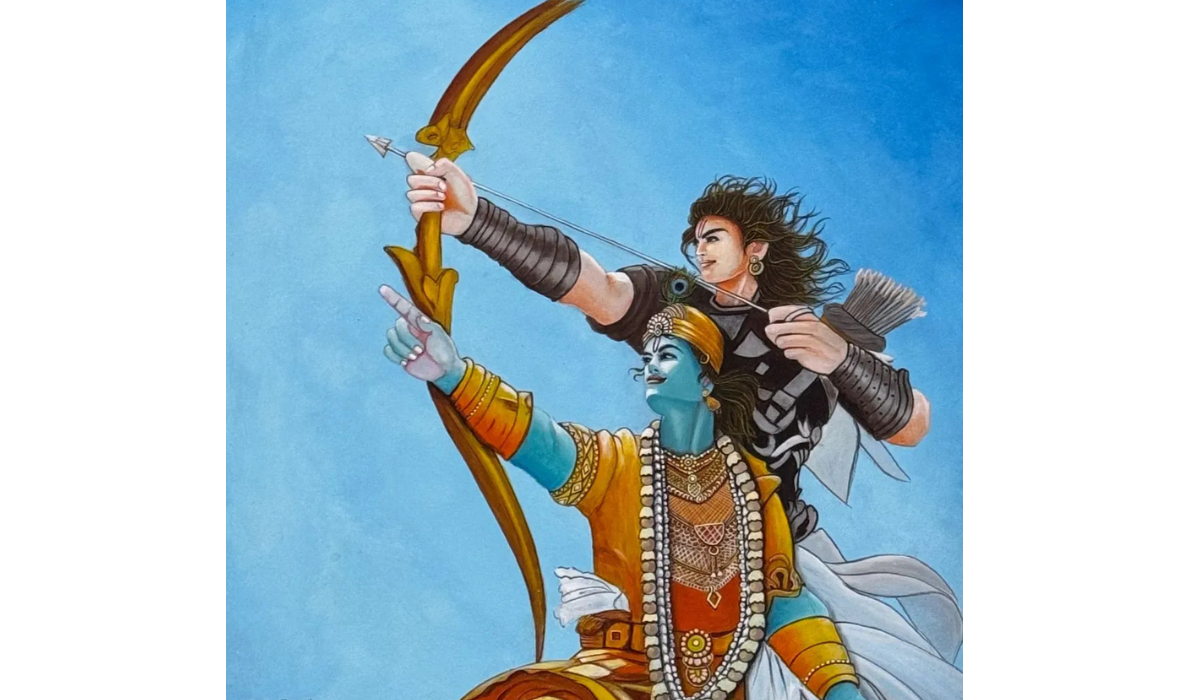
Lord Krishna states: “One’s own Dharma (Swadharma)— even if devoid of merit—is far superior to the Dharma of another (Paradharma), even if the latter is perfectly executed. Indeed, to die while adhering to one’s own Dharma is beneficial; the Dharma of another is fraught with peril.” (3.35). This complex verse tends to generate more doubts than clarity in our minds. In one sense, this verse is purely relevant to Arjuna within the specific context of the Kurukshetra War. Up until that moment, Arjuna embodied the “Dharma” of a warrior; yet, in the very next moment, he aspired to become a saint. Such a transformation is not feasible, and this is precisely what Lord Krishna is alluding to in this verse. While Dharma is fundamentally one, we perceive and interpret it in diverse ways—much like the proverbial five blind men who, by touch alone, perceive the same elephant in five different manners. If one of them perceives it as a tusk, then that constitutes “his” Swadharma. The verse further suggests that the individual who perceives it as a tusk should steadfastly continue to follow his own path, rather than attempting to adopt the eloquently articulated description offered by another individual who perceives it as a leg or a tail. The next question that naturally arises is: whose perception is correct? They are all correct in their own respective ways; consequently, Lord Krishna does not encourage comparison when He advises us to adhere to our own Dharma—even if it appears to be devoid of conventional merit. Dharma is akin to electricity: it enters our homes and manifests in distinct forms, depending on the specific appliance it powers. Each appliance possesses its own inherent nature; thus, a fan cannot realistically aspire to become a television set. Lord Krishna has previously indicated that repression— or the suppression of one’s true nature—leads us nowhere (3.33). To adopt the Dharma of another “Paradharma” is, by definition, to repress one’s own Dharma (Swadharma). Repression leads to exclusion, whereas true Dharma represents the harmonious convergence of all individual perceptions—much like the scenario involving the blind men and the elephant.
In our seemingly always-on society, there’s great temptation to shortchange sleep. But sleep is a vital driver of...

Parents please take note! Children who play games on smartphones right before hitting the sack are at increased...

Our country currently requires new paradigms and research in higher education. Students need to be prepared for nation-building....

The capacity for lifelong learning is a human inexhaustible resource. The fundamental question is how to learn and...
The Centre's Department of Animal Husbandry and Dairying will launch the Livestock Insurance Portal on Monday, marking an...
Our eyes faithfully serve us every waking moment, yet they are often among the most neglected organs in...

Aries: The day will be auspicious...