Last Updated: November 28, 2026
Last Updated: November 28, 2026




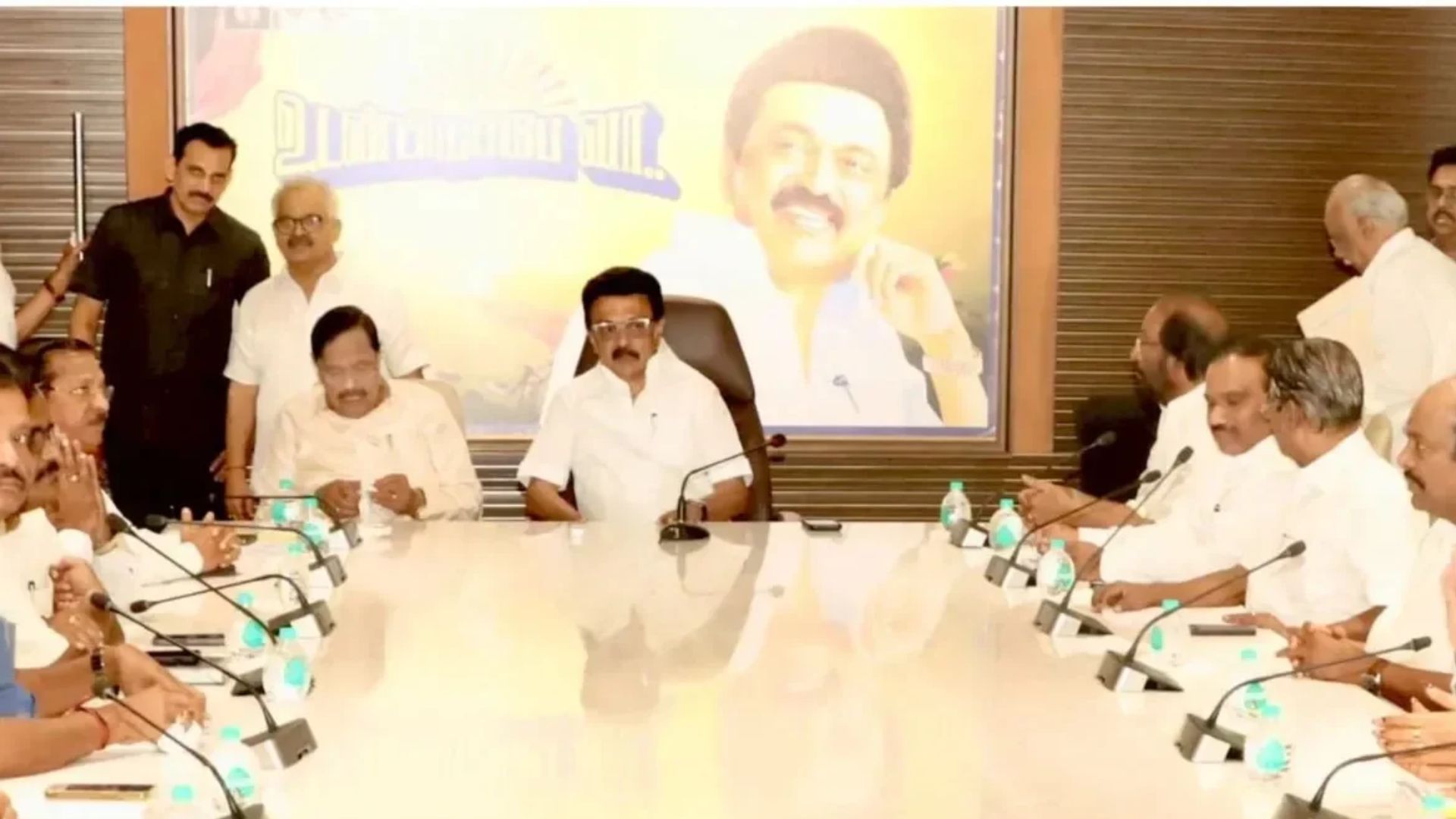
The Dravida Munnetra Kazhagam (DMK) has announced its support for the Delimitation Bill following the central government’s acceptance of its demand for a fair delimitation process. Party president and Tamil Nadu Chief Minister M.K. Stalin announced this decision on Saturday morning, following a meeting with the party’s Members of Parliament (MPs). This stance by the DMK is considered politically significant. It could also provide momentum to the central government’s efforts to implement the proposed 33 percent reservation for women.
DMK leaders stated that the party has received assurances that the interests of all states will be protected during the delimitation process. A key demand of the party is that Tamil Nadu’s current level of representation in Parliament must not be reduced, and the state’s share of the total Lok Sabha seats must remain intact.
DMK States: Key Demand Regarding Delimitation Accepted
Following the meeting with DMK MPs, M.K. Stalin announced that the party would support the Bill, as its demand for a fair delimitation framework has been accepted.
DMK MP Dayanidhi Maran also welcomed the decision. He noted that the central government’s proposal to increase the number of Lok Sabha seats in every state by 50 percent has addressed the party’s concerns.
“Our demand has been met,” he said. “The number of seats in every state will be increased by 50 percent. This also paves the way for providing 33 percent reservation for women. We welcome this.”
The DMK’s support is particularly significant because the issue of delimitation has been a point of contention between the central government and several opposition parties—especially those from South India. These parties fear that if the allocation of seats is based primarily on population, the political representation of southern states—which have performed better in terms of population control—could decline in Parliament.
Raja Addresses Tamil Nadu’s 7.18 Percent Share
Regarding the DMK’s decision, MP A. Raja stated that the party chose to support the bill based on the assurance that Tamil Nadu’s current 7.18 percent share would be maintained.
He said, “We made this decision based on the principle that there should be no change to Tamil Nadu’s 7.18 percent share. We have agreed upon a figure of 59 seats. The DMK president has given us full leeway to propose other necessary amendments. This was also our demand back when the Congress was part of our alliance.”
A. Raja reiterated that the DMK’s stance on delimitation remains unchanged. The party continues to advocate for a fair process that ensures the protection of Tamil Nadu’s representation. He added that this demand had also been raised during the party’s alliance with the Congress.
The party leadership has authorized its MPs to introduce further amendments, as deemed necessary, to safeguard the state’s interests throughout the legislative process.
What is the Proposed Delimitation Process?
The proposed delimitation bill is expected to pave the way for increasing the current 550-seat capacity of the Lok Sabha to a maximum of 850 seats. The delimitation process involves redrawing the boundaries of Lok Sabha and Legislative Assembly constituencies and allocating seats to various regions according to a defined framework.
Political parties, particularly those from South Indian states, have expressed concerns regarding this proposal. They have raised questions about how the delimitation exercise might impact the existing representation of states in Parliament. This debate is also intertwined with the implementation of 33 percent reservation for women, the determination of representation based on population, and the need to balance these factors with the interests of states that have performed well in population control.
Mumbai (Maharashtra): Bisleri International Private Limited on Saturday sought a thorough review by the Food Safety and Standards...

Prime Minister Narendra Modi made a significant statement on Saturday regarding the Women’s Reservation and Delimitation Bill
New Delhi: India and Denmark adopted the Joint Action Plan 2026-2031 and exchanged Memoranda of Understanding (MoUs) covering...
New Delhi: The Cockroach Janta Party (CJP) on Saturday appealed to all opposition parties and MPs to take...
Hyderabad (Telangana): A case has been registered at Chikkadpally Police Station following a complaint alleging that Congress leaders...
Guwahati: Rail connectivity between southern Assam, Tripura, Mizoram, Manipur, and the rest of the country was disrupted following...
Aries: The day will be auspicious...