Last Updated: October 21, 2026
Last Updated: October 21, 2026





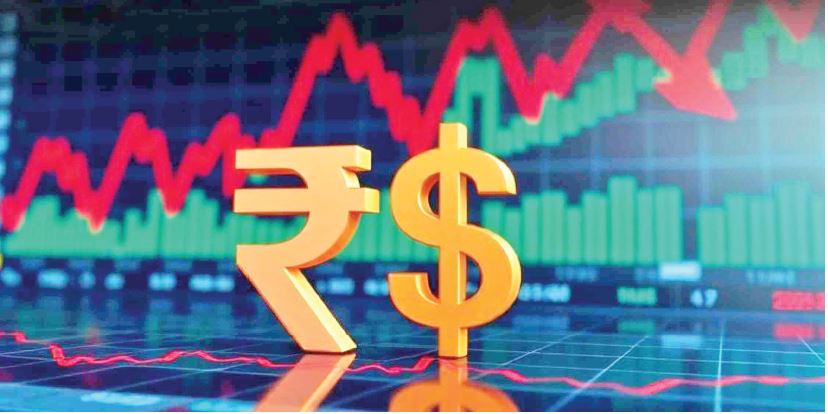
The Indian rupee has been trading at record lows even as the United States dollar continues to lose strength worldwide, creating a paradox that underscores the pressure on India’s financial markets.
On Wednesday, the rupee closed at 88.74 against the dollar after touching an intraday low of 88.80. The weakness came just a day after the currency hit its lowest closing level of 88.73. The movement highlights how domestic and external factors have combined to push the rupee into uncharted territory despite the global trend of a declining dollar.
Dollar’s Fall Fails to Lift the Rupee
In most situations, a weaker US dollar benefits emerging market currencies. It lowers import costs and tends to encourage capital inflows. But 2025 has not followed the usual script.
The Dollar Index (DXY), which measures the dollar’s strength against six major currencies, has fallen 11.3 per cent since January and around 7 per cent since April. This decline has been driven by concerns over America’s fiscal position, slowing economic growth, and the likelihood of more interest rate cuts by the Federal Reserve.
Market analysts note that unless the US manages to revive growth or bring down fiscal risks, the dollar may remain under pressure in the medium term. Yet the rupee has not shared in the gains that other currencies have seen. Instead, it has continued to slide, diverging sharply from the global pattern.
Policy Shocks from Washington
Two policy steps by the United States have rattled Indian markets in recent weeks.
First, the announcement of higher tariffs on Indian exports has raised concerns about the country’s trade prospects. Any erosion of export competitiveness could widen the trade deficit, which is already a structural weakness for India.
More significantly, the US has imposed a steep increase in H-1B visa application fees, raising them to \$100,000 for new filings. The fee hike, combined with changes in the selection process that favour higher-paid, more specialised workers, has created unease across India’s information technology sector.
The sector depends heavily on deploying skilled professionals to the United States, and the new regime is expected to raise costs and limit opportunities. With Indians accounting for 71 per cent of H-1B approvals last year, the shift has an outsized impact. The immediate fallout has been a sell-off in IT stocks, which has deepened the rupee’s weakness.
Foreign Outflows Add Pressure
Foreign portfolio investors have been steadily pulling funds out of Indian equities. On September 23 alone, investors sold Rs 3,551 crore, the biggest single-day outflow of the month. The selling pushed September’s net equity outflows past \$1 billion. So far this year, foreign investors have withdrawn close to \$16 billion.
Persistent outflows have weighed on both the rupee and stock markets. On Wednesday, the BSE Sensex dropped 380 points to 81,721.62, while the Nifty 50 fell 106 points to 25,063.05. Fifteen of sixteen sectoral indices opened lower. Small-cap and mid-cap stocks also fell, with losses of 0.2 per cent and 0.5 per cent respectively.
The IT index was the hardest hit, falling 0.9 per cent on fears that the visa changes would erode profitability. The auto sector, which had recently touched record highs, slipped 0.5 per cent.
Individual stock movements reflected the mix of pressures in the market. Ashok Leyland fell 2.6 per cent after Goldman Sachs cut its rating from “buy” to “neutral,” citing limited upside following earlier gains. Minda Corporation rose 7.5 per cent after projecting revenue growth of 3.5 times between fiscal 2025 and 2030. Real estate developer Sri Lotus Developers gained 5.2 per cent after Motilal Oswal initiated coverage with a “buy” call, positioning it as a key beneficiary of Mumbai’s redevelopment drive.
RBI Steps In
The Reserve Bank of India has been intervening in currency markets to prevent a disorderly fall in the rupee. Traders reported that the central bank sold dollars both in the non-deliverable forward market and in the onshore spot market to cap volatility.
Market participants believe the RBI stepped in earlier in the week and again on Wednesday, when the rupee slipped toward the 88.80 mark. While these actions helped stabilise the currency in the short term, they have not been able to reverse the broader downward trend.
Analysts point out that the RBI faces structural challenges in defending the rupee. India remains heavily dependent on crude oil imports, and the recent rise in global oil prices has pushed up dollar demand. Brent crude was trading at \$67.79 per barrel this week, adding to the burden on the country’s current account.
Safe Havens Surge
Global uncertainties have also triggered a rush into traditional safe havens. Gold prices climbed to a record \$3,790.82 per ounce, reflecting investor demand for protection against currency volatility and geopolitical risks. The surge in bullion underscores the nervous mood in financial markets and the growing appetite for assets perceived as more stable.
An Unusual Divergence
The rupee’s behaviour this year highlights how local factors can outweigh global trends. The steady weakening of the dollar has not translated into strength for India’s currency, as policy changes, foreign investor behaviour, and commodity price pressures have pulled the rupee in the opposite direction.
The paradox of a falling dollar and a weakening rupee underscores the vulnerabilities facing India’s economy at a time of heightened global uncertainty. For policymakers, the challenge lies in containing volatility while addressing the deeper structural issues that continue to weigh on the currency.
Rescue teams recovered the bodies of four youths from the Kotri canal in Kota on Wednesday morning, after...

A balloon containing a suspected flammable chemical burst during a stage play in Siwan, injuring around 10 spectators....

State Bank of India has confirmed that 3,897 customer records containing personal information were found on the dark...

A fire in a hut in Nonapar village of Deoria district claimed three lives, including those of a...

Amit Shah paid tribute to police personnel who died in the line of duty at the National Police...

Reduced water levels at Har Ki Pauri and other Haridwar ghats have inconvenienced pilgrims during the Upper Ganga...

Aries: The day will be auspicious...