Last Updated: October 21, 2026
Last Updated: October 21, 2026





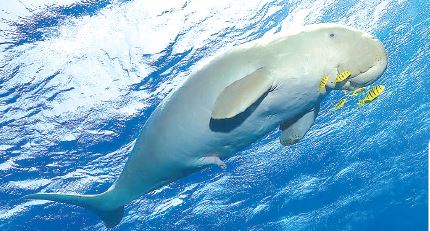
A new report released at the International Union for Conservation of Nature (IUCN) Conservation Congress in Abu Dhabi on October 12, 2025, has painted a sobering picture for dugongs, the gentle sea cows of India. The study highlights that the long-term survival of these marine mammals in the Gulf of Kutch and the Andaman and Nicobar Islands faces significant challenges, while populations in the Gulf of Mannar–Palk Bay region have sharply declined in recent years.
The Gulf of Kutch supports a small, isolated population of dugongs, restricted by limited seagrass habitats. The IUCN report describes the prospects for their long-term survival in this region as “highly uncertain.” The southern Gulf of Kutch has been identified as an Important Marine Mammal Area (IMMA), with dugongs as a qualifying species. Similarly, the Andaman and Nicobar Islands host a small resident population, with shallow coastal waters limiting their numbers. The ‘Southern Andaman Islands’ are also recognised as an IMMA, underscoring the fragile status of these populations.
In the Gulf of Mannar–Palk Bay, dugongs remain the region’s most important marine mammals, yet numbers are lower than in the past. The report lauds the establishment of a dugong conservation reserve along the Tamil Nadu coast as a positive first step, while recommending stronger governance frameworks, community participation, and targeted research to safeguard both dugongs and their seagrass habitats. The analysis also warns that new infrastructure projects or petroleum exploration could place additional pressures on these populations.
The report suggests that, given the small and fragmented populations in Kutch and the Andaman Islands, conservation efforts may be more effective if designed for marine megafauna broadly rather than focusing solely on dugongs. It also recommends separate IUCN Red List subpopulation assessments for these regions, noting that robust quantitative data is essential for proper conservation planning.
Globally, dugongs face a vulnerable future. The report, compiled with inputs from more than 70 experts, notes that while populations are relatively stable in Australia and the Persian Gulf, they are critically endangered or extinct in parts of East Asia, Eastern Africa, and several offshore islands. Only two locations in Asia host populations exceeding 100 individuals.
In India and across South Asia, dugongs are scattered and vulnerable. Pakistan and the Laccadive Islands host none, while Bangladesh’s status remains uncertain. Sri Lanka has small populations outside the Gulf of Mannar–Palk Bay. The report calls for urgent research to clarify these distributions and inform conservation strategies.
Dugongs, slow-moving and seagrass-dependent, are silent indicators of coastal ecosystem health. Their struggle is not just a story of species decline, but a warning of the pressures on marine habitats and the urgent need for coordinated conservation action.
Reduced water levels at Har Ki Pauri and other Haridwar ghats have inconvenienced pilgrims during the Upper Ganga...

Six people returning from a Dussehra Mela were seriously injured when a car hit them on National Highway...

A bus travelling from Pachiound to Ramnagar fell into a gorge at Gulli Gula in Udhampur district. Nine...

Start your day with The Savera Morning Brief, bringing you the latest news from India and around the...

Union Home Minister Amit Shah will pay tribute to police martyrs at the National Police Memorial in New...

Four more people, including two women, have been arrested in the Tiger Shroff firing case. Delhi Police are...

Aries: The day will be auspicious...