Last Updated: October 5, 2026
Last Updated: October 5, 2026





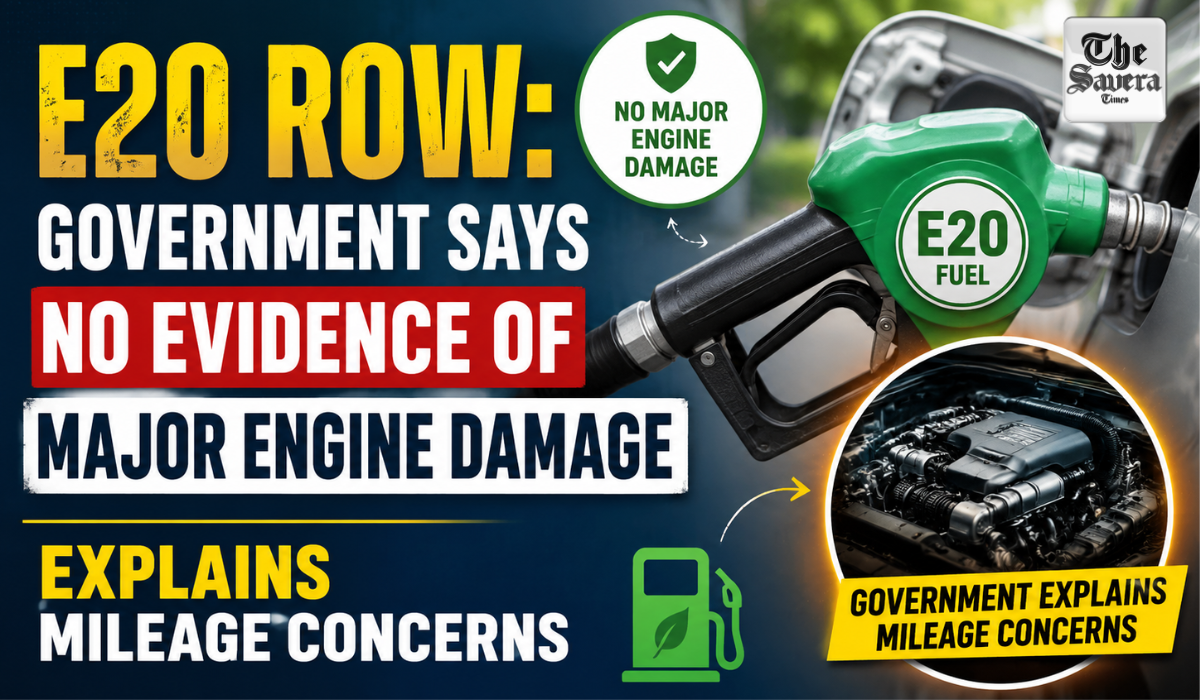
For millions of vehicle owners, one question has become increasingly important: Is E20 petrol really reducing mileage and harming vehicles? The debate has intensified after motorists raised concerns over fuel economy, performance and possible contamination.
Now, the government has said E20 petrol alone cannot be blamed for lower mileage, pointing to several other factors—from driving habits and traffic conditions to tyre pressure, servicing and air-conditioning use. But what exactly is E20, why is India pushing it, and what do the latest facts say?
India’s Shift Towards E20: What Is Driving the Change?
E20 is petrol blended with 20 per cent ethanol and 80 per cent petrol. India has gradually increased ethanol blending from less than 1.5 per cent in 2013-14 to 20 per cent in 2025-26, achieving the target five years ahead of the earlier schedule. The government says the programme aims to reduce dependence on imported crude oil, save foreign exchange, support farmers and promote cleaner fuel.
According to the Petroleum Ministry, the ethanol-blending programme has so far saved over Rs 1.97 lakh crore in foreign exchange, substituted nearly 316 lakh metric tonnes of crude oil, reduced around 952 lakh metric tonnes of CO2 emissions and transferred over Rs 1.66 lakh crore to farmers.
Why Are Motorists Reporting Lower Mileage? The Big Consumer Concern
The biggest concern remains mileage. The government has previously acknowledged that some vehicles may experience a 3–5 per cent reduction in fuel economy. However, the Ministry of Petroleum and Natural Gas says real-world mileage cannot be linked to fuel alone. Driving style, traffic congestion, tyre pressure, vehicle maintenance and AC use can all affect how far a vehicle travels on a litre of fuel.
In simple terms, two vehicles using the same E20 petrol can still deliver different mileage depending on how and where they are driven.
The government’s recent position is that E20 may cause a marginal reduction in fuel economy in some vehicles, but claims of a massive mileage loss are not supported by its technical assessment. Ethanol has a lower energy content than petrol, which is one reason fuel economy can be affected. However, E20 also has high octane properties and can support smoother combustion in engines calibrated for it.
How Is E20 Tested?
The government and technical agencies say E20 underwent laboratory and field testing before wider rollout. The tests covered engine durability, drivability, startability, corrosion resistance, material compatibility, emissions and fuel efficiency.
ARAI (Automotive Research Association of India) said in July 2026 that E20-compatible vehicles undergo structured validation before commercial introduction, with testing covering 40,000 to 60,000 kilometres to assess performance and long-term engine health.
What About Older Vehicles?
This remains one of the most important questions for consumers. The government says extensive studies found no significant performance variation or abnormal wear in legacy vehicles under prescribed standards.
However, vehicle compatibility is ultimately defined by manufacturers, and owners should check their vehicle manual, compatibility sticker or contact the manufacturer for model-specific guidance.
What Nitin Gadkari Said About Older Vehicles?
Union Minister of Road Transport and Highways Nitin Gadkari recently cited a joint study involving the Indian Oil Corporation (IOCL), the Automotive Research Association of India (ARAI), the Indian Institute of Petroleum (IIP) and the Society of Indian Automobile Manufacturers (SIAM).
According to Gadkari, under standard operating conditions, legacy vehicles did not show any significant variation in performance or abnormal wear and tear while using E20 petrol. The government has also maintained that there is no scientific evidence so far to establish that E20 causes major engine damage.
However, Gadkari also highlighted an important point for owners of older BS-III vehicles, particularly those manufactured between 2005 and 2016.
While E20 is not expected to cause engine failure and no engine modification is generally required, some older vehicles may have rubber components and gaskets that can deteriorate over time because of ethanol exposure.
He advised that such rubber parts should be inspected during regular servicing and replaced if required.
What Do the Latest Tests Show?
Concerns have also been raised about chloride and moisture contamination. Indian Oil, BPCL and HPCL recently said nationwide testing found chloride levels at or below prescribed limits in tested refinery, ethanol and E20 samples.
The companies also said inspections of underground storage tanks at around 90,000 fuel stations found no water ingress.
However, the contamination issue has remained part of the wider debate, with recent reporting also highlighting concerns raised internally by some automakers.
The Final Verdict
E20 is now a key part of India’s energy strategy, and the government says there is no proposal to return to E0 or E10 as the nationwide standard. The available official data suggests that a small mileage impact is possible, particularly depending on vehicle design, but fuel alone does not determine real-world mileage.
For consumers, the practical takeaway is simple: check your vehicle’s recommended fuel compatibility, maintain proper tyre pressure and servicing, and remember that traffic, driving style and AC use can also significantly affect what you see on the mileage meter. The E20 debate may continue, but separating verified data from assumptions will be crucial as India moves further towards ethanol-based mobility.
Catch the top India and world news in The Savera Times Evening Wrap, featuring the latest developments, major...

Kolkata: Former West Bengal Chief Minister Mamata Banerjee on Sunday condemned the assault on Calcutta High Court advocate...

New Delhi: The OPEC+ cartel has agreed to keep oil production targets steady for November at a meeting...

Kyiv: One person was killed and several others were injured after a pharma plant belonging to India’s Kusum...

New Delhi: India’s strong growth prospects, expanding infrastructure and growing international credibility are increasingly positioning the country as...

Lucknow: Uttar Pradesh Chief Minister Yogi Adityanath on Sunday urged teachers to take over the responsibility of standing...

Aries: The day will be auspicious...