Last Updated: November 10, 2026
Last Updated: November 10, 2026





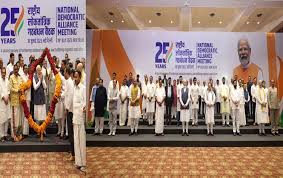
India’s economic policies have witnessed a significant shift over the past decade. The NDA government has moved away from the traditional subsidy-centric approach of a welfare state, adopting a strategy focused on directly empowering the middle class. Through income tax relief, structural reforms, infrastructure investment, and social security schemes, the government has attempted to boost both consumption and savings. The question is not whether relief has been provided, but whether this shift is proving to be a restructuring towards the long-term economic strengthening of the middle class.
Government data indicates that in the last 11 years, approximately 250 million people have moved out of poverty and into the middle class. This emerging “neo-middle class” is not merely a sign of income growth, but also evidence of a transformation in the structure of the country’s economy. While India’s growth was previously primarily dependent on investment and exports, domestic consumption is now becoming a major engine. The increasing purchasing power of the middle class has given new impetus to sectors such as real estate, automobiles, education, and healthcare.
The government has made infrastructure investment the cornerstone of this transformation. The expansion of the metro rail network from 5 cities to 23 cities is not just an improvement in urban transportation, but also a means of increasing productivity. Improved connectivity has reduced travel time and fuel costs, indirectly increasing the real income of the urban working class. The expansion of digital infrastructure has made government services faster and more transparent, reinforcing the “ease of living” agenda.
Tax reforms have been the most direct part of this strategy. Raising the zero-tax income limit to Rs12 lakh and restructuring the tax slabs to account for inflation reflects the government’s approach of considering taxpayers as partners in development, not merely as a source of revenue. This has put more disposable income in the hands of the middle class, boosting consumption. While critics argue that this will increase fiscal pressure, the government maintains that increased consumption will ultimately broaden the tax base.
The GST 2.0 reforms have worked towards reducing costs by simplifying the indirect tax system. The removal of higher tax slabs has made everyday goods and consumer products more affordable. Exempting insurance premiums from GST makes health and life protection more accessible. This indicates that the government is using the tax system not merely as a revenue collection tool, but also as an instrument of social policy.The use of the Price Stabilization Fund to control inflation reflects a proactive market intervention model. Through direct procurement from farmers and subsidized sales to consumers, the government has attempted to mitigate food inflation shocks. While the long-term solution lies in increasing agricultural productivity, this strategy has been effective in safeguarding middle-class household budgets in the short term.
On the financial security front, the expansion of small savings schemes strengthens the social contract where the state provides secure investment options. Schemes like PPF, SCSS, and Sukanya Samriddhi, with their guaranteed returns and tax benefits, have become reliable instruments for the middle class. This model promotes stable wealth creation compared to risky market investments.
In housing policy, through PMAY-U 2.0, the government has made homeownership a crucial pillar of social security for the middle class. The significant increase in budget allocation demonstrates that affordable housing is being viewed not just as a welfare scheme, but as a catalyst for economic growth. Job creation in the construction sector and increased domestic demand are direct benefits.In the health sector, the expansion of Ayushman Bharat creates a comprehensive social safety net. Covering over 500 million people, this scheme is not only for the poor but also a means of reducing the financial burden on the entire healthcare system. Providing universal coverage to senior citizens reflects the state’s growing social responsibility.
The significant reduction in medicine prices through the Jan Aushadhi Yojana has considerably controlled healthcare expenses for the middle class. The availability of affordable medicines has also increased price competition in the private pharmaceutical market, which is beneficial for consumers. Overall, the NDA government’s policies can be seen as an attempt to transform the middle class from subsidy-dependent consumers into economically empowered participants. This shift represents a move beyond mere relief towards structural empowerment. While questions regarding fiscal balance, job creation, and long-term productivity still remain, there is no doubt that the policies of the past decade have redefined the role and expectations of India’s middle class.
Prime Minister Narendra Modi held a phone conversation with Ukrainian President Volodymyr Zelenskyy and reaffirmed India's readiness to...

Trinamool Congress MLA Pareshram Das was arrested by Baruipur Police at Kolkata airport in connection with a rape...

Revised prices of 1,364 anti-cancer medicine formulations have come into effect across India. The government expects annual consumer...

Six people from Haryana's Narnaul district died after their Hyundai Aura crashed and caught fire on the Panipat-Khatima...

Rahul Gandhi has renewed his open debate challenge to Prime Minister Narendra Modi over the ‘Dimagi Naxal’ remark...
Police have arrested 16 accused across two cases following a clash during the Ganeshotsav immersion procession in Vaijapur,...

Aries: The day will be auspicious...