Last Updated: October 21, 2026
Last Updated: October 21, 2026





What the 2025 paddy procurement season in Punjab, Haryana tells us about India’s farm-policy machinery
Sheena Sandhu
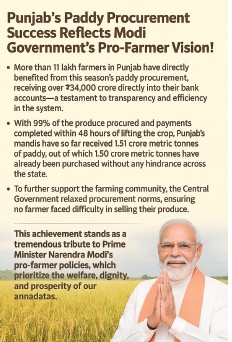
This Kharif season has again put procurement under the spotlight. In Punjab, mandis have recorded arrivals of roughly 15.18 million tonnes of paddy, of which about 15.03 million tonnes — roughly 99 per cent of arrivals — have been procured. Payments exceeding rs34,000 crore have been credited into farmers’ bank accounts as the operation moves towards completion. These are not small numbers: they represent both an administrative feat and a political statement about the state’s — and the Centre’s — commitment to guaranteed purchase and prompt payment.
Haryana’s procurement story this season has been different in scale but similar in intent. The state has reported procurement running into tens of lakh tonnes, and state briefings put the amount transferred to farmers at around rs9,000 crore as purchases crossed the several-lakh-tonne mark. Whether the totals are read district by district or aggregated state-wide, the key point is the same: the procurement machinery — mandis, procuring agencies, the Food Corporation of India and state civil supplies departments — has been mobilised to remove market uncertainty from the farmer’s doorstep.
What changed this season is not simply volume but the manner of delivery. The Centre and state machines have leaned on digitisation and tighter process control to make payments fast — the oft-repeated benchmark being payment through direct bank transfer within 48 hours of procurement. The central ministry has publicly emphasised online farmer registration, integration of land records, digital e-weighment, and DBT payments to ensure that funds reach beneficiaries quickly and transparently. These are procedural fixes but they have real, measurable effects on cash flow and farmer confidence.
Why this matters
At root, procurement is both an economic instrument and a social compact. For small and marginal farmers, the difference between getting paid the MSP after 48 hours, or waiting weeks for dues to be settled, can determine whether a household will borrow, sell assets, or cut back on essential consumption. Quick liquidation of the crop into cash reverses the perennial cycle of distress sales and high-cost borrowing. The large sums now being moved into bank accounts — tens of thousands of crores in Punjab alone — are not abstractions: they represent payroll-like infusions into rural economies, supporting consumption and input purchases for the next season.
The Centre’s role: facilitator, guarantor, enabler It helps to unpack what “central role” actually means in practice. The Union Ministry of Consumer Affairs, Food & Public Distribution provides the policy architecture — the MSP, procurement targets, guidelines on moisture and quality, and funds for purchases and lifting. It also co-ordinates the logistical backbone: mandating lifting schedules, ensuring FCI and state agencies have the budgets and transport capacity to take procured rice into the central pool, and running central monitoring systems to quickly surface and resolve bottlenecks. In short, Delhi does not buy the crop at the mandi gate — state agencies and agencies like FCI do — but the Centre sets the rules, underwrites the commitment and runs the national-level machinery that makes the commitment credible.
Operational flexibility has been an important adjunct. Recognising weather, delayed harvesting and higher moisture levels in some consignments, procurement norms this season were relaxed in certain circumstances to avoid excluding farmers whose crop was salvageable but technically marginal on specification. Such pragmatic tweaks — while not substitutes for long-term quality improvements — prevented avoidable hardships during a season with erratic weather in parts of the north-west.
The limits beneath the success The headline figures invite applause, but they must be read against structural and ecological realities. First, procurement performance varies by district and agency; pockets exist where arrival and lifting rates lag, where local outbreaks of pests or disease have reduced yields, and where farmer groups report procedural hassles. Second, the very success of procurement raises policy questions about cropping incentives. Paddy is water-intensive; sustained, large-scale procurement can entrench cropping patterns that stress groundwater. If procurement systems are to be a long-term instrument of farmer welfare, they must be complemented by incentives for crop diversification and investments in water-efficient agriculture.
Third, there is the question of private market participation. This season, private traders’ off-take from mandis has been muted in many areas, which pushed greater responsibility onto government agencies. While state purchase protects farmers from distress, healthy private participation in procurement and post-harvest trade is necessary to deepen market liquidity and price discovery; policy must try to balance assurance with market vibrancy. Finally, quality control and storage infrastructure remain bottlenecks. Procuring agencies have improved lifting schedules, but lifting and warehousing large volumes on time remains challenging. Delays in lifting, inadequate covered storage in some regions, or uneven milling capacities can impose hidden costs on the system and on farmers indirectly.
Policy priorities that follow from this season If the 2025 season is to be more than a single operational success, policymakers must use this moment to institutionalise three priorities. First, make the digital systems resilient and farmer-friendly: registration, e-weighment, quality testing and DBT must be made seamless and accessible to less-literate farmers, with local helpdesks and quick grievance redressal.Second, couple procurement with a visible diversification push: MSP and procurement logic can be extended to millets and pulses where possible, allied with incentives for less water-intensive crops and investments in extension services. Third, expand and rationalise storage and lifting logistics: faster off-take from mandis into covered storage and better synchronisation with mills will reduce spoilage risk and lower the system’s implicit carrying costs.
A trustworthy system, not a politics of promises
This season’s numbers — large arrivals, very high procurement coverage in Punjab, prompt payments and the substantial sums transferred to farmer accounts — are proof that a well-run procurement system can stabilise rural incomes effectively. That is an achievement that transcends partisan rhetoric: it is about building trust in the rural economy. But trust is fragile. It needs steady, technical improvements, transparent oversight and a policy architecture that looks beyond the next season to sustainability and diversification. If the Centre’s stated aim is to honour the farmer’s dignity, then delivery must be continuous: timely payments, fair quality assessment, predictable lifting and real options for crop choice. The Kharif season of 2025 has shown that the machinery — at scale, digital and co-ordinated — can deliver. The task now is to ensure it keeps delivering without letting convenience harden into complacency.
(The writer is a retired civil servant, views are personal.)
State Bank of India has confirmed that 3,897 customer records containing personal information were found on the dark...

A fire in a hut in Nonapar village of Deoria district claimed three lives, including those of a...

Amit Shah paid tribute to police personnel who died in the line of duty at the National Police...

Reduced water levels at Har Ki Pauri and other Haridwar ghats have inconvenienced pilgrims during the Upper Ganga...

Six people returning from a Dussehra Mela were seriously injured when a car hit them on National Highway...

Two people were killed and ten injured after a passenger bus met with an accident at Gala Pachound...

Aries: The day will be auspicious...