Last Updated: October 21, 2026
Last Updated: October 21, 2026





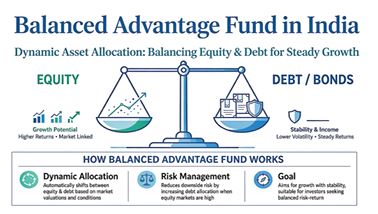
Every investor wants the wealth-creating power of equity and the reassuring stability of debt. Balanced Advantage Funds attempt to bring the two together—without asking investors to become experts at predicting the stock market. For generations, the Indian saver has followed a simple financial philosophy: protect the principal, earn a predictable return and sleep peacefully at night. Bank fixed deposits, Public Provident Fund (PPF) and government savings schemes have therefore occupied a place of pride in household portfolios. After all, money saved for a child’s education, a daughter’s wedding or retirement is not something most people want to see swinging wildly with the stock market. But there is a catch. The desire to avoid risk can itself become a financial risk. When savings earn less than inflation over long periods, their purchasing power quietly erodes. The money may look safe on paper, but it may buy considerably less in the future. Equity offers the potential to beat inflation and build long-term wealth, but its journey is rarely smooth. For the ordinary investor, a stock market chart can resemble a financial roller coaster—exciting on the way up and terrifying on the way down. A sharp correction can turn a confident investor into a nervous seller, often at precisely the wrong time. Yet volatility is not a malfunction of the stock market. It is part of the price investors pay for the possibility of earning higher long-term returns. The real challenge is not simply choosing the right investment; it is staying invested when markets test one’s patience and courage. This is where the Balanced Advantage Fund (BAF) enters the picture. The Best of Both Worlds? A Balanced Advantage Fund, also known as a Dynamic Asset Allocation Fund, is an open-ended hybrid mutual fund that invests in a combination of equity and debt, adjusting its allocation in response to market conditions and the scheme’s investment strategy. Unlike conventional hybrid funds that generally follow a relatively stable asset-allocation approach, a BAF can increase or reduce its equity exposure as market valuations, quantitative models and other investment signals change. Some schemes rely heavily on valuation-based models, while others combine quantitative frameworks with the fund manager’s judgement. The underlying idea is straightforward: when equity valuations appear expensive, the fund may reduce its equity exposure; when valuations become more attractive, it may increase it. The debt component provides diversification and can help moderate portfolio fluctuations. Of course, no model can predict market movements perfectly. Markets can remain expensive for longer than expected, and apparently cheap stocks can become cheaper still. A BAF is not a magic formula that eliminates risk. Rather, it offers a disciplined framework for managing the balance between growth and stability. For investors who find the idea of managing this balance themselves intimidating, that can be a meaningful advantage. Buy Low, Sell High: Easier Said Than Done Almost everyone knows the golden rule of investing: buy low and sell high. The real difficulty lies in following it. When markets are soaring, optimism takes over. Investors fear missing out on the next rally and buy even when valuations are stretched. When markets tumble, fear replaces optimism. The same investors who were eager to buy at higher prices suddenly hesitate— or sell in panic after prices have already fallen sharply. In other words, we often do the exact opposite of what successful investing demands. Even investors who manage to control their greed and fear face a more difficult question: How do you know when the stock market is cheap or expensive? What looks like a bargain to one analyst may look overpriced to another. Even seasoned professionals struggle to identify market peaks and bottoms consistently. This is where a Balanced Advantage Fund can help. Instead of requiring investors to make repeated decisions about when to enter or exit the equity market, it places much of the asset-allocation decision within a defined investment process. The investor does not have to guess every market turn, monitor valuations daily or decide whether the latest correction signals a buying opportunity or the beginning of a deeper decline. The fund’s strategy takes care of adjusting the portfolio within its stated framework. That does not mean the fund will always buy at the bottom or sell at the top. It means the investor can follow a more systematic approach rather than allowing every market headline to dictate an investment decision. And sometimes, in investing, avoiding a costly emotional mistake is just as valuable as identifying a winning stock. The Tax Advantage: What Investors Take Home Matters There is another consideration that can make Balanced Advantage Funds particularly attractive to Indian investors: tax efficiency. Investment returns should never be judged by what a fund earns before tax alone. What ultimately matters is the return that remains in the investor’s pocket after taxes and expenses. BAFs that qualify as equityoriented mutual funds under Indian tax rules receive the capitalgains tax treatment applicable to equity-oriented funds. This can be a significant advantage over many debt-oriented mutual fund investments, whose gains may be taxed at the investor’s applicable income-tax slab rate, depending on the scheme, acquisition date and relevant provisions. Under the current capital-gains provisions, short-term gains from qualifying equity-oriented mutual funds are generally taxed at 20%, while long-term gains are taxed at 12.5% on eligible aggregate gains exceeding ₹1.25 lakh in a financial year, subject to applicable conditions. For an investor in a higher tax bracket, the difference in tax treatment can materially influence post-tax returns. Thus, a qualifying BAF may offer not only dynamic asset allocation and the potential for long-term wealth creation, but also a tax-efficient structure. However, not every BAF automatically qualifies for equityoriented taxation. The scheme must satisfy the applicable conditions, including the prescribed equity exposure. Investors should verify the scheme’s tax classification before investing. Tax rules may also change, so the prevailing provisions should always be checked. Tax efficiency, of course, should complement a sound investment decision—not determine it entirely. A tax advantage cannot compensate for an unsuitable investment or excessive risk. A Middle Path, Not a Magic Bullet Balanced Advantage Funds can appeal to different kinds of investors. A conservative saver looking to diversify beyond traditional fixedincome investments may find them worth considering. An investor sitting on a substantial lump sum may also appreciate a professionally managed approach to balancing equity exposure with debt and other permitted instruments. However, a BAF should not be mistaken for a fixed deposit with better returns. It is a market-linked investment, its net asset value can fall, and neither capital protection nor positive returns are guaranteed. Different schemes can follow substantially different allocation models, so their risk profiles and performance can vary. Investors should examine a scheme’s investment philosophy, historical performance across different market cycles, costs, portfolio composition and risk measures—not merely its recent returns. The investment horizon and ability to tolerate losses matter, too. Those who need assured capital or have a short-term financial goal may be better served by more appropriate, lower-risk options. The objective is not to eliminate risk altogether. It is to take risks that are understood, affordable and consistent with one’s financial goals. The Verdict: Let the Market Fluctuate, Not Your Emotions The biggest enemy of an investor is not always a falling market. Often, it is the investor’s own reaction to it. Fear can force a sale at the bottom; greed can encourage a purchase at the top. Between these two impulses, years of patient wealth creation can be undone by a few moments of panic or exuberance. Balanced Advantage Funds offer a practical way to address this behavioural challenge. By dynamically managing equity and debt exposure, they seek to combine the growth potential of stocks with the diversification and relative stability that debt can bring. For schemes that qualify, favourable equity-oriented tax treatment can add another layer of appeal. They cannot promise a smooth ride, eliminate market risk or guarantee that investors will always come out ahead. But they can provide a disciplined framework for navigating uncertainty without requiring investors to make every market-timing decision themselves. Ultimately, successful investing is not about predicting every market move. It is about having a strategy that you can stick with when the market refuses to behave as you expect. Because the best investment is not necessarily the one that delivers the highest return in a bull market. It may be the one that helps you stay invested when the bears arrive—and lets you keep more of what you earn.
We are very proud that at present India is the number one country in the world by surpassing...

Tourism is a major source of government revenue in our country. There are different types of tourism. Scenic...

Good Evening Viewers! Catch up on the day's biggest stories with The Savera Times Evening Bulletin. Get the...

Congress leaders continued their protest outside the Jaipur Police Commissionerate on Tuesday, demanding the registration of a zero...

On the auspicious occasion of Vijayadashami, Prime Minister Narendra Modi on Tuesday called on the countrymen to unite...

A historic milestone was achieved on Tuesday in the expansion of Chhattisgarh's rail networkA historic milestone was achieved...

Aries: The day will be auspicious...